

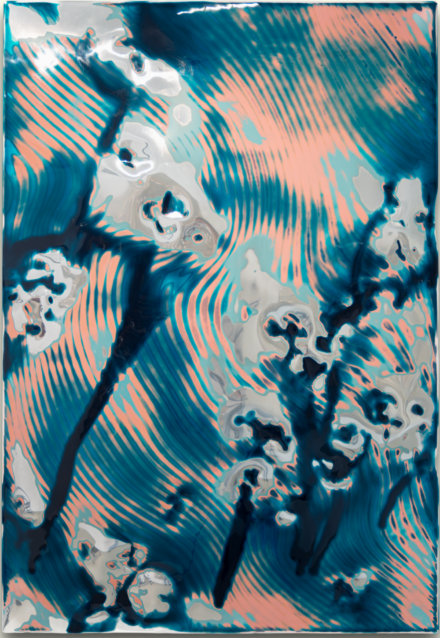

The very first thing you encounter in CONCENTRATE is not an artwork, but rather a smell. The sharp scent of car paint, aluminium and solvent fills the gallery and spills outside. This sensory detail perfectly captures what Tom Fellows’ exhibition does best: before the mind gets a chance to unravel the curatorial framework, the body already captures it. The works pull the viewer in through a physical pressure that wall texts can only later attempt to translate into language.
CONCENTRATE, Tom Fellows‘s solo exhibition at Ruzy Gallery, brings together new works produced between the artist’s studio in Maslak Oto Sanayi and the gallery space itself. Working between painting and sculpture, Fellows constructs topographies that treat every surface less as a completed image than as an accumulated residue. Concentration is presented as a form of resistance in an age of distraction, while the material itself — pressed, eroded and reheated — emerges as a record of slow attention. Among the most striking surfaces in the exhibition are the aluminium works into which baklava trays have been pressed. Objects associated with Istanbul’s culinary culture sit beneath layers of car paint and industrial pigment, sharing the surface with references to Birmingham’s Black Country region and the coal economy that shaped Fellows’ childhood landscape. Throughout the exhibition, seemingly ordinary objects acquire meaning through the layers and erasures concealing them. The surfaces reach their strongest moments when they simultaneously reveal what an object is and what it has been forced to become.
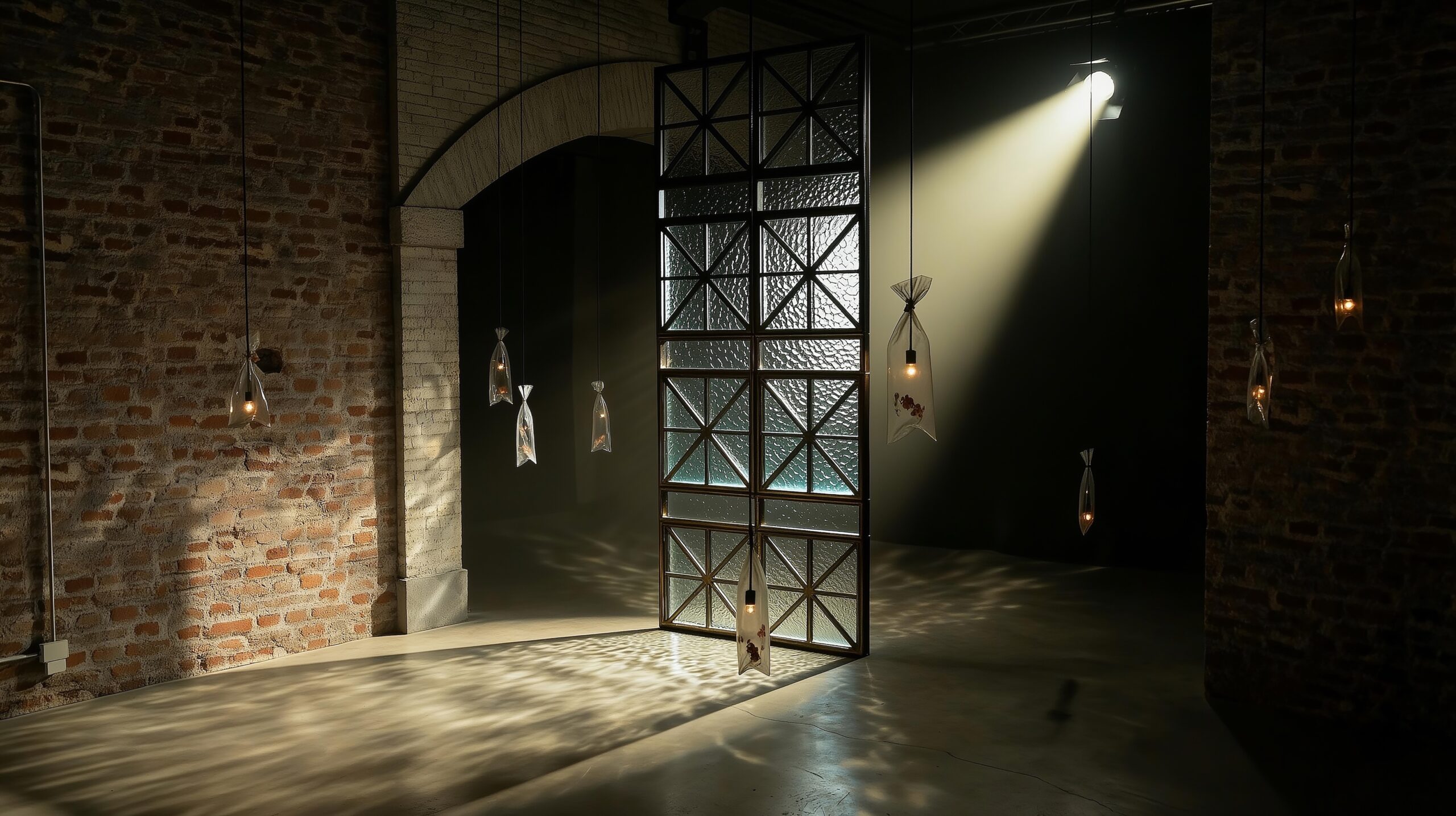
The site-specific installation connecting the gallery’s two rooms reshapes the architecture itself. Built together with the artist’s father, a traditional sign painter, this wall carries a second record of labour into the exhibition: generational, familial, and named. Fellows describes constructing each work digitally first and then transferring the composition onto the surface; he describes hanging the works on the wall and sometimes waiting months to understand whether or not they are finished, and speaks of one work that looked better after it had fallen and broken. By his own account, almost all of his works remain unfinished. The exhibition carries this contradiction without trying to resolve it. Surfaces presented as the record of slow material accumulation are, in practice, the outcome of digital decisions, aesthetic judgement, and, at times, accidents.
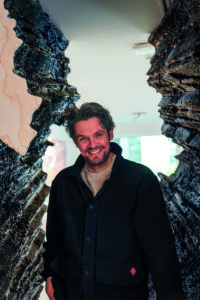
How much of your formation in architecture do you recognise in your own practice?


Well, I think physically first. Architecture probably did that to me. You start thinking about weight, tension, and circulation. After a while, everything started feeling like sculpture really. It’s all just matter organising itself in space. I don’t see myself composing images in the traditional sense; I’m building them more than I am painting them. I want the work to convince you as an object first, not just visually but physically as you stand in front of it. That probably comes from looking at Frank Stella or Donald Judd. Stella saying what you see is what you you see always made perfect sense to me. Judd stripped things back to material, scale and placement. Those are all architectural endeavours. There was no illusion to it.
Even with paint, I am still thinking structurally, even if it’s on the microscopic level. I want it to feel like something built-up and wrestled with, not just an image floating on the wall.
How has Istanbul and especially Maslak Oto Sanayi affected your work on material, surface, and transformation?
Maslak has this energy that I recognise from being a kid. Heat, dust, thinners in the air. I grew up around those environments with my dad, fitting signs to freshly painted trucks, so it already felt strangely familiar to me. You learn early on that a surface is just a site for work. Nobody treats the materials as sacred. Paint is functional, metal is functional. Things get used hard, repaired, sanded back, sprayed again. I think that “hallederiz” attitude has definitely rubbed off on me. You stop focusing only on the finish and start noticing everything going on underneath it.
Can you walk us through your practice? Layering, erosion, compression, heat application, are these processes pre-planned or do they emerge in the studio? Is there a moment where you lose control, and do you welcome it?
I look at the process more as a system or a pipeline rather than a fixed plan. You have an input stage and an output stage but the bit in between can actually be quite open. I introduce the materials, the pressure, and then let them have a go at each other for a bit. I’m never standing there with a perfectly mapped-out image in my head. It is much more physical and reactive than that. I build surfaces up and stress them heavily. I’m really just responding to whatever begins to happen on the surface. It’s a lot of push and pull. The interesting part is when the work begins to develop its own logic, to the point where even I get confused about how it came about. That’s when it starts getting exciting for me. Yes, control definitely slips at some point, but I do build room for that from the very beginning. It’s those little weird bits that usually end up carrying the most weight. Really the only thing I’m fully in control of is when to call it a day and stop interfering with it.
Do your materials resist you? And do you think of that resistance as a kind of agency?
Yeah they do. They resist constantly, it can be a bit of a battle to be honest. People might assume that industrial materials are completely controllable, but that is only if you’re following the instructions on the back of the tin. As soon as you start playing outside of those guidelines, they start behaving quite differently. You start to embrace those nuances through muscle memory. They become something you celebrate instead of polish out. I suppose that’s a kind of agency, but I wouldn’t get too soppy about it. The material simply has its own limits. The work comes about through wrestling with those boundaries rather than trying to completely dominate the stuff. You’re never really the boss of it. Honestly, that resistance bit might be the only interesting part for me. If the material just behaved perfectly every time, I’d become pretty bored with the whole thing.
Are you interested in capturing a specific moment in a material’s transformation, or in suggesting that transformation never really ends? At what point does a layered surface become an archive for you – and what does it hold?
I suppose the second I stop working is the moment you’re asking about, but it never feels final. I just decide to leave it for a bit and see how I feel. Sometimes I dig in again and sometimes I leave it as is. Regardless, the surface still feels pregnant with potential and buried information. I’m much more interested in the idea that the transformation never truly ends. Even once the thing leaves the studio, the materials are still reacting, oxidising, getting scratched and abused by curious wandering hands. A new scratch appears, the surface gets refinished, and suddenly the composition has subtly shifted. It will always feel unresolved. This is when the works truly start to become an archive in my eyes. I suppose what it holds is evidence really. Evidence of labour, time, correction, failure, and repetition. The works don’t hide their history well at all; they carry all the scars of how they were made very openly. They’re fairly honest I think.
Is working between painting and sculpture without fully committing to either, a conscious resistance, or simply a description of where the work lands?
Well, I’ve always been a painter I think. I spent my weekends watching and copying my dad paint, so that language was there early on for me. But when I started studying sculpture, it felt like someone had knocked down a wall. It gave me more scope, physically and conceptually. It’s just a bigger sandpit to play in. To be honest though, I see painting as sculpture anyway. A painting is still an object. It has weight and edges and thickness, and a surface that’s been worked on and into. It feels a bit pointless trying to define those boundaries too rigidly now, but I suppose categorising things like that is just human nature, isn’t it?
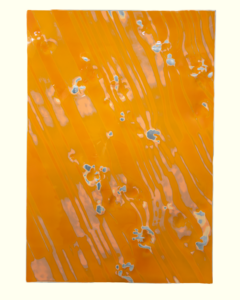
Many of the works feel geological even though they are made with industrial materials like car paint and aluminium. What draws you to this tension between industrial fabrication and natural processes?
Well, growing up in the Black Country probably shaped that quite a lot for me. It was the heart of the Industrial Revolution. Coal and canals and foundries. Industry and geology were completely tangled together there. You had entire towns that only existed to extract compressed black fuel out of the ground. It was a very direct relationship. Strangely though, modern geology itself emerged from that industry. William Smith only managed to produce his groundbreaking geological maps because the canal excavations literally sliced the country open. Those cuts through the landscape allowed him to observe and document the layers for the first time. It was the industry that made geological time visible. I’ve always liked that idea. Maybe that’s why industrial and geological processes never feel in opposition to me. All that heat, compression, and pressure, they’re the same language, just played out over vastly different speeds.
You describe the surface not as a fixed result but as a living archive where time, labour, and material memory accumulate. Do you think this idea of accumulation extends beyond the work itself, perhaps to architecture, cities, or forms of personal memory?
I think so yes. Troy is where you can see it best. You’ve got all those layers of history just sitting there. When you build something new, you are usually displacing something else. You can push it aside or bury it, but it’s never really erased. I think these surfaces work in much the same way. The memory of previous actions is held within that skin. Archaeology sits somewhere between my work and geology. They’re all playing the same game.
The exhibition title CONCENTRATE refers both to mental focus and to material compression. How did those two meanings begin to intersect in your practice?
Well, “concentrate” is one of those words you hear all your life, especially at the rigid school I went to. You spend half your time being told to do it, and then I find myself saying it to my own kids, but especially to myself in the studio. Sit still. Focus. Pay attention. It’s a strangely loaded expression. At the same time, the work is completely tied up with physical compression. It’s all just time condensed into material. I liked the overlap between these two ideas. Mental pressure and physical pressure.
How did the Ruzy Gallery’s light – filled, open architecture influence the way you approached the exhibition and the placement of the works?
Well these surfaces are quite dynamic, so we took advantage of the natural light. The aluminium pieces shift depending on the time of day and where you’re standing. It’s a bit like watching light dancing on a swimming pool. We arranged the works to create their own rhythm of compression and expansion through the space. It’s difficult to experience the work from one fixed position, which I quite like.
How does CONCENTRATE contribute to Ruzy Gallery’s evolving conversation around surface and material?
I felt quite connected to the earlier “Surface” show. They were already looking at material as something active and unstable, which I liked. It was more about transformation than a fixed image. I just take that idea in a more geological direction. So much of the world now is designed or even over-engineered to be seamless and frictionless, as if it has no history at all. My works do the opposite. I think you need a bit of that manmade wobble to remind you that there’s an actual person behind it.
When someone walks into CONCENTRATE without reading any wall texts, what is the first thing you hope they feel physically?
I think confusion can be a good thing sometimes. You want the viewer to look at the surface and try to unpick the history of it for themselves. I know that’s what I often do. I spend so much time in the studio developing and trying to solve material problems, so I like the idea of the audience doing a bit of that work too. You end up looking much more actively when you’re busy doing that. Like I said, sometimes even I get overwhelmed by it all.