

The Hong Kong Pavilion at the 2026 Venice Biennale features “Fermata: Hong Kong in Venice,” a joint exhibition by artists Kingsley Ng and Angel Hui. Taking its name from the musical term fermata (a pause or prolongation of a note), the exhibition responds to the Biennale’s overarching theme, “In Minor Keys”. It invites visitors to slow down and reflect on the poetic rhythms and overlooked details of daily life in Hong Kong.
Artdog International’s interview with artists and curators on Fermata.
Hong Kong Museum of Art
Fermata suggests a pause held at the performer’s discretion. In a biennale context that often accelerates viewing, how do you imagine this “pause” operating as a curatorial and perceptual strategy?
In music, a fermata marks a moment when notes or rests are prolonged at the performer’s discretion. Here, that held breath becomes a way of seeing. It offers a temporary suspension of the accelerated habits of biennale viewing, inviting the audience to slow down and linger with what might otherwise slip past unnoticed. In that gentle interval, the overlooked moments of daily life begin to resurface and gather, opening onto a quiet moment of recognition.
The exhibition engages with La Biennale di Venezia’s theme In Minor Keys. How do you interpret “minor” not as marginal, but as a method of attention?
We understand “minor” not as secondary but as a mode of attunement and listening. Musically, a minor key asks for a different kind of listening: one that is slower, more patient, more willing to dwell in tonal nuance until its emotional weather reveals itself. Fermata is devoted to that register. It gives oneself the chance to notice the gentler, softer moments in life, to pick up traces of quotidian life that too often pass unnoticed. We ask the audience to listen beyond the crescendos of grand events, toward the living whispers in the neighbourhoods of both Venice and Hong Kong.
The idea of “shared breath” between Hong Kong and Venice is poetic but also spatially complex. What kind of relational geography are you constructing between these two port cities?
For this exhibition, we sought a connection between Hong Kong and Venice that moves beyond the fact of both being port cities, toward something more fugitive: a shared sensitivity to movement, light, atmosphere, and the quiet pulse of daily life. Fermata maps this relation through echoes rather than analogy, through small vernacular signs that seem to answer one another across distance—laundry drifting between buildings, metal-gridded windows, the after-dark murmurs of streets, all held beneath the same cotton-clouded sky. One city does not stand in for the other; rather, each comes gently into focus through the other’s breath and rhythm.
Would you say the exhibition proposes an alternative form of urban knowledge—one that emerges not from monuments but from micro-observations?
The exhibition remains grounded in familiar materials, urban gestures, and fleeting perceptions. The works presented attend to what is modest, recurrent, and easily overlooked trinkets in life. At the same time, references to Suzhou embroidery, Hong Kong poetry and wrought-iron metalwork by Hong Kong metalsmiths anchor these observations in deeper cultural memory.
Both Hong Kong and Venice are cities defined by water, density, and transition. Where do you see convergence—and where does the comparison resist itself?
Hong Kong and Venice converge in their fluidity. Both are port cities shaped by porosity and perpetual movement, where light shifts constantly and daily life unfolds through passages of air, sound, labour, and transit. Still, the exhibition is less about comparison and more about a shared vernacular of living. Fermata does not reduce one place to another. Instead, we stage a meeting through affinities, allowing moments of convergence to surface while preserving distance and dialogue.
There is a subtle sense of disappearance in the works, especially in relation to Hong Kong’s changing urban fabric. How does memory function here: as archive, reconstruction, or fiction?
It is more about shifts in visibility and perception. Memory functions here less as a fixed archive than as a shifting medium. In tracing what we inherit, we move through a vast interior space in which we also generate versions of our own. Nothing ever disappears entirely; it simply evolves into another state. What seems lost returns in altered form, in sound, material, movement, or atmosphere. So, the same story can be told in a dozen different ways by different people and continues to live through a multitude of versions in poetic and beautiful ways.
Kingsley Ng
Your work often transforms sensory perception—light, sound, rhythm—into spatial experience. How does Laundry Nocturne extend your ongoing synesthetic practice?
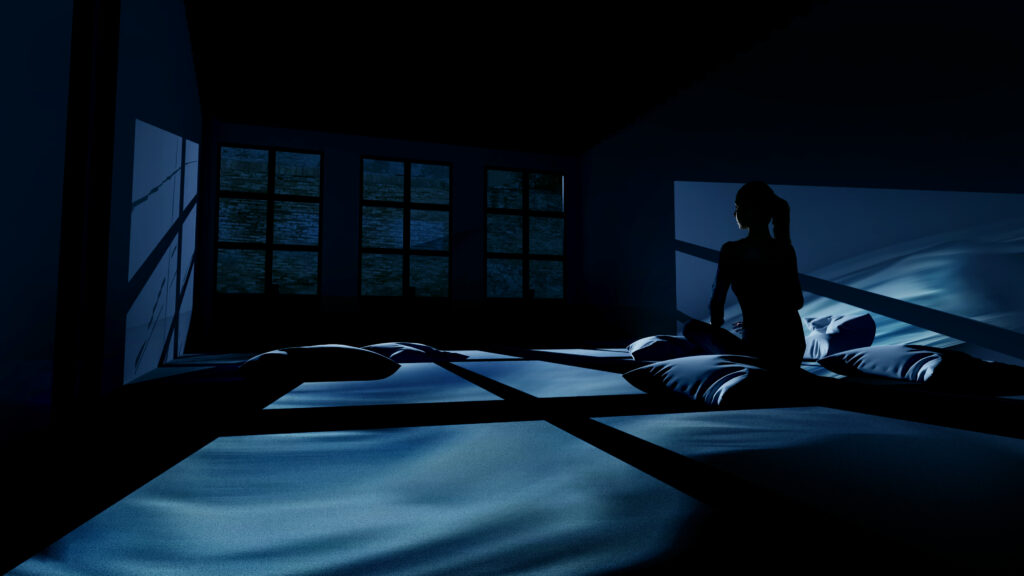
In a world saturated by ceaseless stimuli, I often ask whether urban media art can do more than dazzle—whether it might return us to a finer state of feeling. Sound, light or rhythm, I am drawn to small, almost imperceptible interventions: gestures slight enough to let perception open slowly, and encounters flourish naturally. Laundry Nocturne (2026) is a variation of a long-running series inspired by the Chinese character of “leisure”, in which moonlight penetrates through open doors. This rendition is an homage to both Venice Hong Kong–especially what is usually unsung. The central motif is fluttering laundry, which charts rhythms of everyday life in both cities. The accompanying audio is also grounded in the quotidian, with field recordings in night-time Hong Kong (which is day time Venice during which the exhibition opens), including tribute to those who prepare the city for tomorrow while most are asleep, and other sounds of intimate domesticity. As a meditator, I try to engage the audience in an experiential chamber, where one might briefly step away from the pronounced and into a quieter, more inward tide.
I sense that there is a quiet melancholy in the work—an awareness of something disappearing. Do you see your practice as a form of preservation or transformation? Your installations seem to require time and stillness. How do you negotiate this with the fast-paced consumption of biennale audiences?
My work always revolves around the notion of impermanence. I don’t really see my practice as preservation or transformation. It is more like an acknowledgement of ephemerality and seizing a fleeting moment.
A biennale often produces a kind of accelerated looking: too much to see, too little time to truly stay with anything. But slowness cannot be demanded; it has to be offered, almost tenderly. What I can do is create the conditions for pause: a seat, a measured rhythm, a text that unfolds like a bedtime story, an invitation to look with one’s own eyes rather than through a screen. If someone accepts that invitation, even briefly, the work may begin to reveal itself differently. Sometimes a single unhurried moment is enough to change the quality of attention. That, to me, is already meaningful.
Angel Hui
Your work focuses on overlooked utilitarian objects. What draws you to these marginal elements of the urban environment?
Utilitarian objects are usually understood in terms of function or exchange value, yet their material lives hold other meanings. I am interested in the biographies of everyday things—objects so abundant that they are often dismissed, even as they quietly witness and participate in the rituals of quotidian life. My work tries to excavate those latent readings. I try to recontextualize familiar domestic items through sculptural painterly interventions, to make familiar objects become quietly uncanny.
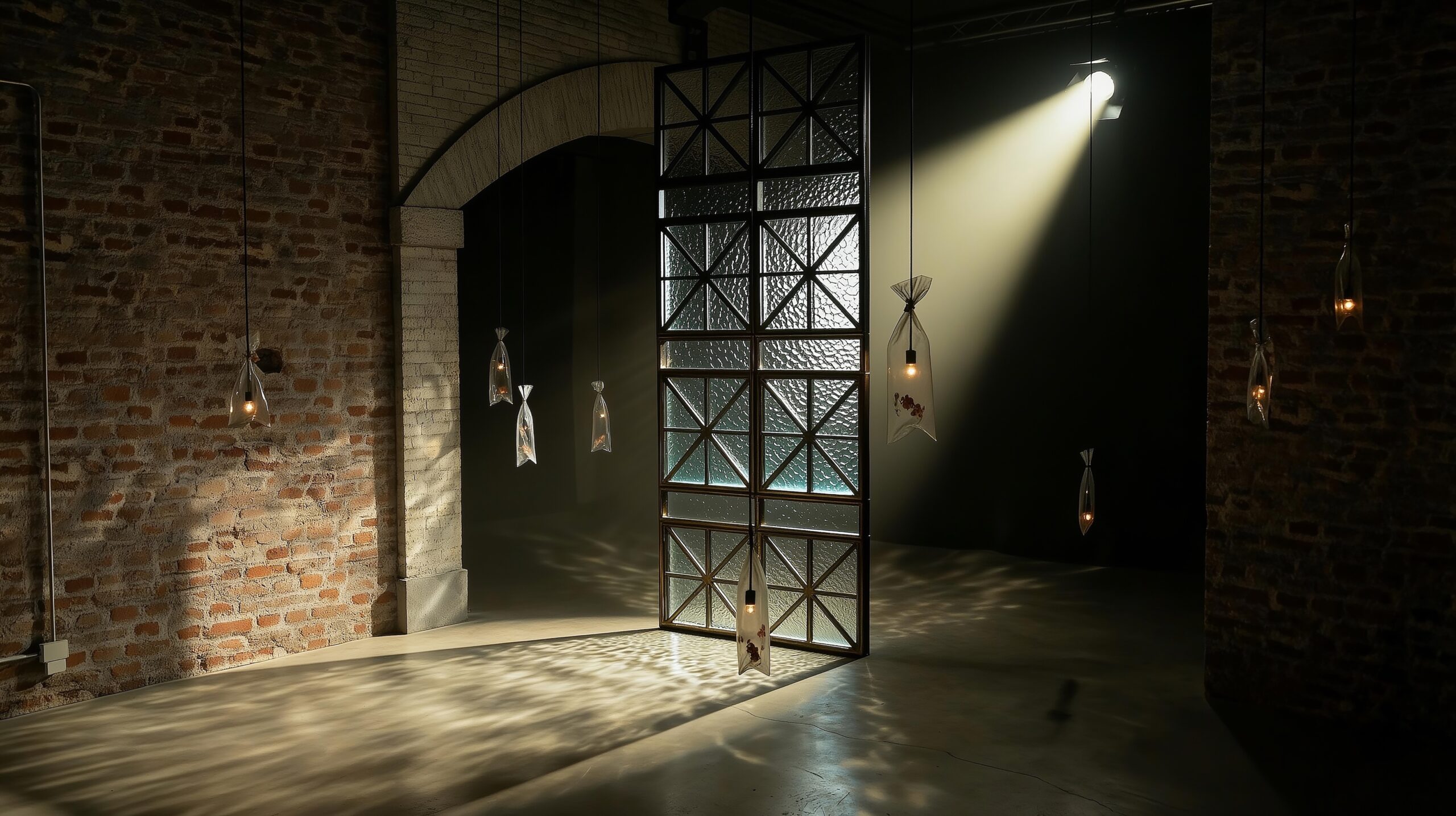
In Drifting Sanctuary (2026), plastic bags are embroidered with goldfish using Suzhou embroidery. I think of the work almost as a gentle trap: the eye is first seduced by the delicacy of the stitching, by the patience and beauty of the gesture, and only later returns to the bag itself—to its disposability, its banality, its place within circuits of excess. In that delay, the object changes status. Its symbolic and material values begin to press against one another. So, in a sense, I’m recasting its inherent worth, unsettling the hierarchy between craft and banality, care and excess.
In I Would Like to Open a Window for You, the act of “opening” becomes both literal and metaphorical. What kind of access—or invitation—does this gesture propose?
Like the broader curatorial idea of the exhibition and the Biennale’s invitation to listen differently, “opening” suggests a willingness to participate. It is a gesture against numbness or suppression; it asks the viewer to remain porous to what is happening around them. To be open is to experience something fully, and to become deeply aware of its presence. It is to let something enter, even when its meaning has not yet fully arrived.
The metal window is, on one level, an ordinary architectural structure, part of the house and part of the city. Metaphorically, it can also suggest an inward aperture—a window of the heart, perhaps. To stand before the work, is to be poised at the edge of encounter. Something may be admitted there: a memory, a sensation, an unease, a moment of recognition. Whether what enters feels luminous or difficult, the invitation is the same—to remain open, and to dwell for a moment.