

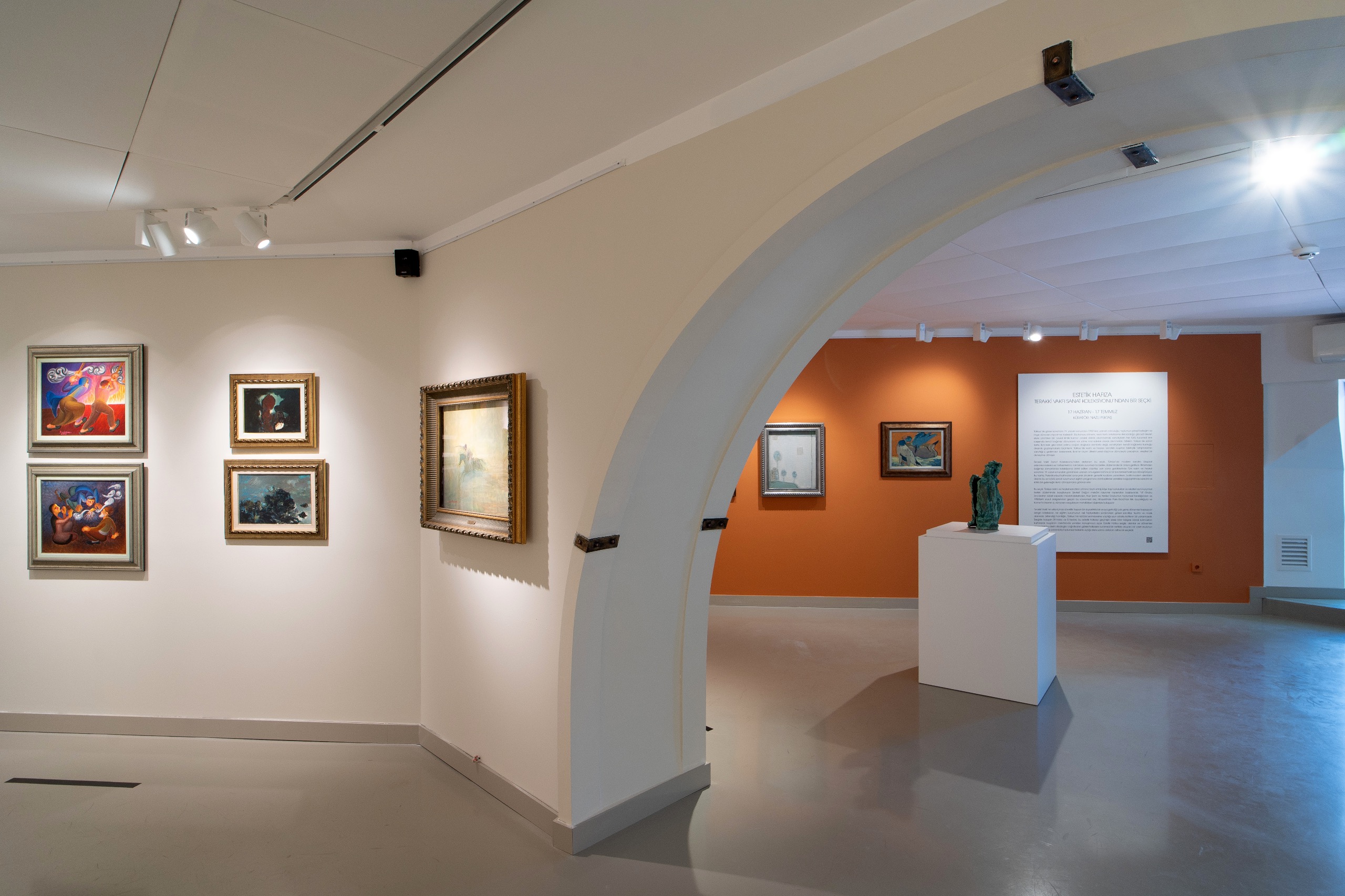
Aesthetic Memory: A Selection from the Terakki Foundation Art Collection opened on 17 June at the Terakki Foundation Art Gallery. Curated by Nazlı Pektaş, the exhibition brings together works by some of the leading figures of Turkish painting and sculpture.
While nostalgia tends to romanticize the past, memory carries with it layers of individual and collective trauma, transformation, and loss. Offering a cross-section of the Westernization and modernization of Turkish art, Aesthetic Memory also serves as a visual testimony to the social and cultural transformations that paved the way for the founding of the Republic and shaped its early years. The exhibition, held at the Terakki Foundation Art Gallery—part of the Terakki Foundation, an institution founded in 1877 that has witnessed these historical transformations firsthand—brings together artists from different generations. Their works reveal not only their distinctive artistic languages and personal experiences but also the social and political atmosphere of the periods in which they lived.
The Visual Journey of Modernization
The process of Westernization initiated by the Tanzimat Edict of 1839 in the Ottoman Empire also marked an effort to align painting and sculpture with Western artistic standards in both style and technique. In the final years of the Ottoman Empire, artists sent to Europe for academic training returned home introducing Impressionism, blending its aesthetic principles with local subjects. The 1914 Generation brought back the Impressionist fascination with light and color from France, capturing the changing qualities of nature on canvas.
During the 1930s, the members of the d Group rejected Impressionism in favor of Cubism and Constructivism. Reacting against these European movements that privileged stylized color and form, the Newcomers Group (Yeniler Grubu) advocated a socially engaged realist approach. Following the Second World War, the abstract-lyrical language of the Paris School opened new possibilities for artistic freedom, enabling Turkish art to develop in parallel with contemporary Western art.
Aesthetic Memory presents this dynamic transformation in Turkish art history through a carefully selected group of works from the Terakki Foundation Art Collection. Şevket Dağ’s Topkapı Palace Library (1913) masterfully combines natural light and shadow with the refined architectural details of the period. İbrahim Safi’s Büyükada (Princes’ Island), with its vibrant palette, stands as one of the distinctive examples of Turkish Impressionism. Animated by luminous brushwork and rich chromatic variation, these paintings evoke the fluid passage of time from daylight into night.
Art Through the Lens of the Female Body
The shimmering, dynamic light of Impressionism gives way in the works of d Group artists Eren Eyüboğlu, Halil Dikmen, and Sabri Berkel to geometric compositions, restrained lighting, and a modernist understanding of the figure defined through precise contours. Beyond presenting the female body as an aesthetic model, these paintings also reflect the profound social transformations that accompanied the Republic’s modernization project.
While women artists and the female body had only limited visibility during the Ottoman period, the Republican era made women increasingly visible not only as subjects of representation but also as active producers of art. Women’s access to artistic education, exhibition opportunities, and professional artistic circles became one of the most significant cultural manifestations of modernization.
Yet this visibility did not unfold as a straightforward narrative of progress. Throughout Turkish art history, the female body has remained the focus of ideological, moral, and political debates, and artworks depicting it have frequently been subjected to censorship, intervention, and public controversy.
The visibility of women artists and women’s movements during the Republican period itself became the subject of renewed debate during the Republic’s fiftieth anniversary. Gürdal Duyar’s Beautiful Istanbul, the winning entry of the sculpture competition organized in 1973 to commemorate the Republic’s fiftieth year, was installed in Karaköy Square only to be removed shortly afterward following strong objections from conservative politicians and segments of the public. Deemed “obscene” because of its nude female figure, the sculpture reignited debates over the legitimacy of the female body in public space.
Seen in this historical context, the nude studies included in the exhibition can be read not merely as examples of modernist formal experimentation but also as early witnesses to the ongoing social and political tensions surrounding the representation of the female body in Turkey. Gürdal Duyar’s sculptures featured in the exhibition keep alive the memory of Beautiful Istanbul, reminding viewers that the struggle over women’s bodies and identities remains strikingly relevant today.
Stories of Migration from Village to City
Alongside works that explore modernization through the female body and identity, the exhibition also brings together artworks that foreground rural life and its protagonists—voices often left outside the urban-centered narrative of modernization. The works of Nuri İyem and İbrahim Balaban offer compelling depictions of the everyday lives and social realities of rural communities. Accompanying Nuri İyem’s iconic female figures—whose seemingly expressionless faces quietly convey the experiences of rural life—are his lesser-known abstract paintings. Meanwhile, the rigid figures and dramatic color contrasts in İbrahim Balaban’s paintings, deeply rooted in local narratives, recall the hardships that shaped the artist’s own life.
Representing the memory of village life, these works lead viewers toward the waves of internal migration that accelerated from rural areas to cities after the 1950s, and ultimately to the historic Haydarpaşa Railway Station, a site through which countless journeys, farewells, and reunions once passed. Eren Eyüboğlu’s Haydarpaşa (1946), executed in mixed media on paper, invites reflection on both the station’s own history and its place within the collective memory of Turkish society.
Since opening in 1872, Haydarpaşa has undergone numerous architectural transformations and survived three devastating fires. Although it no longer functions as an active railway station, it continues to occupy a powerful place in public memory as a site of departures, arrivals, reunions, and farewells. Yet despite its enduring symbolic presence, Haydarpaşa is by no means the only public space in Turkey marked by collective sorrow and remembrance.
Carefully expanded over the years, the Terakki Foundation Art Collection now comprises 629 works and continues to grow. Reflecting the Foundation’s long-standing commitment to preserving cultural heritage, this remarkable collection stands as a living testimony to Türkiye’s artistic legacy. Bringing together the works of eighteen artists, Aesthetic Memory: A Selection from the Terakki Foundation Art Collection offers a comprehensive perspective on the turning points of Turkish art history. The exhibition remains on view at the Terakki Foundation Art Gallery through 17 July.