

As this issue was being prepared for print, protests surrounding the Israeli Pavilion had overshadowed the entire Biennale within the previous 48 hours. The actions led by the Art Not Genocide Alliance prompted a number of national pavilions to close their doors temporarily in solidarity.
Shortly afterwards, artists selected by Koyo Kouoh, alongside representatives of several national pavilions, announced their withdrawal from the ‘Visitor Lion’ Awards. Belgium, Luxembourg, France, Slovenia, Latvia, Lithuania, Switzerland, Spain, the Netherlands, Poland, Ecuador, Ireland, Kosovo, Finland, the Czech Republic & Slovakia, and Republic of Cyprus all signed the official statement published on e-flux:
“As of May 9, 2026, we, the undersigned artists from In Minor Keys, selected by Koyo Kouoh, Artistic Director of the 61st edition of La Biennale di Venezia, and from National Pavilions withdraw from consideration for the “Visitor Lion” awards. We do so in solidarity with the resignation of the jury selected by Koyo Kouoh.”
In the official Statement of Withdrawal from ‘Visitor Lion’ Awards published on e-flux, 52 artists — among them Walid Raad, Alfredo Jaar, Otobong Nkanga, Sammy Baloji, Tabita Rezaire, Zoe Leonard, Joana Hadjithomas & Khalil Joreige, Cauleen Smith, Raed Yassin and Michael Joo — also announced their withdrawal.
Within its very first days, the 2026 Venice Biennale had already transformed into one of the most political and chaotic editions in recent memory.
At the exact moment we were trying to send this issue you are holding to print, the main subject circulating through the biennale as of the morning of May 9 was no longer the exhibitions themselves, but the growing protests surrounding the participation of Israel and Russia, the jury crisis, and the closure of pavilions. The biennale opening had become a moment in which the global art system’s claim to “neutrality” appeared to collapse.
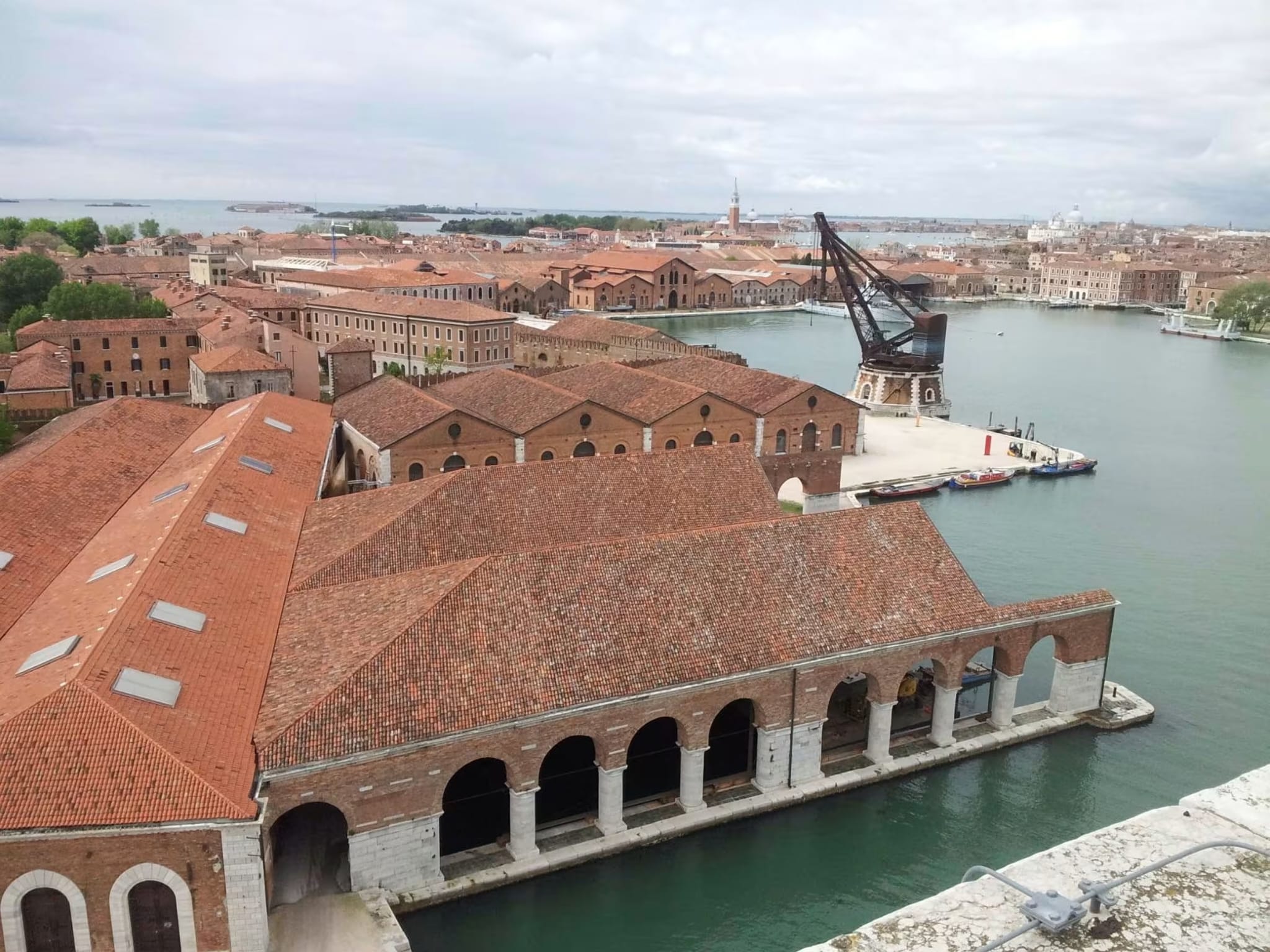
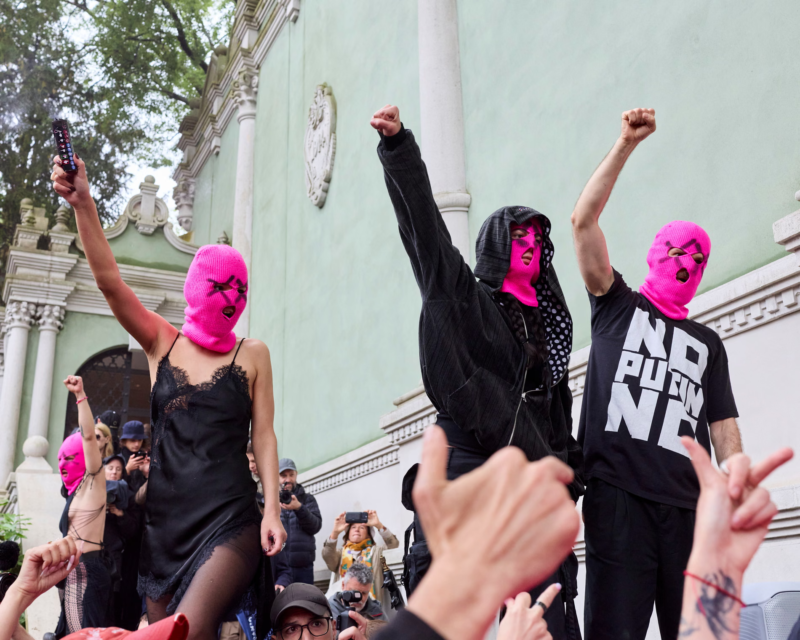
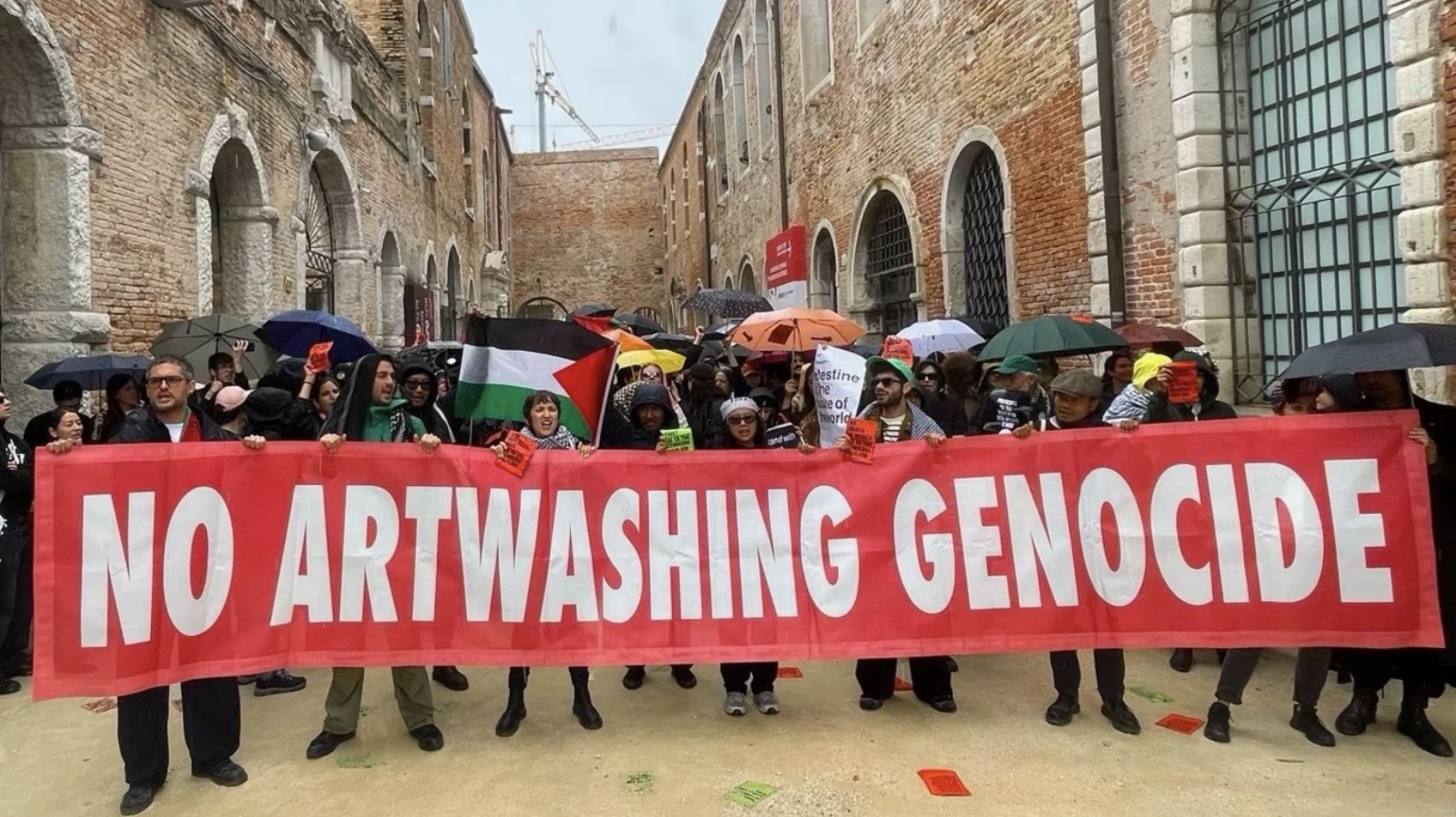
On May 8, the professional preview days of the Venice Biennale effectively came under the control of protests. Due to the 24-hour cultural strike organized following the Art Not Genocide Alliance’s call, more than fifteen pavilions including Austria, the Netherlands, Belgium, France, Japan, South Korea, Egypt, Finland and North Macedonia, partially or fully shut down. Chains were placed on the doors of certain pavilions, alongside banners reading “No Artwashing Genocide” and “On Strike.” Hundreds gathered in front of the Israeli Pavilion at the Arsenale, while Pussy Riot and FEMEN activists protested in front of the Russian Pavilion in the Giardini. Clashes broke out between riot police and demonstrators. The Guardian described the biennale as “a battlefield of international legitimacy,” while Le Monde referred to the Russian, Israeli and US pavilions as “pariah pavilions.” Iran withdrew from the biennale entirely. At the center of the protests was not only Gaza, but also Russia’s return, the Trump-related controversies surrounding the US Pavilion, and the broader question of institutional neutrality within cultural institutions
Top Of Form Bottom Of Form
The most significant rupture came with the collective resignation of the Biennale’s Golden Lion jury. The jury members withdrew from the awards process in protest against the participation of states under investigation by the International Criminal Court—particularly Israel and Russia. As a result, Golden Lion awards will not be presented this year in their conventional form, the organisation will instead turn to a visitor-based voting system. This marks a rare institutional crisis in the history of the Biennale.
Escalating protests building around the Israel Pavilion overshadowed the entire Biennale. The actions led by the Art Not Genocide Alliance prompted many national pavilions to close their doors in solidarity. Numerous pavilions, including Austria, the Netherlands, Belgium, Japan, South Korea, and France, supported the protests. Palestinian flags, protest posters, and performative interventions came to the fore across the Biennale grounds.
Austrian Pavilion
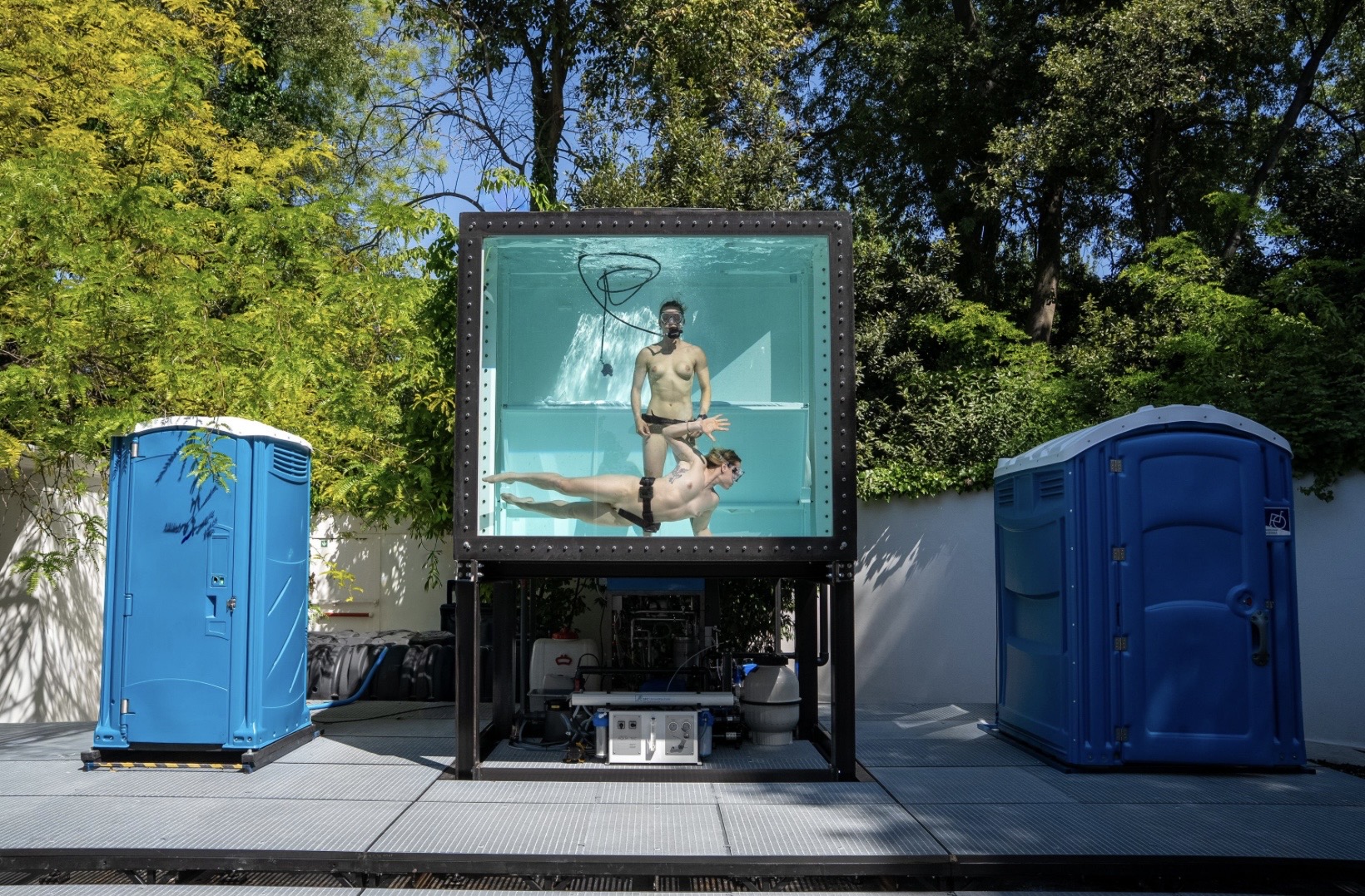
In the middle of this political atmosphere, the most-discussed work was without doubt the Austrian Pavilion. Florentina Holzinger‘s Seaworld Venice has become one of the Biennale’s most controversial and viral projects. Holzinger’s performance in which she was suspended naked inside a giant bell became the Biennale’s “iconic image,” driven by both rumours of police intervention and the dense crowds it drew. Built around the body, waste, water, environmental collapse, and post-human life, Holzinger’s intensely physical performance language was shared millions of times on social media. Combining water filtration systems, sewer aesthetics and performance, the installation drew particular attention for scenes in which visitors’ urine was filtered into a tank where a performer remained immersed for hours. While some dismissed the work as a blockbuster spectacle, others argued that the queues forming outside the pavilion proved it was worth experiencing. In essence, the integration of visitors’ filtered urine into the performance system, naked performers, giant bell mechanisms and the “post-apocalyptic water park” aesthetic generated some of the biennale’s most circulated images.
Yet even the shock effect generated by the Austrian Pavilion was arguably overshadowed by the protests surrounding Israel. Across the Biennale grounds, conversations were dominated less by artworks than by security measures, slogans, and calls for boycott.
Crisis of Legitimacy
Another defining feature of this year’s Biennale has been the fragmented structure that followed the sudden death of the chief curator Koyo Kouoh last year. The main exhibition titled In Minor Keys has been widely described by critics as disjointed and lacking direction, despite the strength of individual works. Perhaps for this reason, the Austrian, British, Ukrainian, and independent Belarusian presentations have, in many cases, attracted more attention than the central exhibition itself.
As things stand, the 2026 Venice Biennale has become less an art event than a stage for the ethical conflicts of the global cultural field. The art world’s long-running discourse of “institutional neutrality” is being seriously questioned along the lines of the war in Gaza and Russia’s invasion of Ukraine. And it looks as though what will stay in the memory from this year’s Venice will not only be the artworks, but the Biennale’s own crisis of legitimacy.
“Love Thy Neighbour” Message from Israel
The Israel Pavilion presents a meditative installation built around dialogue, memory, and the idea of co-existence in the middle of war. This year, Israel is represented by the Romanian-born Israeli artist Belu-Simion Fainaru. Fainaru’s work attempts to carve out a quiet, symbolic space inside the loudest political crisis of the Biennale. Metal locks placed at various points throughout the pavilion reference the European tradition of “love locks.” The locks are inscribed in Hebrew with the phrases “Love thy neighbour as thyself” and “This too shall pass.” Fainaru uses these expressions as a fragile call for hope and for living together within the atmosphere of war.
British Pavilion
Born in Zanzibar and based in Britain for over seventy years, the artist Lubaina Himid takes up the fragilities and dilemmas of trying to belong to a new place in Predicting History: Testing Translation at the British Pavilion as part of the 2026 Venice Biennale. In her Turner Prize-winning practice, Himid this time places migration, settling, and the sense of belonging at the centre, focusing on the survival strategies of newcomers, the feeling of impermanence, and the search for cultural adjustment.
In one of the works on view, two architects debate what kind of structure to build. One proposes a permanent building that will leave a cultural trace on the place where they find themselves; the other defends the idea of a structure that could be abandoned the next day, offering the possibility of escape when needed. The narrative Himid builds out of this scene points to one of the central tensions of the migrant experience: “To remain permanent, or to live ready to leave at any moment?”
Anatomy of the Crisis in Numbers
The Venice Biennale is not only one of the most visible platforms for international contemporary art, it is also a structure that generates an enormous economic circulation for the Veneto region and takes the pulse of the global art market.
100 national pavilions: the number of countries officially participating in the 2026 edition.
110 invited participants: the number of artists, collectives, and art initiatives included in the main exhibition, In Minor Keys.
Millions of euros in economic volume: Each edition of the Biennale produces a major economic mobility for Venice’s tourism, accommodation, and service sectors.
Despite the Censorship
One of the works at the centre of the censorship debates was South African artist Gabrielle Goliath’s performative installation Elegy. The South African government blocked Goliath’s official participation in the Biennale on the grounds that the work dedicated to a Palestinian poet was “excessively divisive.” The artist nonetheless presented it independently in Venice, at the Chiesa di Sant’Antonin, in collaboration with the London-based Ibraaz. First developed in 2015, Elegy is conceived as a ritual of mourning dedicated to women killed through sexualised and racialised violence. In the performance, operatically trained female vocalists hold a single high note for an extended duration; as a voice begins to weaken, the singer leaves the stage and is replaced by another. The emotional intensity that many found missing from the Biennale’s main exhibition was very much present in Goliath’s work.
Ukraine’s Fragility
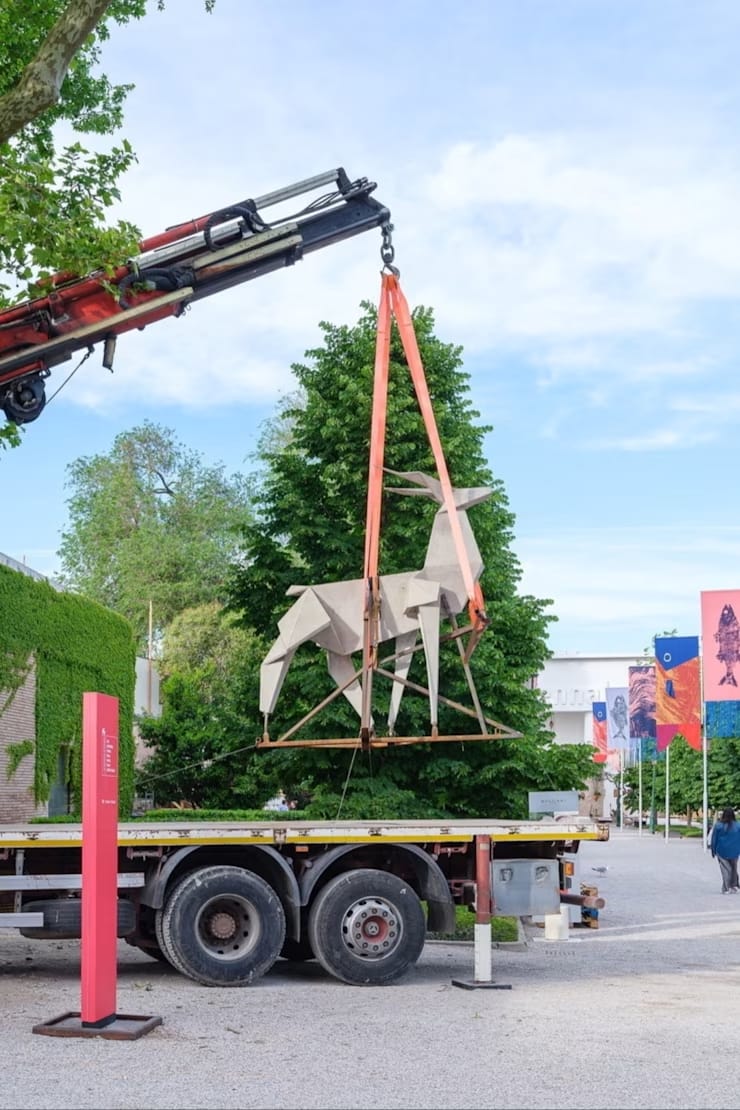
One of the works that has come to symbolise the 2026 Biennale was Origami Deer by Zhanna Kadyrova, a concrete piece suspended from a crane that gives the impression of folded paper. At the centre of the Ukrainian Pavilion, this heavy concrete form, evoking both a playful and melancholic mood offers no real sense of security; on the contrary, it points to the fragility and precarious nature of Ukraine’s safety, held together by a thread.
Despite the Tragedy
Koyo Kouoh, the first Black woman to curate the Venice Biennale explained that with In Minor Keys she wanted to make visible “beauty despite tragedy, the melodies of those who emerged from the ruins, the wounds of those in flight, and the harmonies of those trying to repair their worlds.” Artists from various countries responded to Kouoh’s call by giving personal narratives to the catastrophic condition of the world we live in. In 1991, at least 250 people were killed in the Santa Cruz Massacre carried out by the Indonesian army in Dili, the capital of East Timor. The small island country’s first pavilion at the Arsenale, Across Words, includes 95-year-old Verónica Pereira Maia’s monumental weaving Tais Don, made up of the names of those killed in the 1991 massacre. As the curator put it, it is a work that belongs among the voices of “those trying to repair their worlds.” A keepsake carrying the memory of a small island nation’s journey to independence.
If I Must Die, Tell My Story
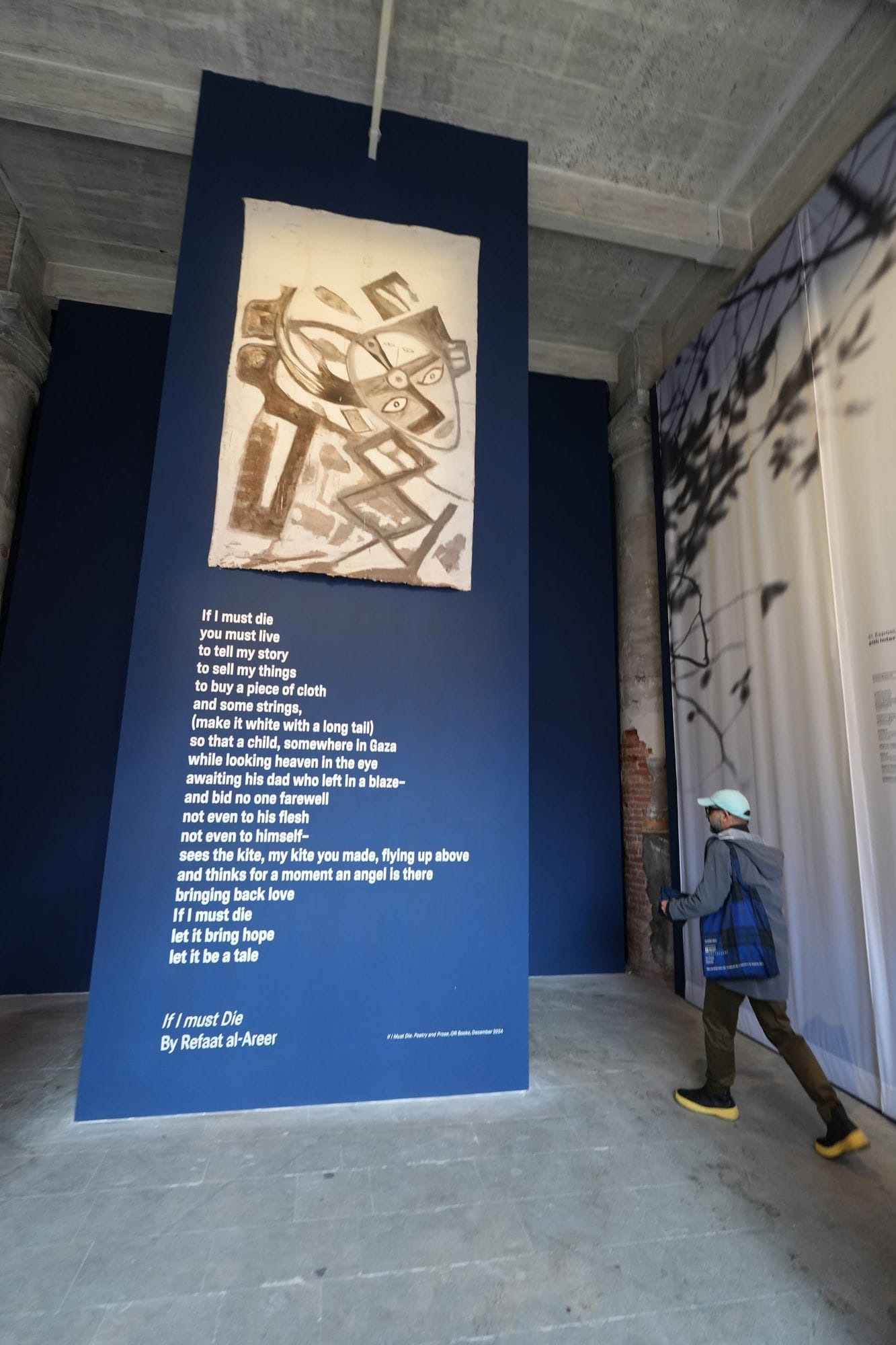
One of the most striking works greeting visitors at the entrance to the Arsenale is the poem If I Must Die by the Palestinian poet and academic Refaat Alareer, killed in an Israeli airstrike in Gaza in 2023. Written shortly before his death, the poem became one of the global symbols of resistance, mourning, and memory with the line “you must live to tell my story”, has been translated into more than 250 languages and continued to be read at anti-war protests.
A Palestinian academic, poet, and activist, Refaat Alareer taught English literature at the Islamic University of Gaza and was particularly known for his work helping young Palestinian writers reach the English-speaking world. He was one of the editors of the book Gaza Writes Back, and for years he wrote about daily life under siege in Gaza, the bombardments, and the feeling of loss. On 6 December 2023, he was killed alongside his brother and his children in an Israeli airstrike on northern Gaza. Shortly before his death, he had written on social media: “If I die, bury me and tell my story.”
The poem If I Must Die, written weeks before his death, in time became one of the most powerful literary testimonies of the war. In the poem, Alareer asks for a white kite to be left behind after his death, so that when a child in Gaza looks up at the sky, for a moment they might believe an angel is still there. The poem was quickly translated into hundreds of languages, read at protests, written on walls, voiced by musicians and actors. Its placement at the entrance to the Arsenale at the 2026 Venice Biennale showed that the poem is no longer simply a text, but has become one of the global symbols of war, memory, and mourning.
Above the poem hangs a 2017 painting by the Senegalese artist Issa Samb, who passed away that same year. An abstract face drifting among rotating geometric forms and fragmented structures, the work represents the human being still trying to survive amid war, destruction, and chaos. Bringing these two works side by side at the Biennale’s opening was one of the strongest moments setting the political and emotional tone of the exhibition.
Isn’t It Enough? The Western-Centred Art Narrative
Setting aside all the Biennale’s political tensions, one of the works with a more universal reach was Nick Cave’s installation Amalgam at the Arsenale. Cave’s presence at the Biennale could be considered one of the most visible expressions of Kouoh’s desire to move away from a Western-centred art narrative and to build a new artistic language grounded in the African diaspora and the Global South. While many noted that the language Cave builds through hybrid bodies, ceremonial objects, and craft carried the spirit of Koyo Kouoh’s In Minor Keys, his ability to transform political language into a bodily and ritual experience rather than using direct slogans was also seen as significant.
The issue the Biennale wished to bring to the fore was the breaking of the Western-centred art narrative. As a result of this approach, it would not be wrong to say that artists from the African diaspora, the Middle East, and the Global South carried noticeable weight. Alongside Nick Cave, names such as Wangechi Mutu, Mohammed Joha, and Gabrielle Goliath were among the most-discussed artists of the Biennale. In particular, as mentioned above, Gabrielle Goliath’s Elegy, censored by the South African government, became one of the Biennale’s symbolic events through being shown in an independent venue.
The US Pavilion Controversy
Another major debate revolved around the US Pavilion. Publications including The New York Times, Vanity Fair, and The Wall Street Journal reported that individuals close to Donald Trump had intervened in the selection process, that several artists refused to represent the pavilion, and that the selection of Mexico-based sculptor Alma Allen sparked significant backlash in the art world. Some galleries reportedly cut ties with Allen following the announcement. The core of the crisis surrounding the US Pavilion lay less in the artwork itself than in the selection process and its political affiliations. According to The Wall Street Journal and El País, the US State Department sidelined the independent selection committee that had been in place for decades. References to “diversity” and “inclusivity” were removed from application criteria and replaced with an emphasis on “American values.” Much of the criticism was directed at the institutional framework and individuals behind the pavilion. Vanity Fair and El País reported that figures aligned with Trump played an influential role in the process, and that the appointment of an inexperienced business figure as commissioner provoked widespread anger in the art world. Anish Kapoor publicly stated that the United States should not participate in the Biennale due to what he described as its “politics of hate.”
Chaos and Mourning
Ultimately, one of the most discussed topics at the 2026 Venice Biennale has been the collapse of the existing “national pavilion” model. Publications such as e-flux, Frieze, and ArtReview wrote that, on account of wars and diplomatic crises, the Biennale has by now turned “less into an art event than into a site of geopolitical contest.” The Russian, Israeli, and US pavilions in particular were referred to as “pariah pavilions.” Le Monde stressed that artists were caught between representing their countries and distancing themselves from state policy.
Completed after Kouoh’s death, In Minor Keys was described by many critics as “a Biennale in mourning.” Artnet described the exhibition as “a Biennale torn apart by the present,” while Frieze noted that themes of melancholy, ritual, memory, and bodily fragility came to the fore in the main exhibition. The Biennale’s overall tone leaned away from showy installations and towards poetry, sound, performance, and a collective sense of mourning.
This year, off-spaces and independent exhibitions drew more attention than the official pavilions. Vanity Fair reported that the Arthur Jafa and Richard Prince shows at Fondazione Prada had overshadowed the main Biennale. Artsy noted that the independent exhibitions spread across the city by names such as Marina Abramović, Lorna Simpson, Amoako Boafo, and Jenny Saville were being talked about among collectors and curators as much as the official Biennale itself.
Another notable thread has been the return of the performance art. Frieze wrote that this year’s Biennale is shaped around “movement, body, and live performance,” and that performance had become the central mode of expression in the Austrian, Belgian, Japanese, and Dutch pavilions. Florentina Holzinger’s work, as mentioned above, stood out as the most controversial performance of the Biennale.
The climate crisis and environmental collapse were also among the Biennale’s central axes. Domus reported that this year many pavilions concentrated not directly on war but on “ecological decay,” “resource exploitation,” and “energy politics.” One of the most repeated sentences throughout the Biennale was: “The art world can no longer normalise itself.” The Guardian, AP, and the Financial Times wrote that, from its opening days, this year’s Biennale unfolded in a “chaotic” atmosphere driven by protests, financial crises, censorship debates, and security measures.
Turkish Pavilion
The Turkish Pavilion presents Nilbar Güreş’s exhibition: A Kiss on the Eyes. Curated by Başak Doğa Temür, the exhibition focuses on questions of migration, identity, labour, and belonging through textile, sculpture, and installation. In the international art press, the Turkish Pavilion has stood out chiefly for its “quiet yet resistant” tone. ArtReview described Güreş’s works as productions that “build a more fragile, everyday language of resistance rather than loud political slogans,” and wrote that Güreş has developed a stance refusing to conform to the expectations of the global art world. The works were said to build a political narrative not through direct slogans but through everyday gestures, the experience of migration, and cultural memory. A point that drew attention across many publications was that the Turkish Pavilion was speaking in a lower register within the Biennale’s generally chaotic and loud atmosphere. Much like the Biennale’s own call suggested…
“If I Must Die”
Rafeet Alareer
If I must die, you must live
to tell my story to sell my things
to buy a piece of cloth
and some strings,
(make it white with a long tail)
so that a child, somewhere in Gaza
while looking heaven in the eye
awaiting his dad who left in a blaze—
and bid no one farewell
not even to his flesh
not even to himself—
sees the kite, my kite you made,
flying up above
and thinks for a moment an angel is there
bringing back love
If I must die let it bring hope let it be a tale