

Halil Altındere’s work flows seamlessly across the international art scene. Working with video, sculpture, performance, and installation, he chooses not just to depict political and social issues but to explore them with those who experience them firsthand. The resulting works do not originate from a single point but from a space where diverse voices come together. Altındere’s pieces were showcased at Art Basel Qatar — one of this year’s most closely watched new stops on the circuit, which ended on February 7. Spanning topics from surveillance and military technology to the absurdities embedded in daily life through historical imagery, these works once again highlight the familiar tension between the ordinary and the extraordinary that runs through his practice. We spoke with Halil Altındere — who has used humor and irony for over thirty years to question power, surveillance, and cultural codes — on the occasion of his solo presentation at Art Basel Qatar.
You participated in the first edition of Art Basel Qatar with Pilot Gallery. How do you see this encounter as a threshold for your practice?
What struck me most about the first edition of Art Basel Qatar was that it was designed by Wael Shawky not as a traditional fair but more like an exhibition — built with curatorial coherence and an exhibition logic. This model, where the lines between booths become more flexible and where conceptual continuity and experimental approaches take center stage, fits well with my own practice and with Pilot Gallery’s programmatic approach. Because of this, I see it less as a “threshold” and more as an exciting and intellectually enriching space for connection.
I also believe that the Doha edition, considering both its geographic location and its choice of participants, will adopt a different content-focused approach from Basel, Miami, or Paris. The parallel exhibitions and talks also point in this direction — at a time when the global art scene is being reshaped, a new cultural map is emerging, with “the East” becoming more central.

In one interview, you say, “I didn’t want to produce works that only the art world would understand.” In a context like Art Basel Qatar — which is global but also has a strong public aspect — whose engagement with your work matters most to you?
From the very beginning of my practice, I wanted to go beyond a framework based solely on the internal references of the art world. I envisioned my audience broadly, including different social and cultural layers. This was both an aesthetic and an ethical decision. The pulse of the street, the language of everyday life, and zones of social tension have always influenced my work. When works that draw from the geography of the Middle East resonate within that same geography, it matters not only for representation but also for dialogue. Connecting my works with different social groups is one of my main motivations in my artistic process.
Coherence Across Media
MOBESE, Turkish Military Drone Rugs, and the Miniature Series appear together in this selection. What is the underlying concern that brings these works together and makes this presentation a whole for you? And how do you think this selection will be read in a context that is as politically and culturally layered as Qatar’s?
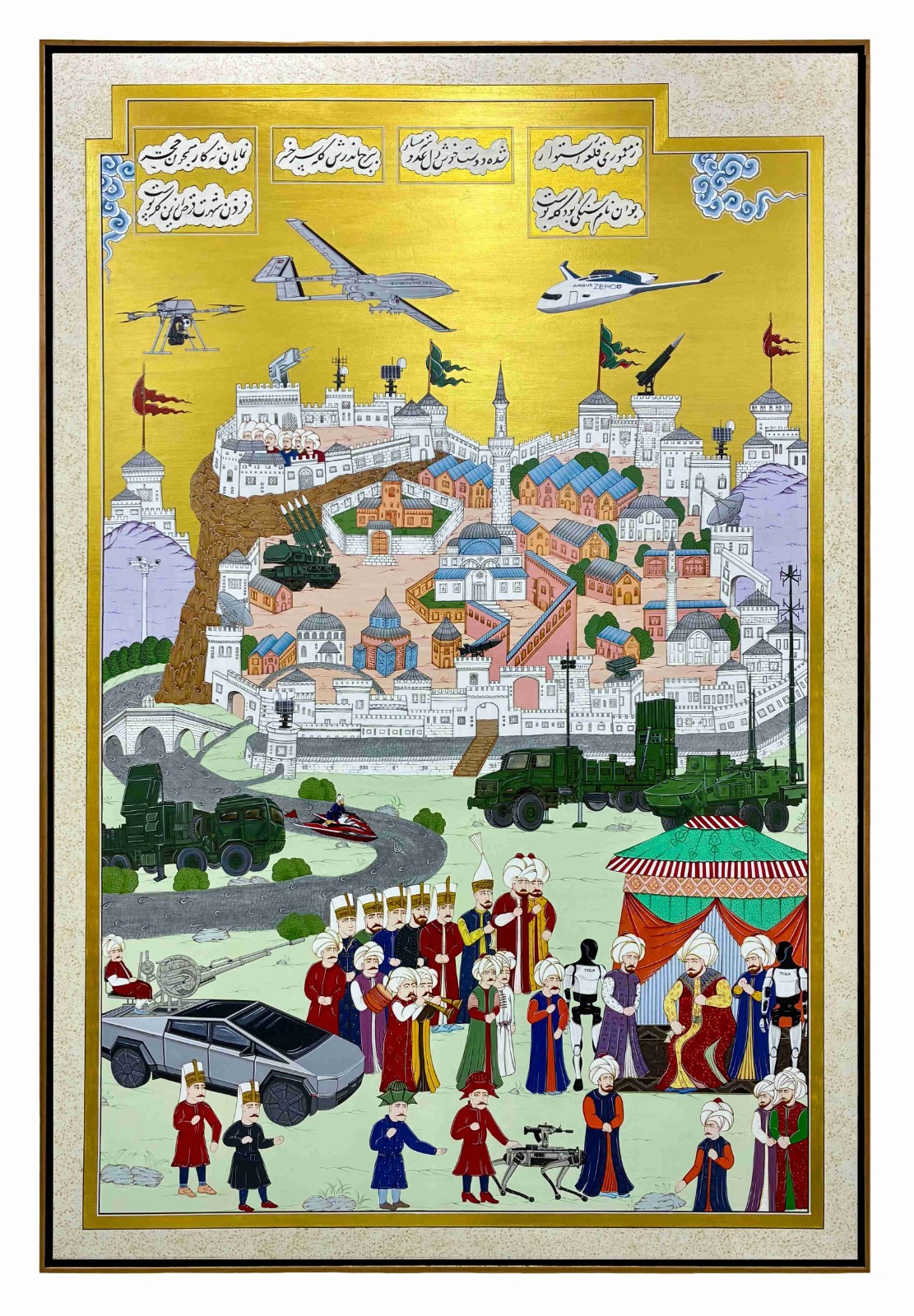
Although there is a temporal distance between the works in this selection, a thematic continuity runs through them. MOBESE from 2011 focuses on the globally expanding culture of surveillance, while the unmanned military surveillance drone rugs I produced in 2023 point to new forms of technological warfare and surveillance regimes. Between these two works, there is a continuity built around surveillance, power, and regimes of visibility. Similarly, the miniature and textile works address the political and geopolitical atmosphere of our time alongside historical references. This selection forms a whole that “sniffs out” the political climate of our age through different media. In a context as multilayered as Qatar’s, these works can enable a reading that both intersects with regional experiences and offers a critical framework for thinking about global power relations.
Art Basel Qatar, through Wael Shawky’s curatorial approach and its theme of “becoming,” offers a format that moves beyond the conventional booth arrangement. How do you think this open mode of display affects the way your works are read?
Together with Pilot, we approached the Art Basel Qatar process as we would prepare for a biennial exhibition. We cared not only about the strength of individual works but also about the conceptual and visual relationships between them. We designed a coherent installation suited to this exhibition’s logic. An open and permeable spatial arrangement makes the dialogue between works visible and allows the viewer to engage in a relational rather than a fragmentary reading. This, in turn, makes the continuities and conceptual backbone within my practice more clearly perceptible.

Sanatçı ve PİLOT Galeri’nin izniyle.
New art centers emerging across the Gulf are changing the landscape of the global art scene. Do you believe this centralization is reshaping not only how art is created but also how it circulates and is received?
The process that gained momentum with the Sharjah Biennial and Art Dubai — followed by the opening of international museum branches in Abu Dhabi, new museums in Doha, state-supported collections, and internationally resonant exhibitions — has established a new cultural ecosystem. Art Basel Qatar naturally extends this trend. The placement of public sculptures both in city centers and across desert landscapes signals the development of a new cultural and artistic corridor throughout the Middle East. This centralization is transforming not only how art is produced but also how it circulates and is received, along with its connection to cultural tourism.
From your early works to the present, political violence, identity, and questions of representation have always been central to your practice. Looking back, what continuity or rupture has surprised you most?
The crisis that started in Syria in 2011 and became one of the largest forced displacement movements in history marked a clear turning point in my work. In pieces like Space Refugee, Homeland, and Köfte Airlines, my collaborations with a refugee astronaut or a hip-hop artist created powerful resonances both in the art world and in everyday life. These works let me explore representation not only through images but also through direct collaboration with the subjects. In this way, they established both continuity and opened up new possibilities within my practice.
You work across very different media—painting, video, photography, sculpture, miniature, and textile. How do you decide which material and technique a given idea will take shape through?
When developing an idea, I don’t focus on any specific form or material. I start by establishing the theme and conceptual framework, then choose the medium and form that best convey the idea — or, when necessary, select the collaborators I will work with. The medium is therefore a tool to serve the idea, not a result of a fixed aesthetic plan.
“Humor and Irony Are a Political Tactic”
In your works, humor and irony often accompany harsh political realities. Does humor create a critical distance for you, or does it foster a more direct connection with the viewer?
Humor and irony to me are not just aesthetic choices but political tactics. They embody a form of resistance inspired by the Situationists—especially Guy Debord’s critique of the “society of the spectacle” — and the creative slogans of the ’68 movement. Humor both creates a critical distance from harsh political realities and opens a space for direct contact. This dual purpose is a crucial element of my practice.
Some of your works, which seemed surreal or absurd at the time of their making, have since come to overlap strikingly with subsequent events. What does this tell you about how art makes contact with time?
The way Köfte Airlines, produced in 2016, unexpectedly coincided with the political developments in Afghanistan in 2021 was remarkable. While art is believed to imitate life, there are moments when it seems that life is imitating art. This demonstrates that art does not just reflect its time — it can sometimes, through an intuitive sense of foresight, hint at possibilities that are not yet visible.
You say, “I don’t shut myself in a studio and paint — I make works about the period and geography I live in.” How do you define the role of art today amid these intense ruptures in the world?
I don’t claim to offer a broad or lofty definition of art’s role. But speaking from my own practice, I don’t isolate myself in a studio creating works disconnected from time and place. Instead, I try to engage with the ruptures, contradictions, and tensions of the era I live in. Perhaps the role of art becomes clear here — in the form and strength of that engagement.