

As an installation artist, Eda Soylu occupies a distinctive position in the creation of unique universes and worlds. Her installations not only prompt the viewer to question the idea of existing in an entirely different space but also lead to a reconsideration of the constructed universe itself. In this way, the artist goes beyond her own universe and discovers a space where she coexists with the viewer. While preparing these works, Soylu stands beyond merely reflecting her own world, foregrounding her inner world, knowledge, and poetic thinking.
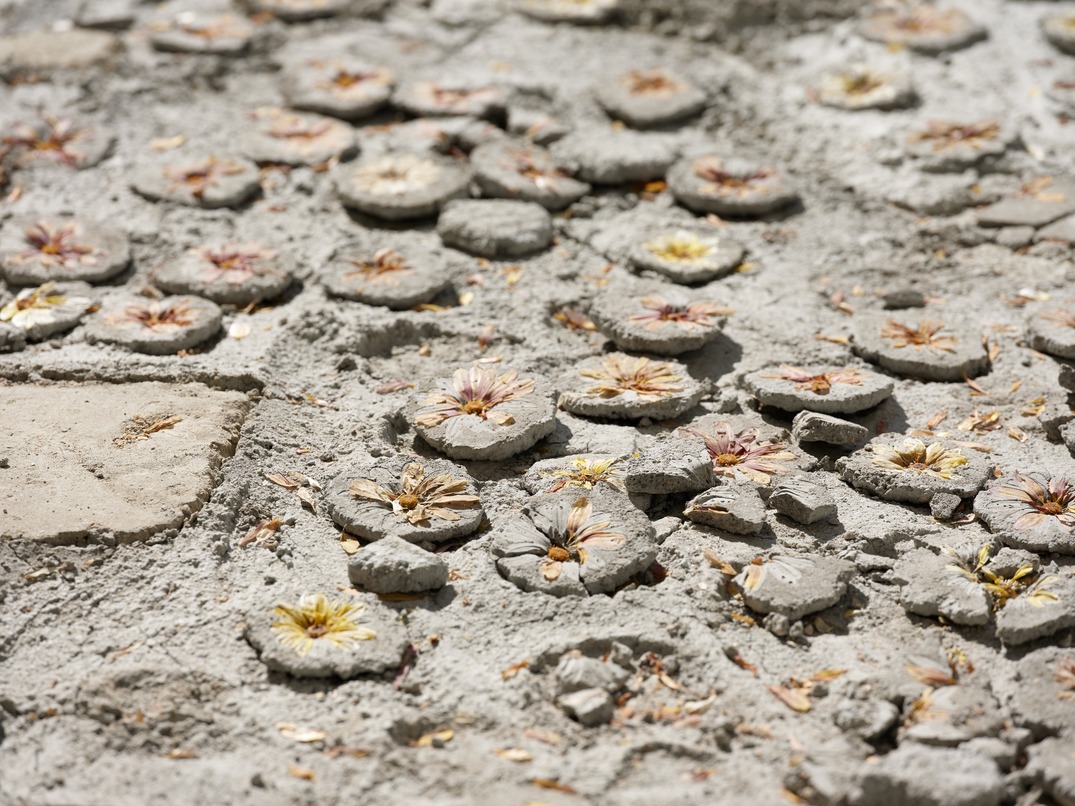
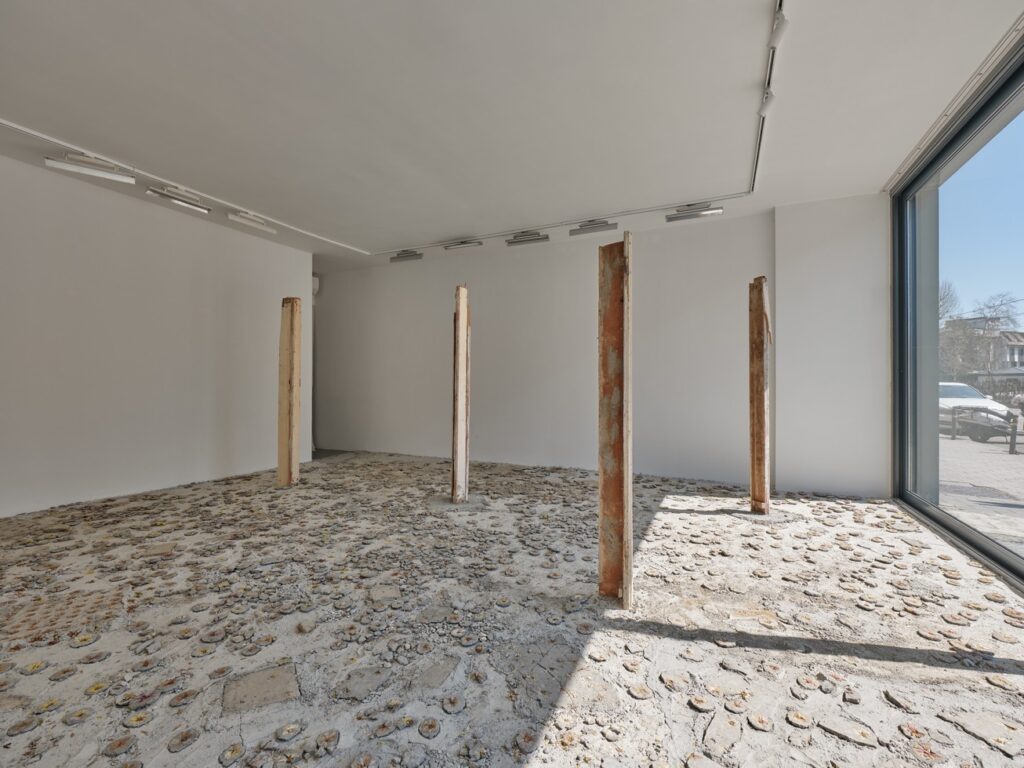
In the exhibition Upended at Merdiven Art Space, we may describe Soylu’s poetic inner world as merging with knowledge and poetry. Spanning two floors of the gallery, the installation greets the viewer with colorful flowers embedded in concrete, dispersed across the raw ground. This distribution is at once random and highly ordered, allowing the viewer to step onto the concrete flowers and, at times, break them—thus discovering new meanings within the installation. The flowers within the concrete evoke how a living entity may, over time, turn to dust, decay, and transform. In this way, we encounter the fragmented state of a whole. We witness the transformation of a universal meaning into a particular reality, while the singular retains its meaning as a single unit. Eda Soylu expresses this movement from the singular to the whole—or vice versa (from the whole to the singular)—within her newly conceptualized installation series. Thus, “Upended” appears as an installation series titled “And the Face of the House Bent.” The central idea presented by the artist in this context is not new; since 2012, Soylu has been working on the concepts of home and dwelling, and here she references her earlier installation, Rebuilding the House, realized in 2016 at Kadir Has University’s Galeri KHas.
The Motif of Poeticity
The poetic quality, a constant motif in the artist’s works and exhibitions, is also present in this installation series. Soylu derives the title And the Face of the House Bent from the first line of Metin Altıok’s poem The Destroyers Have Arrived. This series, developed through the notion of a house’s destruction, points to an inner dissolution. The “bending” here represents not only a physical destruction but also the dismantling of a life, a memory, and an existence. In fact, the artist reminds the viewer that this bending is not only external but also an internal condition—one that can move a person through cycles into different spaces and times.
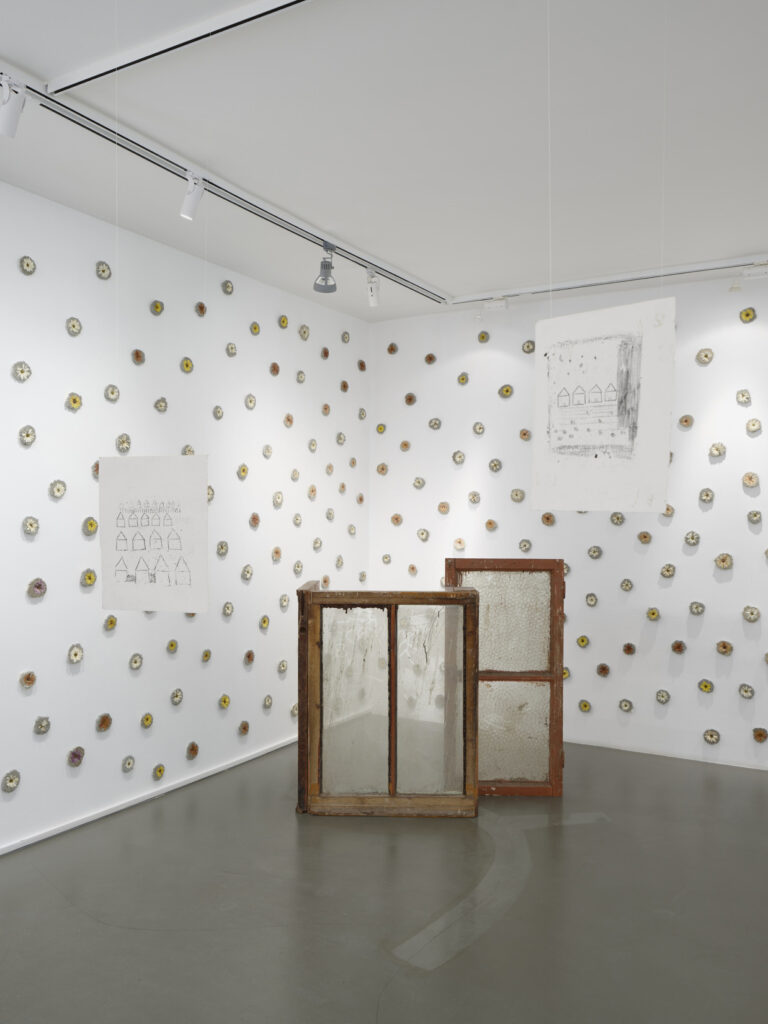
In the exhibition, which unfolds across two spaces, the flowers embedded in concrete that we encounter at the entrance appear both as floor and wall installations. For Soylu, the presence of Merdiven Art Space as a site is significant. She approaches the exhibition as a cycle and invites the viewer into an intertwined loop in which it is unclear what is below or above, what comes before or after, where elements exist only through one another. This cycle also brings together the concepts of home and its place in our lives. For this reason, the title And the Face of the House Bent becomes a concept grounded in space yet extending beyond it toward the depth of human experience. Thus, we once again witness the artist’s effort to create her own unique universes.
The Cycle of Birth/Death/Birth
According to Soylu, Metin Altıok scales the process of destruction through the sequence body–building–city. She notes that the poem describes, step by step, a process of dismantling and demolition, culminating in a state of bareness. The artist interprets this condition within her installation as a form of self-destruction/rebirth. In this way, we encounter the cycle of birth/death/birth, which is also prominent in mythology. For Soylu, who carefully reads this approach and subtly constructs it within her own universe, Below/Above narrates such a cycle of rebirth—but from a delicate and refined realm.
The emotional tone in Altıok’s poem is also subtle and profound. For this reason, we encounter different layers of meaning in each of the artist’s installations through her engagement with poetry. This relationship with poetic expression appears as a kind of evolution within her works. When we look at the two main patterns used in the exhibition—flowers embedded in concrete and window sills—we see that one of the reasons the flowers preserve their vitality is the water within the concrete, while the fractured surface of the sills once again brings us back to the notion of “bending.” Thus, we encounter an order within cycles once more. The artist reveals that a coarse material such as concrete is, in fact, filled with life and water; by contrast, the seemingly broken sills express the delicacy and subtlety of existence. In this way, the viewer embarks on a journey within the universe constructed by Eda Soylu—moving between below and above and from there toward the subtleties of cyclical discovery.