

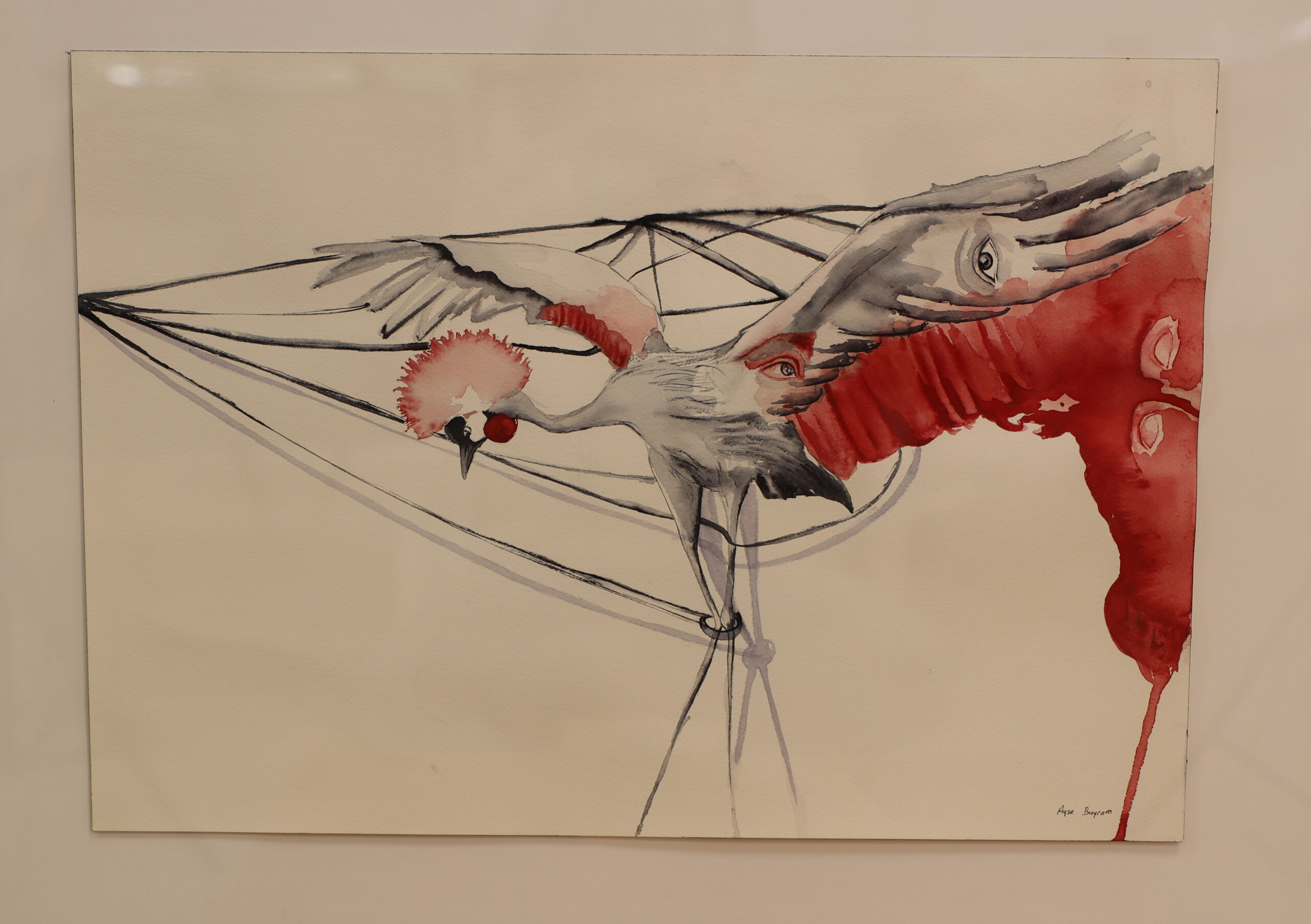
Consciousness has become one of the defining questions of the twenty-first century. While neuroscientists, philosophers, and cognitive researchers seek to understand how subjective experience emerges, artists have long navigated these uncertain territories through intuition, imagination, and visual language. Ayşe Bayram belongs to a lineage of artists who approach the mind not as a fixed structure but as a fluid and evolving landscape. Her watercolor paintings unfold as psychological terrains where memory, identity, dreams, and perception converge, revealing consciousness not as a stable condition but as an ever-shifting process of becoming.
In Ayşe Bayram’s work, identity is neither fixed nor singular. It emerges as a shifting terrain shaped by memory, perception, emotion, and the invisible processes that unfold beneath conscious awareness. Working primarily with watercolor, Bayram constructs dreamlike visual environments in which faces multiply, masks dissolve, and symbolic forms drift between recognition and ambiguity. Her paintings occupy a liminal space between the seen and the sensed, inviting viewers to navigate the unstable boundaries of selfhood.
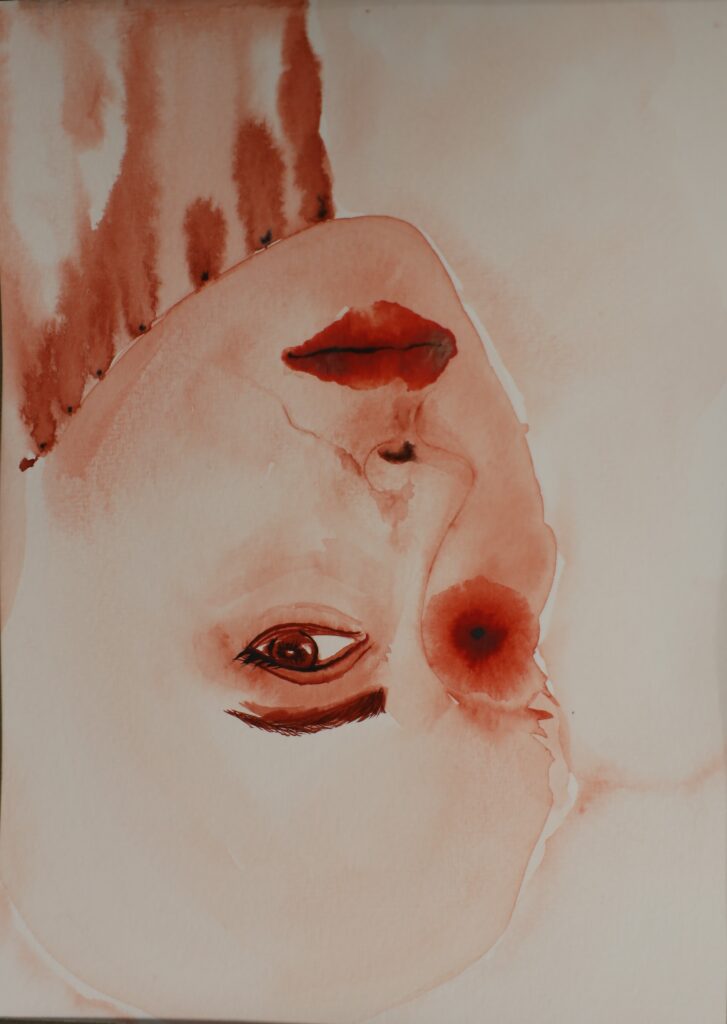
At the core of Bayram’s practice lies an exploration of the subconscious—not as a repository of hidden symbols in the traditional psychoanalytic sense, but as a dynamic field where perception, emotion, memory, and bodily experience continuously interact.
Bayram’s works resonate with contemporary neurophenomenological thought, which seeks to understand consciousness through the reciprocal relationship between subjective experience and cognitive processes. Rather than illustrating psychological concepts, Bayram creates visual situations through which consciousness itself becomes perceptible.
What distinguishes her practice from conventional watercolor painting is the way the medium becomes an active participant in this inquiry. Watercolor is not merely employed for its delicacy or aesthetic qualities; instead, its fluid, unpredictable nature mirrors the constantly shifting processes of thought, memory, and perception. The transparency of layered pigments, the dissolution of boundaries, and the spontaneous movement of water allow Bayram to visualize states of consciousness that resist fixed representation.
Through a series of solo and group exhibitions in Türkiye, the UK, and Italy, Bayram has continued to develop her exploration of consciousness, identity, and perception. Recent solo exhibitions such as Behind the Mask, Beyond the Self (Versus Arts, London), The Metamorphosis of Transcendence (Nidra Art, Istanbul), and Inner Multiplicity (Espacio Gallery, London) have further developed her investigation of the fragmented and evolving self. Her participation in the group exhibition Parallel Traces at Espacio Gallery, alongside presentations at the Venice International Art Fair and the Izmir Art and Antiques Fair (IAAF), situates her practice within a broader international conversation about perception, subjectivity, and the increasingly fluid boundaries of identity in contemporary life.
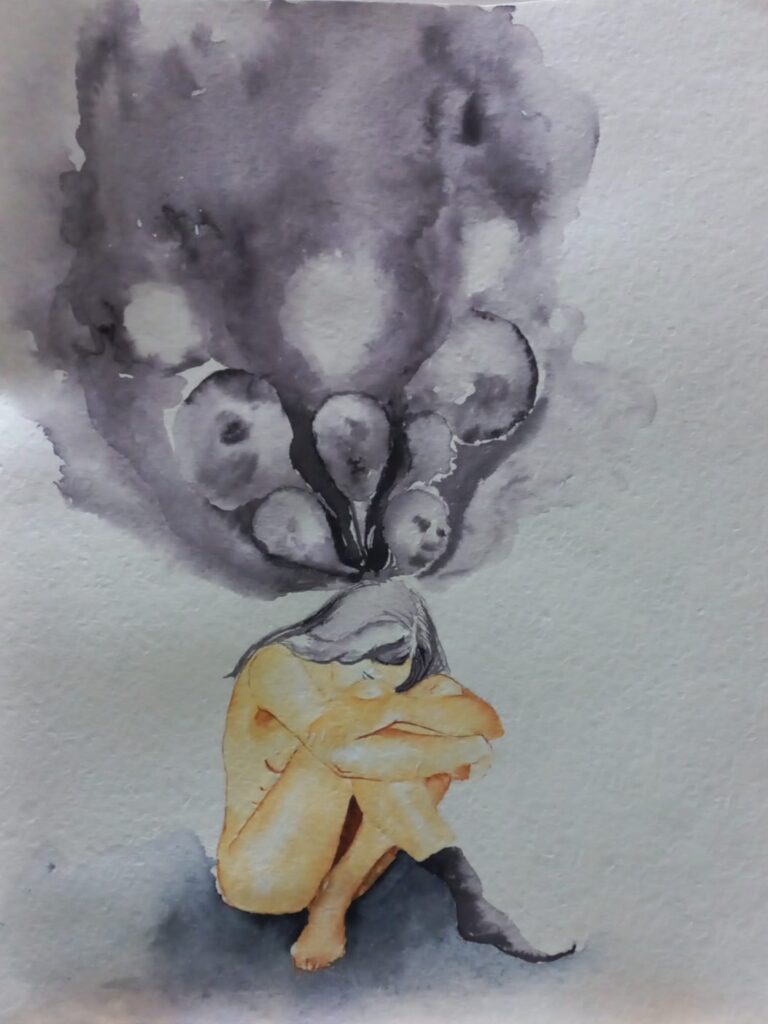
Unpredictability and resistance in recurring motifs
Watercolor is central to this investigation. Its fluidity, unpredictability, and resistance to complete control mirror the nature of thought and perception. Pigments bleed into one another, edges dissolve, and forms remain in a state of becoming rather than resolution. The medium functions not merely as a technical choice but as a conceptual extension of the artist’s inquiry into the instability of identity and the elusive character of inner experience. As images emerge and recede within translucent layers of color, viewers encounter a visual language that echoes the fleeting logic of dreams and memory.
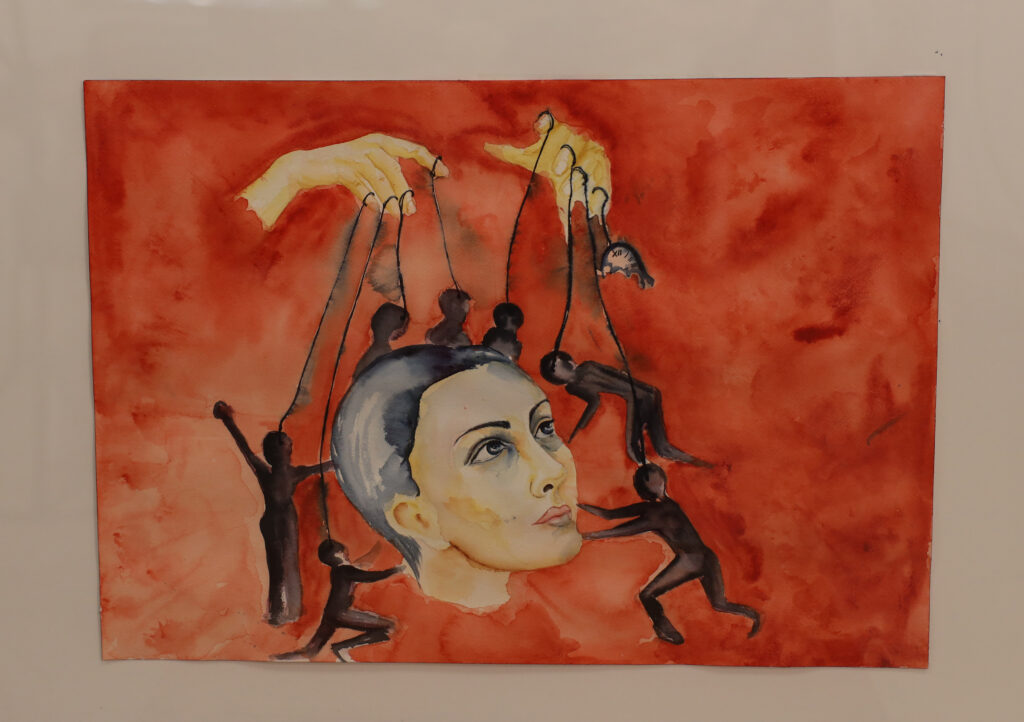
Recurring motifs such as fragmented faces, watchful eyes, threads, masks, and multiplied figures serve as metaphors for the self’s multiplicity. In Bayram’s paintings, identity is not represented as a coherent entity but as an ongoing negotiation between internal and external realities. The mask, a prominent element throughout her work, is not a symbol of concealment but of transition. It marks the threshold between social performance and inner consciousness, revealing identity as something continuously constructed, dismantled, and reimagined.
While her practice draws upon the rich legacy of Surrealism, Bayram’s approach departs from its historical fascination with the unconscious as a realm of irrational revelation. Instead, her paintings engage with contemporary questions surrounding perception, cognition, and self-awareness. Her figures appear suspended between psychological states, inhabiting spaces where memories, emotions, and imagined realities coexist. In this sense, her work reflects an expanded understanding of consciousness.
Universally resonant images
What distinguishes Bayram’s practice is its ability to transform personal experiences into universally resonant images. Her paintings do not offer narratives or conclusions; rather, they create conditions for reflection. Viewers are encouraged to recognize their own fragmented memories, shifting identities, and unarticulated emotions within the works. The paintings become mirrors—not of physical appearance, but of mental and emotional landscapes.
As contemporary culture increasingly confronts questions of identity, authenticity, and self-perception in a digitally mediated world, Ayşe Bayram’s work offers a compelling visual inquiry into what it means to experience oneself. Her paintings remind us that consciousness is not a stable destination but an ongoing process of becoming. Through fluid forms and symbolic complexity, she reveals the self not as a singular truth waiting to be discovered, but as a constantly evolving constellation of experiences, perceptions, and possibilities.
In Bayram’s universe, the subconscious is not hidden beneath reality. It is reality’s most fluid and transformative dimension.