

Recently, you have been creating performances that may seem independent of one another, yet are connected by the way they move between body, labor, everyday life, art, reality, and fiction. These works, which you have carried out consecutively in different spaces over a short period of time, became especially visible in the trilogy you began in December with the “Kunstmuseum Ahlen” and the “Stadtbesetzung/City Occupation” project. This trilogy emerged as the result of real experiences: in September 2025, you worked like an intern, first in a porcelain shop, then in a bed store, and finally in a restaurant. In each one, you spent a full day experiencing that work, strictly following the daily working hours. You then reconfigured, in a performative way, the images inherent to these professions. I’ll come back to your performances in a moment, but before that, I would like to hear a little about the relationship you establish between body and city through shopkeeping. In this project, there is an experience that inscribes the body into the city. If you like, let’s begin with the relationship you build between the city and the body.
Yes, I care a great deal about the relationship between city and body. Because they are two structures that produce one another. After all, as bodies, we are part of cities; we are the people of cities. We live, go to work, go to school, shop. Our bodies walk the cities every day. Whether a lot or a little, for a long or short time, it does not matter; in some way, we are constantly in motion. We meet one another, go to events, wait, carry, grow tired. So our bodies are always in relation with the city.
Walking through cities is also very important. Because truly experiencing a city, recognizing its rhythm, and settling into it is only possible through walking. In addition, the structure we call a city is designed by people, according to bodies. It takes shape according to the flow of everyday life; we walk or pause in places according to that design. But I do not think this relationship we establish with the city is only functional. Personally speaking: I see the city, and the city sees me every day. There is a mutual gaze between us. I often address this in my work as well. I especially like site-specific performances because I work with the memory of a place. I develop ideas specific to the site. But I am not speaking only of a physical city here; the human layer of the city is also very important to me. In other words, I am interested not only in buildings or shops, but also in the forms of life, patterns of movement, and encounters there.
This project is also based on the idea of “occupy.” After each performance, I walk to the next space. Sometimes people accompany me during these walks as well. In this way, the performance does not remain confined to a shop or a museum; the city itself becomes part of the performance, and we occupy the city. Together, we walk through the city again with our bodies, and experience it again. At this point, as I said earlier, walking itself is an important issue. We can only deepen our experience of a city by walking. By exploring its side streets, noticing its details… And perhaps walking together means moving through the same streets with different bodies, feeling each other’s rhythm, and seeing that we experience the same city in different ways. That is also how a real relationship with the city is established.
Of course, the same relationship does not form in every city. Ahlen is a small city; it is not like Berlin, which I am used to. Every city has its own story, its own tempo. I first went to Ahlen in 2013 for my project First Contact. When I returned years later, I encountered a very different landscape. Many shops had closed. Seeing empty storefronts on the main street affected me. This is not something unique to Ahlen, of course; it is a more general issue connected to the transformation of the world economy. I was in Antalya recently, and there was a similar feeling there too. I think a city’s transformation also affects the body. Because continuity in a city creates a sense of trust in our bodies. The possibility of finding a place in the same way even years later brings peace. When that continuity disappears, the body begins to feel differently. It is as if the space for movement narrows, as if the rhythm of everyday life breaks.
Speaking of the city’s relationship to the economy, in these performances you move especially through shops, which are among the most everyday and intrinsic spaces of the city. What kinds of encounters and ruptures emerged as you reconfigured the notions of shops and shopkeeping through art?
I think the most important encounter for me was with rhythm. Because the tempo of a shop is different, and the tempo of an art space is different. In a shop, time flows very physically; keeping up with customers, carrying products, arranging shelves, serving, being on one’s feet constantly… I felt again how much bodily labor these spaces, from which we so often receive service without noticing, are actually built upon. On the other hand, art entering those spaces created small ruptures. Because people first saw me as a worker, and then as an artist. When that boundary shifts, the everyday itself becomes visible. What interested me precisely was this: the moments when art seeps into everyday life and makes the everyday noticeable again.
In the performance you carried out in Ahlen, everyday labor becomes visible. Do you think performance art carries the risk of turning invisible labor into an artistic, aesthetic object, or romanticizing it; or does it, on the contrary, call it back?
I do make performances, but the entire point of departure is that working experience itself. I felt in my own body the physical difficulty of the working conditions there, and I actually built the performances out of that experience. Yes, an aesthetic construct emerges in the end, but for me aesthetics here is not something that romanticizes labor. On the contrary, it is a tool that makes it visible. Because in everyday life, we no longer notice many things. We often pass by without seeing the weight carried by a waiter, the bodies working on their feet all day, the movements that repeat automatically. But when this is brought into the field of art, people begin to look again at the same movement. That is exactly what I want to do through performance: to make the invisible flow of everyday life visible again.
Of course, I could have done it directly; without any artistic construction, I could have opened the shop in the morning and worked there until evening for real — which I did — and the performance could have been nothing more than that. But then I would have remained only an observer. People, too, could have passed through the ordinary flow of everyday life without ever really seeing that labor. I wanted instead to pass that experience through my own body and transform it through my art. Because sometimes only when an artistic or aesthetic frame is created do people truly begin to look.
Yes, at that point you both make labor visible and turn it into an aesthetic experience. But I still insist on the fact that this visibility also involves a reframing. I am not sure whether performance makes labor visible or whether it artistically reproduces it. At this point, don’t you think the boundary between performance and labor becomes blurred?
Yes, but from that perspective, performance art is also labor. It is the labor of my own artist body. There is also intense physical and mental work in the process leading up to a performance. I find the idea, research materials, rehearse, establish a relationship with the space, prepare my body… All of these are labor. Here I start from one form of labor in everyday life and interweave it with artistic labor. So the boundary between performance and labor naturally becomes blurred. Because I also turn my own body into a workspace. Perhaps what I am doing is reframing invisible labor. But even if I inevitably aestheticize that labor while doing so, I also feel that I am making it visible and taking responsibility for it as an artist.
You had actually previously produced performances in Paderborn through professions such as firefighting, laundry work, and milling; you had again worked on certain effects that would find artistic expression in the field of labor. But this time you are doing something different: before the performance, you directly worked in those places and experienced a kind of internship. What kind of transformation did experiencing the reality of a practice before incorporating it into a performance create for you?
Ah! This is exactly very important to me. Because these performances do not begin only at the moment I stage them; they begin in the process of experience, when the ideas start to form. That is why the internship part is at the center of the work. If I had not worked in those shops, these ideas would not have emerged. There, I felt the value of bodily strength much more intensely. That is also what came to the fore in my performances. There is also something personal here, actually. Before university, I had done an internship in a print shop for three years. It was a very difficult experience, but it taught me the relationship between labor and the body.
I often think: I wish people could, even for a short time, work in the places where they receive services. Maybe then we would treat one another differently. We would look for ways to be more patient and more graceful while waiting for a service. Because someone who feels in their own body how exhausting that labor is begins to look differently.
Looking for ways to be graceful while making demands from others — that is a beautiful phrase, a truly valuable desire. So let us return to your performance: what difference did you experience between living the reality of bodily labor and turning it into representation? More importantly, what I am really wondering is whether experiencing a job or a form of labor only temporarily, rather than representing it, left you face to face with the fact that it cannot be fully internalized?
Yes, but even that short experience taught me a great deal. After all, I spent time inside those shops, even if only for one day. Of course, to truly understand a profession, months and years are needed. I never claim that I “took the place of” those people. But still, I entered that atmosphere. I would say I took in the smell of it — I carried the atmosphere’s smell on me. I was in the same rhythm from early morning until evening. And even in one day, you learn a lot, believe me. While working in the bed shop, I learned about different feather types and pillow fillings. In the porcelain shop, I learned that not every paint can be used on porcelain, and I learned about different kinds of paint. In the restaurant, I experienced the rhythm of service and how the body is constantly in motion. All of this became part of my performances as both a physical and mental experience. Because I now knew not only the material, but also the tiredness that material created in my body.
Moving on from the internship part to the fictional dimension of your performances: in this trilogy, you selected images such as the music-box ballerina, the duvet, and the waiter from three different shops, and developed your work through them. What kind of transformation did becoming those images create in you, bodily and conceptually? I want to begin especially with the porcelain shop, because porcelain produces a kind of economy of elegance, and you establish a relationship between your body and porcelain’s elegance. I think I got particularly fixated on the porcelain ballerina image here, because when I was a child, my aunt had a music box that played classical Mozart and had two small porcelain ballerinas turning on top of it. For me, the ballerinas were the “perfect image” then. In your ballerina performance, you are also playing with an aesthetic regime. Music-box ballerinas are usually smooth, idealized figures belonging to a classical understanding of aesthetics. When you place your own body into this image, how do you intervene in this aesthetic perception through the reality of the body and its ability to change over time or under certain conditions?
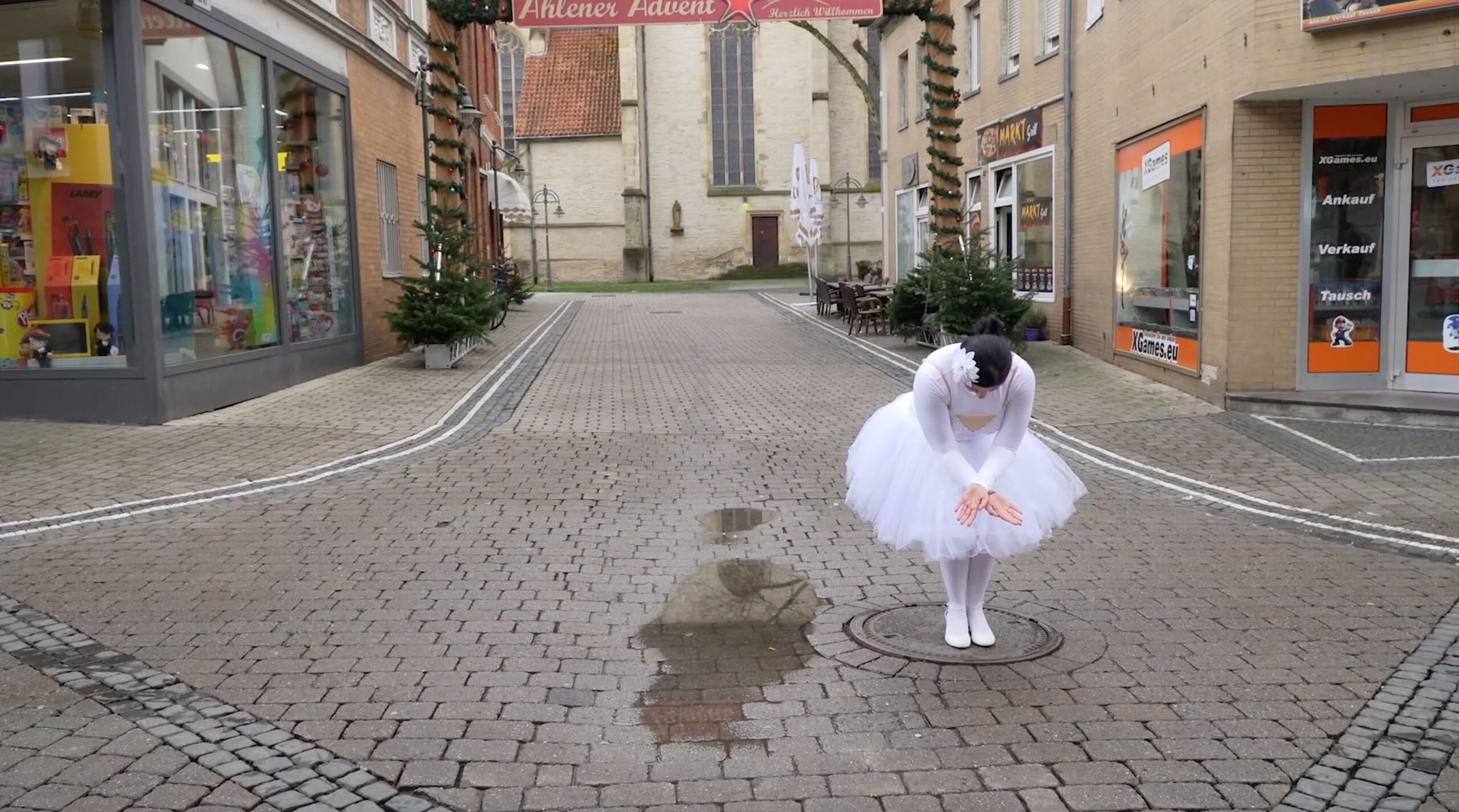
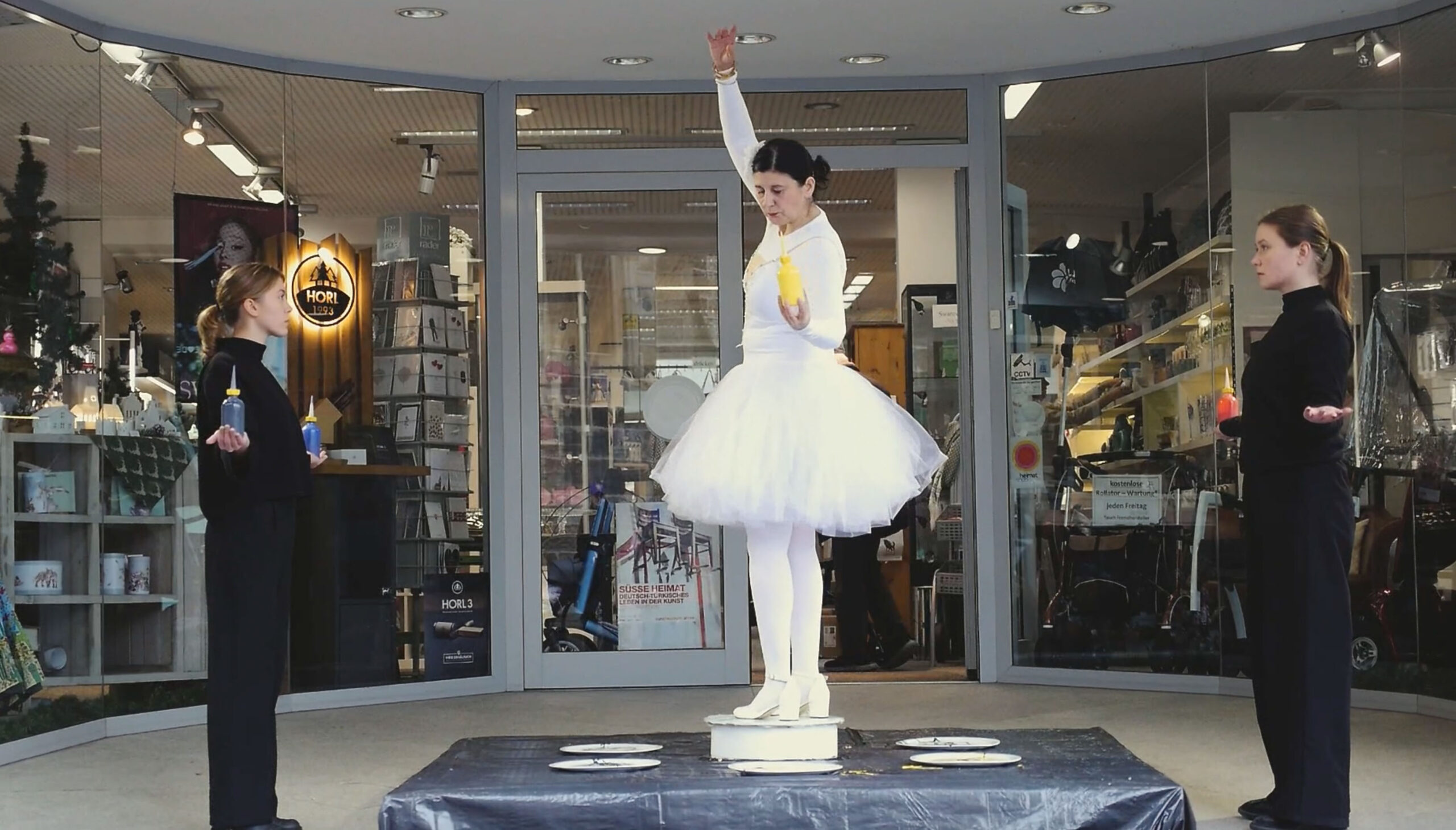
I have always liked becoming statue-like, but I experienced the ballerina figure for the first time. Because the ballerina in the music box is a highly idealized figure. She is like a flawless, fragile, constantly turning aesthetic object. And of course, I am not a figure as slender or flawless as that. But that is precisely why it interested me. I wanted to place my own real body inside that aesthetic image. Because there I was not only a ballerina; I was also a working figure. The platform I stood on was actually a rotating machine; I was on top of it, and the machine kept spinning me. At the same time, I was painting porcelain plates during this movement. So aesthetics and labor were united in the same body.
By the way, the history of the shop I worked in also impressed me deeply. “Josef Ostermann Das Porzellanhaus,” where I worked in Ahlen, was founded in 1706. It first began as a blacksmith shop, then became a store selling porcelain, household goods, and gift objects.
The owner of the shop had been collecting Rosenthal porcelain for years in particular. Rosenthal is a very important brand in Germany that brings together art and industrial production. They have worked with artists such as Salvador Dalí and Walter Gropius. So an everyday object of use also becomes a collectible art object.
When I visited the shop’s storeroom, I was deeply impressed. It was organized like the back storerooms of museums. There were hundreds of objects on the shelves. At that moment I thought, “I am also an artist; I can produce something here too.” First I saw Rosenthal porcelains designed by different artists, and then I came across the ballerina music box. At that moment the idea came to me: “How can I turn into a music-box figure with my own body and at the same time paint plates?” Here, the idea of “Geschenkartikel,” that is, gift items, was also important to me. Because a gift item is an object that enters emotional circulation. I was producing another kind of gift with my own body. I was turning into an object and at the same time into a producer. As a gift item, I produced gift items. But the coordination of this performance was very difficult. While the machine kept spinning me, I also had to maintain my body’s balance. To be both a ballerina and a plate painter required the body to remain in a constant state of balance.
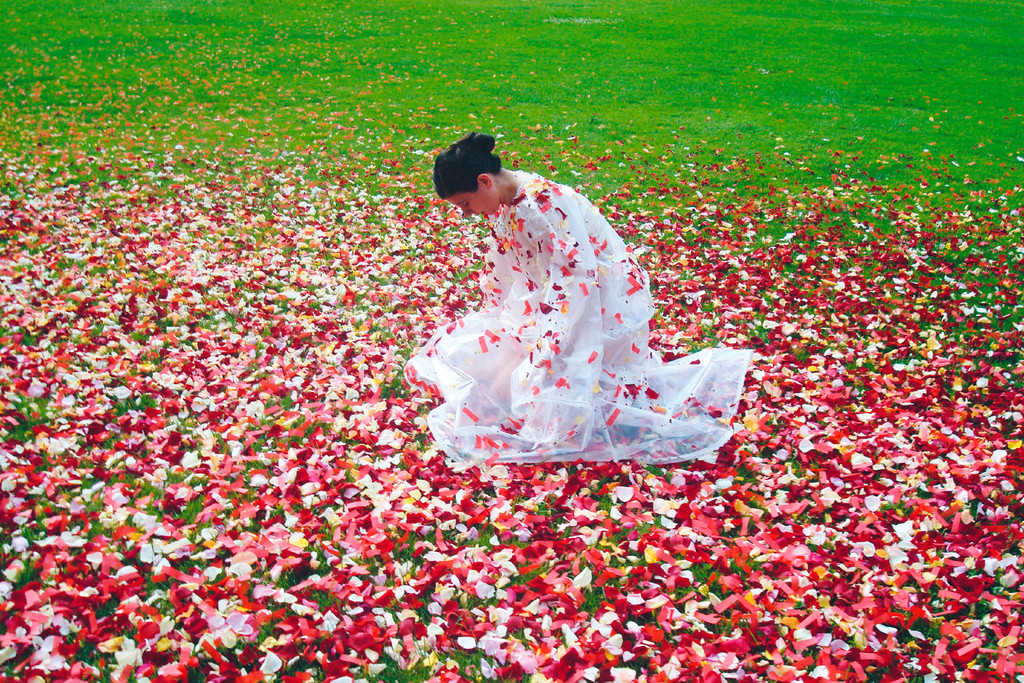
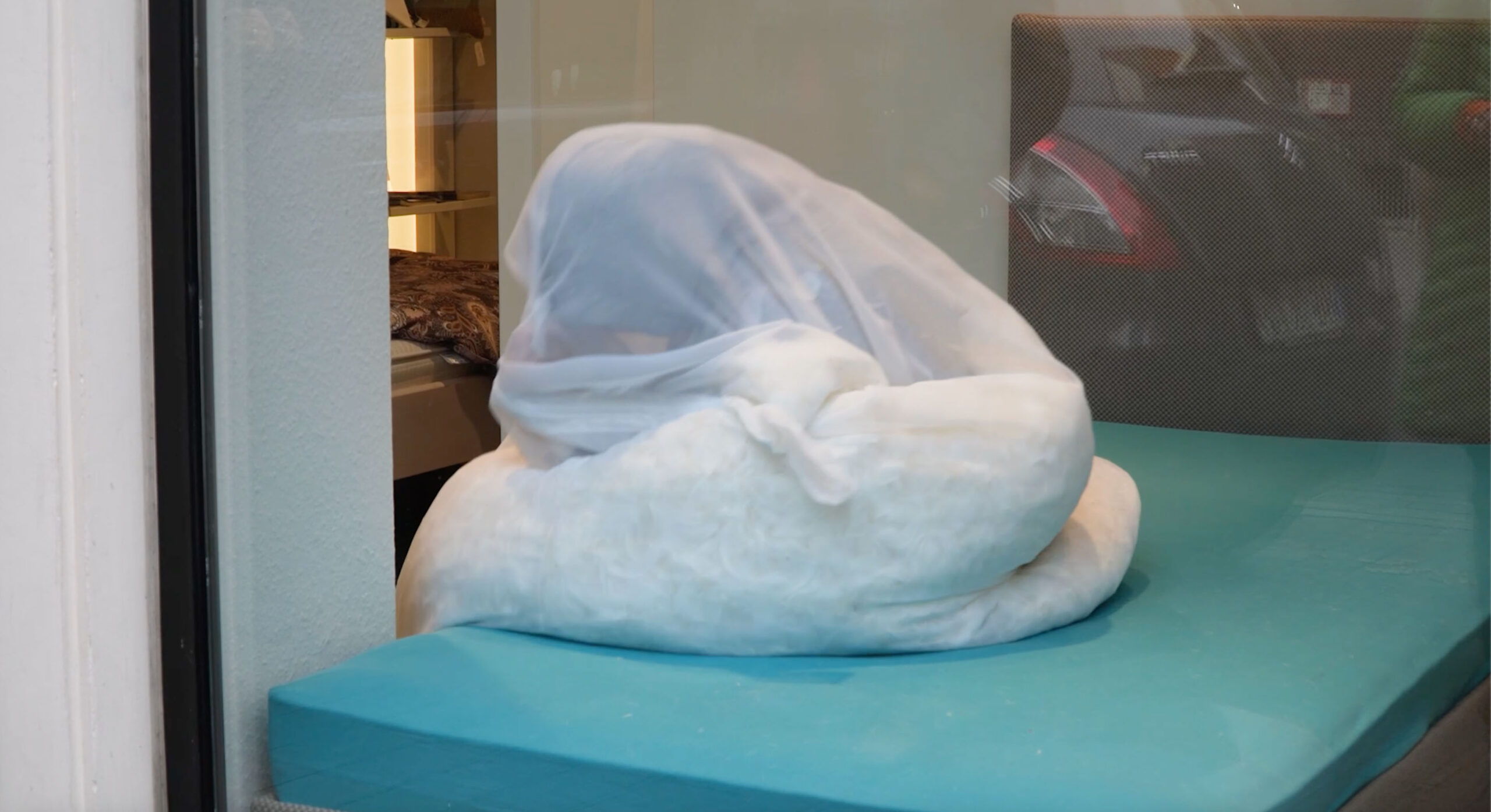
You proceed through fragility and ideal aesthetics in porcelain; in the bed performance, the body enters into relation with a more organic, almost animal material. The bed shop called “Betten Garmann” has been operating since 1743. In this performance, we see a body inside a thin, semi-transparent fabric, surrounded by feathers and struggling with them. Here the fabric functions both as a boundary and as a permeable surface. In this work, how does the body establish a relationship between protection, closeness, and fragility?
One of the things that affected me most there was the fact that the relationship between the body and feathers is much closer than we tend to think. While working in the shop for a day, I learned about different feather types, filling systems, and cleaning machines. But at the same time, I kept thinking: the human body is actually protected, warmed, and comforted through contact with something that comes from another living creature’s body. So within a sense of comfort we take for granted in everyday life, there is the trace of another life.
That is why, in the performance, I specifically used a very thin, semi-transparent fabric. Because I did not want that fabric to function as a completely separating boundary. On the contrary, I wanted to make the permeability between the body and the feather visible. Normally we feel safe inside the duvet; we think of it as a soft, protective space. At the same time, through the feather fabric that covers the duvet cover, we try to protect ourselves. There is a duality here.
But in fact, the contact is so close that between the body and the feather there is almost only a thin surface. I did not want to be outside the duvet; I wanted to be inside it. Because the issue was not to be someone looking from the outside, but to really feel the physical relationship the material establishes with the body. Being inside the feathers was at once comforting and disturbing. On one side there is warmth and protection, and on the other, a density that makes breathing difficult and tires the body. That duality is what interested me. After all, we do not live entirely cut off from nature. We think of ourselves as living in modern, sterile, controlled spaces, but even our everyday comfort rests on invisible relations with other living beings, other bodies. In the performance, I wanted to make that invisible closeness visible.
What about the restaurant performance? In Ahlen, you worked at “Steinofen Türkisches Restaurant,” and there you encountered a much more direct economy of service and pace than in the other jobs. There is a body that is constantly in motion, carrying things, trying to keep up. Moreover, a restaurant is a space that in everyday life is often perceived only through the customer experience. How did you relate to the invisible labor of service in this performance?
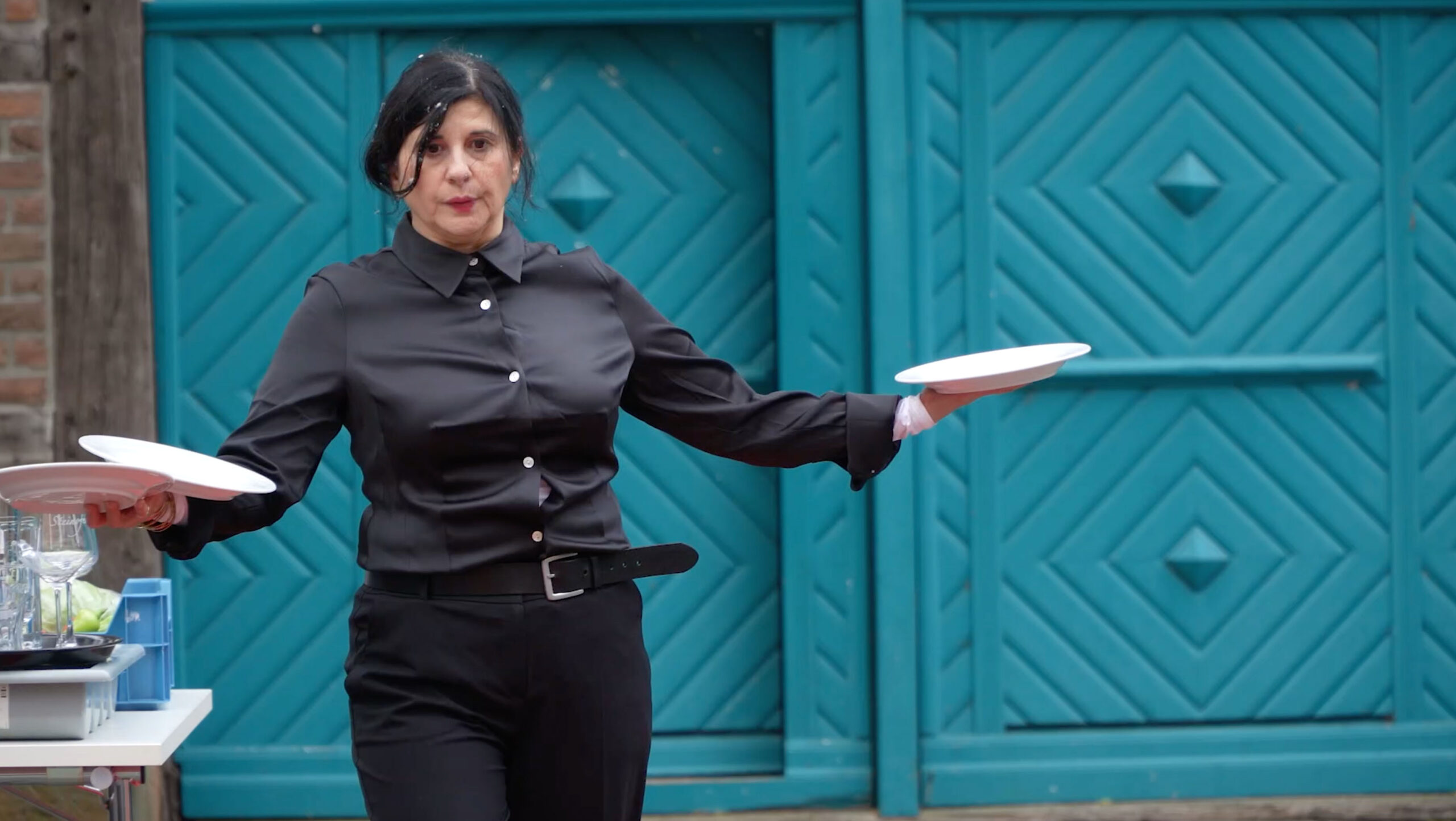
Yes, the performance I did after working at Steinofen Türkisches Restaurant was a much more direct experience. In the others, the transformation was more pronounced, but here I worked almost directly. And to be honest, working in the restaurant was the hardest. There was hardly any break.
In restaurants, we usually exist only as customers. We get annoyed when food is delayed or does not arrive as expected, but we do not think about the bodily labor behind that service. Here, I especially wanted to honor the waiters and everyone working in the restaurant.
There was a very striking text on the menu:
“Welcome to Restaurant Steinofen. Here, you are met not only with a meal, but with an oriental taste and experience that goes far beyond köfte. Please allow some time, because each plate is slowly prepared before your eyes in the warmth of the stone oven. Antalya Plate No. 73: veal shish, sliced veal and köfte… Served on a clay plate, together with the warmth of roasted potatoes, the intensity of the special sauce, and the freshness of the salad… 25 Euro.”
That menu made me think. Then I turned the menu itself into part of the performance. Because if I were really doing the work of a waiter, I would have to know all the prices and dishes. That memorization alone is labor in itself.
The red carpet was also important to me here. Because I wanted to carry the invisible worker’s body into a ceremonial space. Normally, the red carpet is a representational space associated with stars, political figures, or bodies accustomed to being visible. Yet the bodies working in restaurants are constantly in motion, but they often remain in the background. The service gestures are visible, but the body producing them is invisible. In this performance, I wanted to do the opposite. The waiter’s acts of carrying, keeping up, and balancing already contain a very powerful choreography in themselves. I simply moved that everyday choreography into a ceremonial frame. In this way, an ordinary service movement became a public ritual. The red carpet here became not an award space, but a space where invisible labor was centered.
I also could not perform this work inside Restaurant Steinofen, where I had done my internship, because the space was too small. So I took the plates and walked through the city, and people accompanied me. We walked for about one kilometer, and I performed in front of the Heimatmuseum Ahlen museum. The idea of “Heimatmuseum,” or “home museum,” was especially important here; because I brought the service gesture not only into the public sphere, but to the threshold of a building where the idea of “home” is represented. In this way, an everyday service movement became a public choreography in front of the representational space where the idea of home is fixed, a place where invisible labor and the idea of belonging came into contact.
You say that a movement that could not fit inside the space overflowed into the city. Your walking with the plates and people accompanying you takes the performance out of the restaurant and into the streets. What kind of field of meaning do these walks in Ahlen and the performances spread across different spaces create for you?
What mattered most to me in Ahlen was really the way spaces were linked to one another. The movement that began in the restaurant could not remain inside, so it naturally spilled outside and turned into a walk through the city. This spilling over was less a planned thing than something related to the work’s own rhythm. While carrying the plates, the service gesture and the everyday flow of the public space overlapped. With people joining in, it ceased to be a performance I did alone and became a shared movement. That is why the works in Ahlen became for me a form of movement that travels between different spaces and is continually reconstituted through contact with the city.
Finally, I would like to ask this about Ahlen: “Was ich nicht weiß, macht mich nicht heiß” seems to take its starting point from a German saying that roughly means “What I do not know does not concern me,” and you turn it upside down to approach the unknown not as a zone of indifference, but as a zone of curiosity and approach. How does this orientation toward the unknown work in your practice? What does it mean for you to approach, bodily, forms of work and life you have never been part of before?
Yes, I turned that German saying a little upside down. Instead of “Was ich nicht weiß, macht mich nicht heiß” (“What I do not know does not concern me”), I think the opposite: “Was ich nicht weiß, macht mich heiß.” That is, “What I do not know makes me curious.” That became the title of my Ahlen performances as well. My art is largely driven by this sense of curiosity. I want to approach lives and forms of work I have not experienced before. Performance art gives me the chance to touch, even if only briefly, the rhythm of other lives.
Is a one-day practice of working/experiencing enough for these forms of temporary learning, or what did it make possible, and to what extent?
I do not consider one day enough, of course. To really understand a profession, you need much longer. But short-term experience has another kind of power. Because when you enter a field that is foreign to you, your body becomes alert to everything: rhythm, tiredness, smells, sounds…
That was what mattered to me. Entering the atmosphere of that space. Being inside that labor, even if only briefly. It may not produce deep specialized knowledge, but it creates a very strong bodily awareness. My performances emerge exactly from that moment of contact. Because rather than representing, I try, even if only for a short time, to approach the rhythm of that life.
I repeat this, and I want to underline it: I never claim to fully “take the place of the other.” But I turn my own body into a field of research. That is why performance, for me, is also a way of producing empathy.
By turning the saying “Was ich nicht weiß, macht mich nicht heiß” upside down in Ahlen, you approach the unknown not as a zone of indifference but as a zone of curiosity and approach. This attitude also intersects with your practice of bodily moving toward different spaces and forms of life. Following this line, I want to move now to a different spatial and mental plane. In your latest video, “Luftgarten,” produced at Schloss Neuhardenberg, you relocate the idea of the garden from outside the palace into the interior space, reconstructing it anew. Here another conceptual transformation appears: by turning the Renaissance and Baroque concept of “Lustgarten” (pleasure garden) into “Luftgarten,” you take the garden out of a material, physical space and place it on a mental and imagistic plane. Through this play on words, you position the garden in an immaterial, intangible sphere, one that is more mental and imagistic. The garden’s being reimagined inside the palace walls rather than in its own place aligns with your concept of “Luftgarten.” How did this conceptual shift emerge?
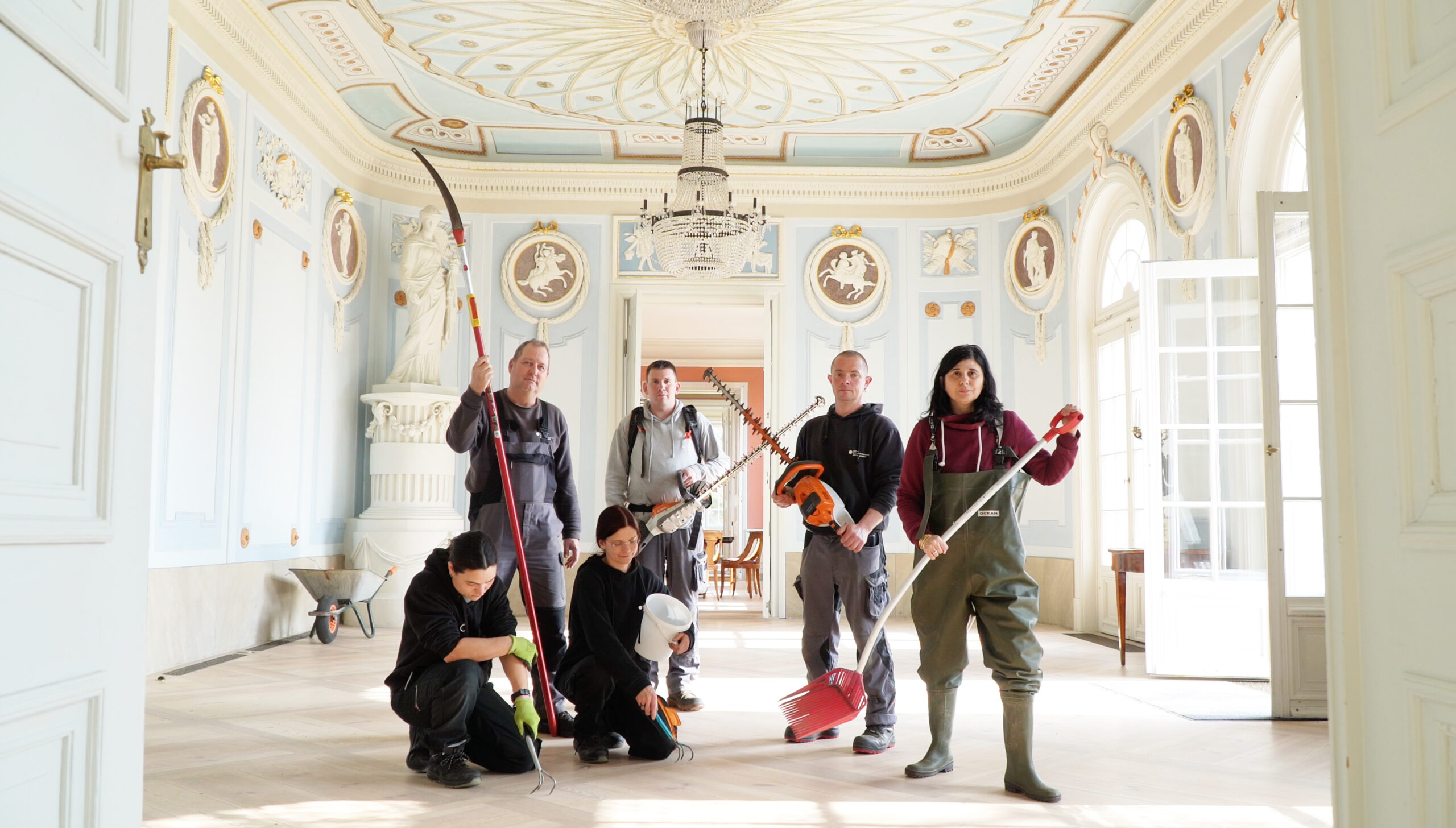
“Lustgarten” historically evokes gardens of entertainment, pleasure, and representation. I transformed it into “Luftgarten” through a play on words, because there was no real garden here, actually. Before performing the video work at Schloss Neuhardenberg, I did, just as in Ahlen, a one-day internship with the gardeners, working from early morning until afternoon. After that internship, I brought the garden into the palace by imagining it through the movements my body had recorded. There were no trees, no pond, no soil. But the bodies were still performing the same movements. These movements are so memorized, so internalized through years of repetition, that even without a real garden, the movements came out with the same rhythm and force as if they were tending a real garden. The gardeners were cultivating an invisible garden inside the palace hall. That really fascinated me. Here I am playing with the boundary between reality and representation. Because the movements are real, but the garden is not there. And yet the body continues to produce the same labor through the same movements.
In that sense, “Luftgarten” can be read as a kind of “air garden,” an abstract, intellectual, and imagistic garden. Almost like a thought bubble, a space whose existence is constructed in the mind. Could you elaborate a bit more on this performative garden? What kind of reality or unreality do you propose in it?
The gardeners perform the same movements every day, but here what they were doing turned into an invisible garden. Repeating the same labor without seeing the tree, without touching the soil, without seeing the pond was very striking to me.
On the other hand, by bringing the gardeners into the palace walls together with the garden, I also wanted to turn the idea of class upside down. Because throughout history, the palace was the space of representation and privilege; the gardener, by contrast, was the invisible labor of that representational order. I wanted to bring that invisible labor into the center of the palace.
There was another difference in this project: in Ahlen I had performed alone, but here at Schloss Neuhardenberg I worked with five different gardeners. So this was the first time the performance acquired a collective dimension.
Finally, you now know the palace and garden at Schloss Neuhardenberg through experience, and this process does not end here. You have a new performance in the same space, this time to be realized directly in the garden: “Gehend-Sehend” (Walking and Seeing). In the performances we have spoken about so far, the body’s relation to space and especially to work/practice spaces can be read as a process of entering a job, learning, and transforming. If we take that as a starting point, what is the body now seeking in this third performance in preparation, or in what direction is this line evolving? Do you think the body will proceed this time through an act of learning or an act of questioning? Would you like to talk about this new work?
In my new performance, Gehend-Sehend, I also refer to gardening labor and try to convey the landscape architecture of the English garden to the viewer.
On the one hand, I focus on the labor of the gardeners; on the other, I am interested in the conceptual structure and ideology behind the English garden.
By carrying three large golden frames into the park and temporarily placing them at different points, I create living scenes within the landscape. In one scene, I emphasize the representational side of the park and palace: at the place where I set up the first frame, I wear an elaborate white costume, swing on a swing, and drink tea, while the viewers can watch me inside this empty frame. This gives the park a completely different aesthetic and meaning, where the focus is entirely on representation, elegance, and display.
Then, with a second frame, I continue moving through the park together with the viewers. The performance again takes the form of a kind of parcours or guided walk. In the second framed scene, I am dressed as a gardener. Behind the frame, the viewers see a large mound of soil and me working in front of it. The landscape itself becomes invisible through this mound of soil; the viewer cannot see the park as a whole through the frame. I begin lifting the soil with a shovel. This makes physical labor visible not only through carrying the heavy frames through the park, but also through the bodily difficulty of moving soil.
From there I move to a third station. Here themes of sports culture, leisure, and health come to the fore. At the same time, I continue working with the landscape architecture of the English garden, especially with sightlines, perspectives, and carefully constructed viewpoints. I explore these ideas using elastic exercise bands; by stretching them across the space, I create visible lines and directions. By running with the bands and fixing them in place, I establish multiple linear connections that reveal the garden’s hidden axes and perspectives. Then I leave the third frame there as well, and all three frames remain as installations after the performances.
In the end, my aim is to activate the entire park for a few hours and enable viewers to experience it by walking and moving through it. During this excursion, the viewer experiences the park as a historical and social space layered with different narratives: the immense labor required to maintain it, its function as a space of representation and status, but also its role in leisure culture, physical activity, health, and public life.
Through acts of carrying, lifting, revealing, and following lines of sight, the performance makes these normally invisible structures and histories bodily perceptible.