
In her book Hope in the Dark: Untold Histories, Wild Possibilities, Rebecca Solnit states that during periods of crisis, people instinctively turn inward. She writes, “But people return to those selves, those ways of self-organizing, as if by instinct, when the situation demands it. Thus, a disaster is a lot like revolution when it comes to disruption and improvisation, to new roles and an unnerving or exhilarating sense that now anything is possible. This was a revolutionary vision of human nature and revelation that can pursue our ideals not out of diligence but because when they are realized, there is joy, and joy is itself an insurrectionary force against the dreariness and dullness and isolation of everyday life.”
Looking at today’s world, we can see that this very feeling awakens the need for collective movement. While Solnit speaks of this phenomenon primarily in relation to activism, explaining how solidarity increases during times of societal disaster, we are currently witnessing a similar condition emerging through a profound inward turn within the spiritual realm—particularly in art.
The era we are living through—and one in which humanity continues to endure devastating consequences—is referred to in Indian mythology as the Kali Yuga. In Hindu cosmology, the Kali Yuga is the fourth and darkest age of cyclical time, lasting 432,000 years and characterized by ignorance, moral decay, materialism, and conflict. Believed to have begun in 3102 BCE with Krishna’s departure from the world, this “Age of Darkness” is considered a period in which human virtues diminish to their lowest point, and truth and compassion decline.
In such dark periods, we once again witness people turning inward and returning to the self, often through artistic expression. The need for spirituality, introspection, and renewal is now stronger than ever, as reflected in numerous exhibitions taking place worldwide. Many contemporary artists are also producing works that foreground spirituality more directly.
The Venice Biennale and Returning to the Self in a Fragmented World
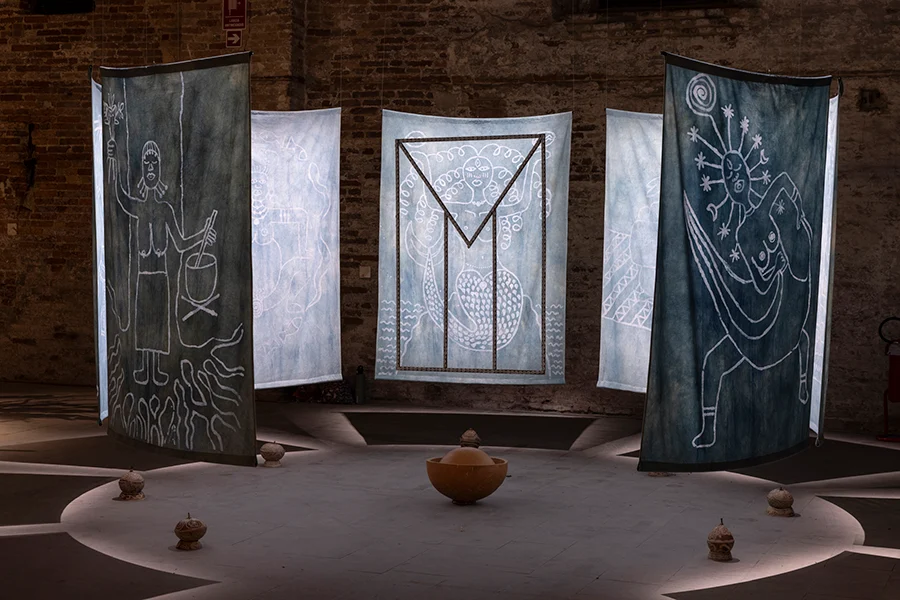
A significant example of this shift is the 61st Venice Biennale. The exhibition focuses heavily on themes of intimacy, introspection, and spirituality. Featuring 110 participants, the biennale offers a slower-paced experience that emphasizes listening, ritual, and emotional resonance rather than mere spectacle. The curation highlights artists working with “ritual-inspired forms of expression,” creating a “meditative procession” for viewers while focusing on quieter, more personal, and deeply affecting works instead of loud, monumental installations.
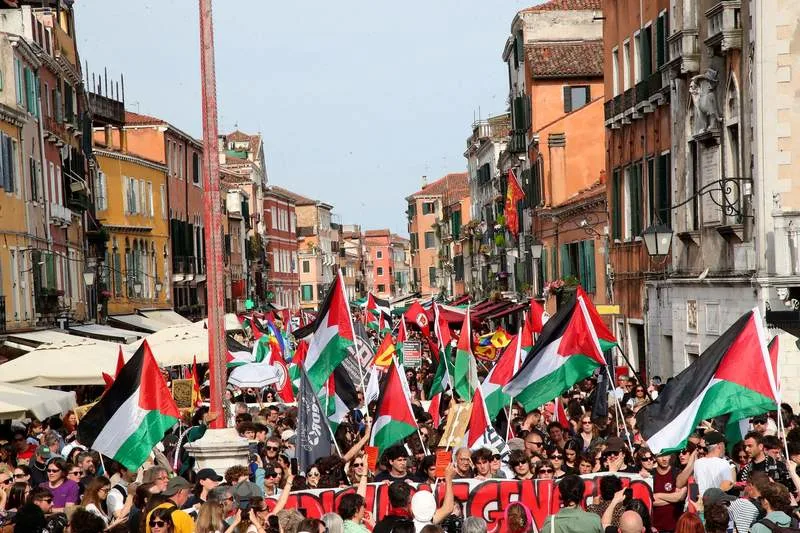
In many ways, the biennale emphasizes “a living collectivity born from togetherness,” bringing together artists whose practices directly engage with social life and who use art as a means of reconnection within a fragmented world. Curator Koyo Kouoh aims to “listen closely to whispers,” foregrounding artworks capable of creating profound effects on the soul and mind. As these works come together to form a collective perspective, they attempt to show how art—and artistic ways of seeing—might help us emerge from these dark times, or at least transform them through perception.
Yet, one crucial point must be remembered: spirituality does not mean living in a world adorned entirely with wonders. On the contrary, it requires confronting immense shadows, awakening, and carrying a great burden. From this perspective, the protests that took place during the biennale can also be understood as part of the need to unravel these dark times. During these demonstrations, certain national pavilions were targeted over war and occupation policies, as artist groups and activists issued statements questioning the biennale’s claim of being a “neutral cultural space.” Here, we return once again to Solnit’s arguments in Hope in the Dark: In difficult times, people unite in an effort to build a better world. The biennale simply opens a space, reflecting society’s transformation and ongoing change.
Spiritual Awakening Through Exhibitions
The current landscape of 2026 shows that museums are embracing this shift toward collective healing and alternative fields of consciousness through diverse curatorial approaches.
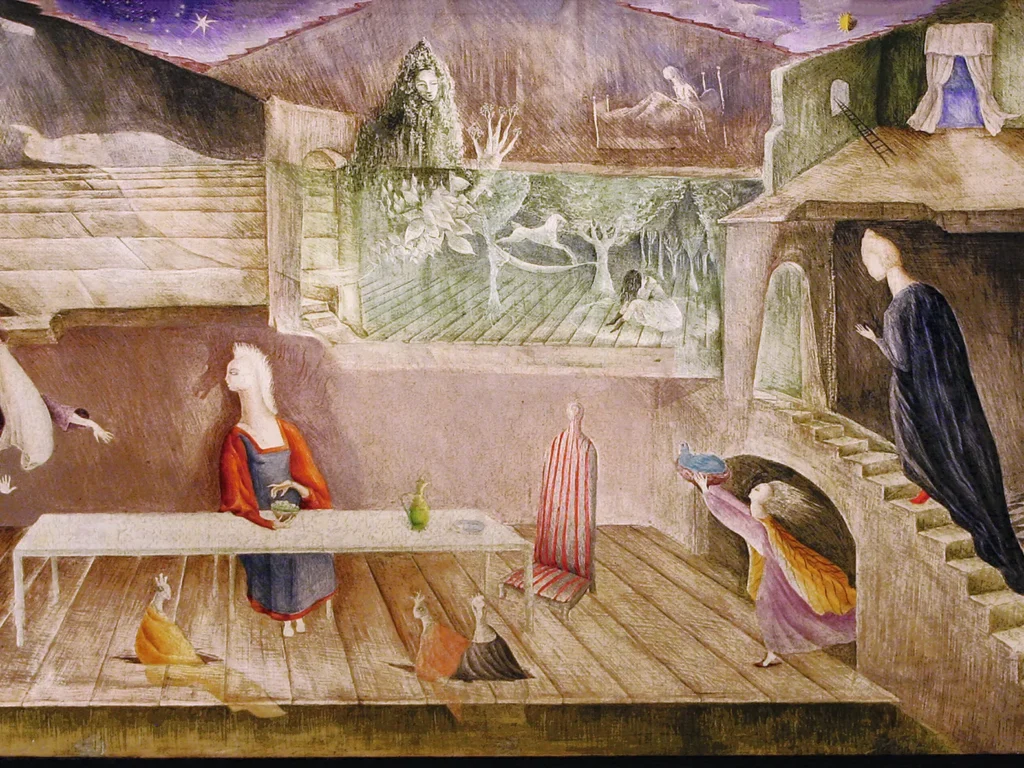
For example, the Leonora Carrington Exhibition at Musée du Luxembourg highlights the artist’s deep engagement with spiritualism, esotericism, and occultism. As the first major exhibition in France dedicated to Carrington, the show brings together 126 works—including paintings, sculptures, and drawings—examining her creation of a mystical, feminine, and fantastical universe. The exhibition reveals her relationship with magic, alchemy, and esoteric literature, while exploring her lifelong fascination with mysticism, Irish and Celtic folklore, and the occult.
Meanwhile, Metamorphoses at the Rijksmuseum approaches transformation not simply as a mythological theme, but as a spiritual movement of existence itself. Works by artists such as Caravaggio, René Magritte, and Louise Bourgeois reveal the permeability between the human and the divine through the lens of metamorphosis. Auguste Rodin’s sculpture Pygmalion and Galatea, alongside Jean-Léon Gérôme’s interpretation of the same myth, invites viewers to think of transformation as a moment of animation—a threshold where matter comes into contact with spirit. In this sense, the exhibition creates a space not just for the alteration of form, but for inner transformation and a kind of spiritual awakening.
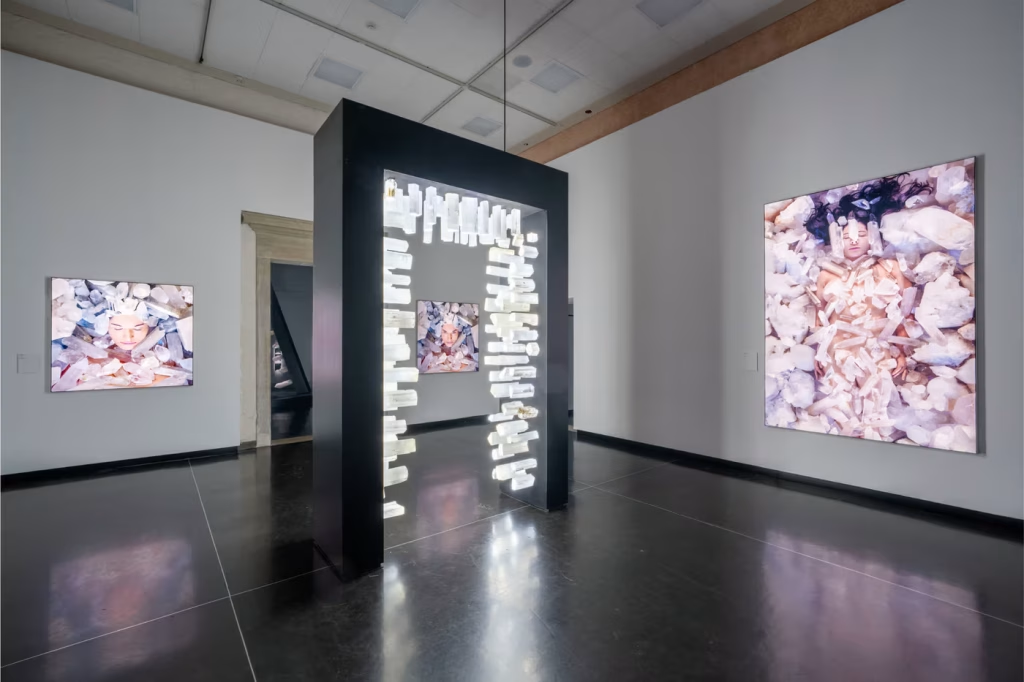
Transforming Energy, taking place at the Gallerie dell’Accademia, features Marina Abramović, who has long been known for her interest in spirituality and mysticism. Particularly fascinated by the subject of death, Abramović’s exhibition revolves around crystals, bodily rituals, and the concept of “energy transformation.” The showcase invites viewers into a meditative experience, encouraging a much-needed technological detox.
The Magical Women at the Draiflessen Collection explores the intersection of art, magic, and feminist perspectives. Bringing together works from the 20th and 21st centuries, the exhibition reconsiders the occult, spiritual practices, and traditional figures such as witches and seers. Featuring 13 international artists, it demonstrates how magic can function as a tool for empowerment and social critique, examining how artists employ these themes to question gender-based power structures, social norms, and patriarchal systems.
Finally, the Mark Rothko Retrospective in Florence centers on the meditative and almost religious silence present within his paintings. The exhibition foregrounds the artist’s search for inner darkness, contemplation, and spiritual intensity.
Through all these exhibitions, the spiritual realm emerges as a form of collective consciousness. Artistic production has never served a singular, rigid purpose. Contrary to common belief, art moves beyond the artist’s own cognitive field and is reborn within a spiritual space through the raw energy of creativity.
Examining these mythological rituals through Joseph Campbell’s book Pathways to Bliss, the message he conveys acquires renewed meaning. Humanity is always in search of profound significance, and periods of destruction, rebirth, and reconstruction inevitably bring forth new rituals and forms of togetherness within society. Contemporary artistic production—and the forms of creation that draw the viewer into this process—once again tells us the timeless story of returning inward.