
Your exhibition title, I’m Feeling Lucky, reframes luck not as coincidence but as a result of continuity and labor. Can you talk about a moment in your career that felt like luck, but was actually the result of years of work?
While I was preparing the show, I was thinking about titles. Then the Google button came to my head — “I’m Feeling Lucky.” I looked it up. That button costs Google millions of dollars in ad sales because, normally, whoever pays the most gets the top link. But when you hit “I’m Feeling Lucky,” it takes you to a random result. The only reason they’ve kept it is tradition. In a world where nothing has the right to exist unless it’s making a profit, it’s just a nice little gimmick. They still have it for the sake of having it.
That idea of luck as a gimmick — something that looks like chance but is actually just tradition, habit, a button that’s still there because no one bothered to remove it — felt right for the show. Luck is one of those things people talk about as if it appears out of nowhere. But I don’t really believe that.
I do feel lucky a lot. But the more chances you take, the more you try, and the more consistently you keep going, the better your chances become. So what looks like luck is often just the result of repetition and persistence.
Think of it like statistics. If you make ten paintings and one works, nine don’t. But if you make twenty, two work. The number of failures goes up, but so does the number of wins. Michael Jordan has the most missed free throws in basketball history — because he threw more than anyone else. So the more you try, the luckier you get.
You describe this exhibition as an “artist’s diary” shaped around curiosity, repetition, and continuity. What have the last few years looked like in that diary?
It’s been a process of trying things, failing, and then trying again. I think that’s really what the diary is. It’s not a straight line at all. It’s more like banging into walls, changing direction, and slowly finding your way. The process itself keeps you going, though. A painting can take me a year to make, and then I’ll hate it. And only after that, I’ll do something in two days and love it. But if I hadn’t made that painting for a year, I wouldn’t have made the two-day one. So even the failures are load-bearing. That’s what the diary really is — not the finished work, but everything that made it possible.
For a long time, I was working mostly with minimal and geometric forms. That came partly from where I was born and raised, and from the visual culture around me. But over time, I started moving toward more figurative, more pop-driven imagery. It wasn’t a sudden shift. It came from collecting things, sketching, keeping random images around me, and slowly realizing that they belonged in the work.
I have a studio in Kadıköy, and last year I turned the street-facing window into a display area. I started placing paintings there, then making installations around them, painting the walls, releasing prints, and organizing openings around each presentation.
That changed the relationship between the work and the audience. It became less sterile than the white cube; not a very welcoming place for an everyday person. It wasn’t just about collectors or people buying objects for their homes. Friends could engage with the work, and the whole thing felt more shared. The prints became almost like memorabilia from an experience rather than standalone art objects. That wasn’t really the goal at first, but once I saw it happening, it made sense. The prints are still the work, but the whole idea, the experience of visiting a “display opening,” is the main event, and the prints are what you get to keep as a memory of that experience.
Your work feeds on popular culture, media, and graphic design, putting familiar images back into circulation. How do you decide which images to pull in and which to leave out?
It’s intuitive. For a really long time, I did mostly minimal and geometric works. I think that comes intuitively from being born and raised here. Turkey is a modern country with Islamic roots from the Ottoman Empire, where figural representation was forbidden for a long time. So the majority of the visual heritage consists of geometric patterns and ornaments rather than figures or representations.
So I was doing geometry and minimal art for a long time. But in my sketchbooks, in my studio, at my home, there were always things I kept. Sometimes things would strike me visually — anything from a sign to packaging to a game card, a wrapper of a chocolate bar. It was never like “I’m going to paint this”. It was more like “this is interesting, I’ll keep it around”.
Slowly, they made their way into the work. And although painting consumer goods might bring to mind other references from art history, I think these things mean something completely different to us now in 2026 than they did 60 years ago. Take the Campbell’s soup can; It’s originally not an artwork, but it shaped an entire moment in art history. The object has so much more meaning without the intention of how it was created by an artist. It’s a powerful object now, in the hands of the artist. However, I think Warhol used the soup can very deliberately to comment on the consumer culture. I would say that we have a very different relationship with consumer objects in today’s world than in Warhol’s time. The consumer goods in the show are mass-produced, stripped of meaning besides their commercial value, and exist because of their profit margins. But they are also things of sentimental value for me, which is why they made it into my work in the first place.
I also like to hide easter eggs inside the show. I usually don’t point them out unless someone spots them and asks me about them, but since we’re on the subject, I’ll give an example. The Savarin Coffee jar stuffed with brushes in one of the paintings looks like an ordinary studio object. It’s actually a representation of a bronze sculpture by Jasper Johns, depicting brushes in a coffee jar. It looks mundane. It’s one of the most celebrated sculptures in American art. That kind of layering, where something familiar turns out to carry a whole other meaning underneath, is exactly what I’m after. And this instinct — accumulating images, layering meanings — isn’t unique to me. It’s how visual culture works.
If I have a hundred of these, maybe five make the cut. That’s all based on intuition. If something is strong enough, it makes its way into the work. If it doesn’t, it doesn’t.
On the glove and invisible labor
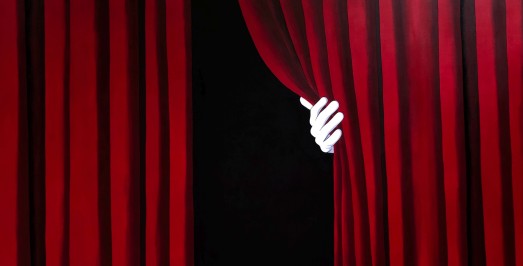
The white glove points to invisible labor in art production and circulation. Is the glove protecting the artwork, or protecting the artist?
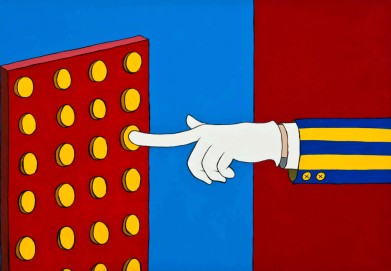
I think it’s both. The first piece I made with the glove didn’t have anything to do with art handling, actually. It was an elevator painting with all these buttons, and a white-gloved hand pressing one button. I called it “The Hardest Button to Button.” Back then, it was more about mystery than the art world.
But the glove itself carries so much. We’re all familiar with white gloves from cartoons. At the same time, when you see a white glove, you don’t know who the person is. No fingerprints. No sex. No race. No intentions. There’s also this idea of an invisible hand — something that lets destiny unfold, that makes things happen.
So is it protecting the artwork? Yes. Is it protecting the artist? Also yes. But more than that, it points to the work that happens around art. It makes labor visible. There’s something anonymous about it, and something theatrical. But for me, it was never really about the art world. It was always more about the mystery.
The glove is simultaneously anonymous and visible, protective, distant, and sometimes theatrical. Do you see yourself in that duality?
Yes, definitely. That duality is everywhere in my work. The tension between being present and being removed. Between being part of something and standing slightly outside it.
I think the glove became such a strong image for me because it captures exactly that. Even the moment it came to me — when I was putting on those gloves as an art handler — something just clicked. The image was so vivid. And looking back, the cartoon association was probably the main thing, even unconsciously.
That same duality shows up in how I work with images. I take things that are very recognizable, even familiar, and place them in a way that makes them feel a little strange. It’s the same logic. You recognize the glove. You recognize the cartoon. But then you start asking questions. Who is behind it? What are they protecting? What are they hiding? That space between knowing and not knowing — that’s where the work lives.
Beyond the motif, how did working as an art handler shape your understanding of what it means to be an artist — especially handling other artists’ work?
When I first started working at PS1, Mike Kelley had this big retrospective, and it completely changed my mind about what an art show could be. It was one of the things that first drew me seriously into art. It was almost like a carnival — so many interesting things everywhere, just for you to look at and experience. Not to buy. Not to take photos. Not to profit. Just for you to be there and be like: “Whoa, what’s going on?”.
That experience stayed with me. All the artists I admire are bigger than painters or sculptors. They’re almost like directors or architects. They have something in their mind, and it turns into an organism rather than just something you put on the wall.
I call myself a painter, but every time I say that, I feel like I’m not really being honest. Being a painter is more like a skill. Being an artist is more like being on a mission. Like you have a thing you’re after. Your call to an adventure.
On sculpture and materials
How does the viewer’s experience change when your work moves off the wall and into physical space?
I started doing these sculptural paintings — canvases stretching out into the viewer. Shapes that first started with one thing and then turned into many different things, like a ghost, like a bee. It displays the same idea but more conceptually, grabbing people’s attention.
The challenge is grabbing someone’s attention who wants nothing to do with what you’re offering. Making it interesting enough for people to question, “What is this?” Taking them out of autopilot mode. Even if they hate it, I just want them to pause.
What I try to do with the studio display is get the attention of anyone and everyone — usually people who want nothing to do with art. The first time I did it, after the opening, I went back at 4 or 5 in the morning. Three guys who had nothing to do with art were discussing what the piece was in my studio window. Not an ad, not a shop. Just thinking about what’s going on. I almost cried. That’s when I realized — if I can attract people who have nothing to do with art, and get them curious enough to stop and question the work, then I’m doing something right.
Your work emphasizes tactile, material experience. Is that a conscious move toward the analogue?
When I was a kid, if I found a song I was looking for, I downloaded it, put it on my MP3 player, or made a CD — it meant something because there was effort in it. Now I have access to everything, and it means so little. The algorithm decides what I’m listening to, so I don’t even know what I want anymore. And the smallest inconvenience feels like a hassle because I have to be comfortable at all times. That’s what digital does — it makes everything too safe, too bland.
If a DJ carries tens of kilos of records to a gig, they deserve it more than someone with a USB in their pocket. The sacrifice matters. That same logic applies to the art.
You’ve quoted Warhol and talked about saying old things in new ways. How does reinvention function in your practice?
Andy Warhol said art is what you can’t get away with. What I like about art is that you can constantly reinvent what it means to you.
Living in a world that changes every six months, the way you react is inevitably new. Even if you say something exactly the way it was said a hundred years ago, it carries a different meaning now. It becomes a new thing on its own.
On Turkish identity and pop culture
Your college profile notes a “bold awareness of Turkish identity and American pop culture.” How does that dual awareness show up specifically in this exhibition?
Once you’re exposed to a completely different culture at a young age, it’s so hard to feel like you belong anywhere specific. That feeling of not fully belonging anywhere is exactly what shows up in the images I choose.
I think it’s a blend. Sometimes it’s something very local, like a Turkish coffee brand, and sometimes it’s something that belongs to global visual memory, as a Campbell’s soup can. I like that collision. It creates a tension between familiarity and strangeness, and that tension is part of what makes the work feel alive.
Many of the paintings in this show reach back that far. When I was eleven, my mom took me to New York for the first time. Then I moved and lived there for 6 years. I felt way more at home in New York than I ever have in Istanbul.
Some of what I’m doing now is a statement, maybe just for myself: I was there, and it was real. It wasn’t a dream. It’s part of my reality, and I want to hold onto that.
At the same time, the Turkish side is there. The ornaments. The Mehmet Efendi coffee. The geometric patterns. Even the glove carries something from here. There’s a Turkish idea — the invisible hand. Something that lets destiny unfold, that makes things happen behind the scenes.
It’s like a fingerprint. No two people are born the same. An artist is inevitably different from any other artist.
What are you working on after this show?
Music is such a big part of my life. I want to blend it into my art practice as well. Music is way more in the moment, more honest. Even if you’re preparing something, you’re doing it in real time.
I also want to push the idea of showing, exhibiting, and hosting happenings at my studio. Turn exhibitions into more like experiences. Almost like rides.
You know those haunted houses you walk through? You enter here, exit there, and it’s a whole experience. When you’re in a gallery, it’s so safe. White walls, white ceilings, paintings on the wall. I want to challenge that.
Bruce Nauman had this piece — a really skinny corridor you can walk into, but it’s so tight that only 1 person can fit at a time. At the end, a screen. You get closer to seeing what’s on it, and you realize it’s you. The camera is watching you. It puts you in this weird hyperaware mode. I thought that was really cool.
There’s a quote I keep coming back to: “think mystery, not mastery”. I can never make paintings as realistic as AI, or as technically refined as someone who spent their whole life on that. But I can create situations where people feel something — where I draw their attention to a tiny detail, and they think, oh, I never considered that before. Or where they find themselves in an experience they wouldn’t have had anywhere else. That’s the mission. Not the perfect painting. Getting the message across.
The gallery’s perspective reflects the same duality. İrem İmre, Associate Director of Anna Laudel, adds: “The exhibition title ‘I’m Feeling Lucky’ is playful, but the work is technically rigorous. The works are undoubtedly the result of meticulous craftsmanship. Oğulcan’s aesthetic language is always refined and precise. The contemporary painting scene in Turkey is highly rich and multi-layered. Within this broad landscape, Oğulcan Kuş is one of the representatives of the younger generation, drawing from neo-pop aesthetics and blending them with his own visual language.”
I’m Feeling Lucky is on view at Anna Laudel through May 31, 2026.