




A phrase that evokes both hope and fear, and that has turned into the slogan of a generation, now seems to have descended upon us like a prophecy fulfilled. The pressure of irreversible transformations makes the need for a collective mourning increasingly visible. One reason for this is that we almost always remember the past as a “lost paradise.” Yet, even if we long for it, it is in fact possible to approach the past more soberly. At this point, two fundamental states of mind bring forth the following tension within us: either we idealize the past and become trapped in a pathological nostalgia, or we try to move forward by accepting loss and transformation, mourning without romanticizing what has been.
The idealization of the past—or, in a more fashionable term, pathological nostalgia—also carries the risk of turning into a collective myth. When we say, with longing, “It used to be like this, our generation was different, we lived through a golden age,” we often fail to notice that we remember the past selectively; that we erase negative experiences, inequalities, and violence. In other words, we escape from the problems of the present and create an imagined “sterile lost paradise.” In doing so, we draw on memories, objects, emotions, and images that we try, with all our might, to bring back so that they do not remain merely imaginary—but it does not work. Even if it looks similar, what we eat, the object we hold, the landscape we see is no longer the same.
The most visible arena in which all this manifests today is in interventions carried out under the heading of the restoration of artworks. We are constantly confronted with the “enhancement,” colorization, and sharpening of old photographs, or with the transformation of artworks and historical buildings under the name of restoration. Every day, on social media, we encounter applications that animate old photographs using artificial intelligence, clearing faces and removing blemishes as they are marketed. In a sense, they erase the traces of time and promise to bring the past back flawlessly; yet they do so at the cost of erasing lived experience.
The Desire to Improve


Moreover, we are not only speaking of architecture, art, or photography. If you consider how, on the streets or in the media, we encounter people whose appearances are increasingly similar, it becomes clear that this desire for “improvement” has also enveloped our bodies. People attempt to erase the traces of time on their own bodies as well, striving—as if it were possible—to perfectly restore the past. It is undeniable that we have been seized by a frenzy of “improvement” and “reconstruction.” At what cost? That is, of course, another question. Here, it is impossible not to recall the film The Substance, written and directed by Coralie Fargeat and released in Turkey under the title Cevher, which has been nominated for numerous awards; the film stages precisely the dark side of this obsession with bodily reconstruction.
Yet art, at times, emphasizes wear and tear and, far from avoiding it, confronts us directly with loss. It does not aim for the overly bright colors, non-existent embellishments, and smoothness often seen in historical restorations. What is produced here is not so much a re-presentation of an artwork as the construction of a touristic décor consumed as an aesthetic backdrop. When carried out without question, the “animation” of old photographs and the “excessive” restoration of historical works serve this sense of pathological nostalgia; they attempt to conceal loss, fragility, trauma, and every historical trace, producing an easy, seamless fantasy of the past. Perhaps this is precisely why a critical approach to art is so valuable: because it can reverse all of this and open up space for such discussions in our minds.
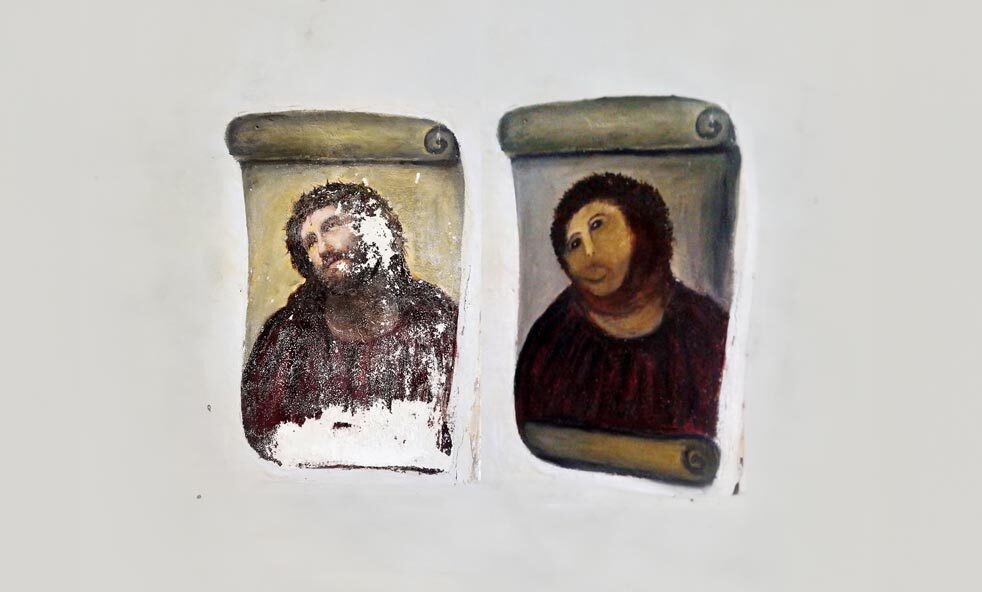
For instance, German painter Gerhard Richter—considered one of the greatest living painters, even referred to as the Picasso of the 21st century—deliberately leaves faces blurred when translating photographs into painting. The relationship between photography and painting is not used to render the past in high definition, but rather to make its uncertainty even more visible. The artist embraces the “poor quality” of the (former) photograph not as a flaw, but perhaps as an ethical position. Contemporary restorations, however, do the exact opposite: “What is damaged is unacceptable; let us erase it, correct it.” The emblematic example of this is the Ecce Homo (“Behold the Man”) fresco by Elías García Martínez, located in the Sanctuary of Mercy Church in Spain. Though artistically insignificant, it became famous after being “restored” in 2012 by amateur painter Cecilia Giménez, who passed away at the age of 94 in recent months; the intervention, which caused an international sensation, transformed it into “Ecce Mono” (“Behold the Monkey,” a hybrid of Latin and Spanish). Ironically, no further intervention was made to the work, and in this state it has become an educational and tourist attraction generating significant revenue for both its restorers and administrators.
Pathological Nostalgia
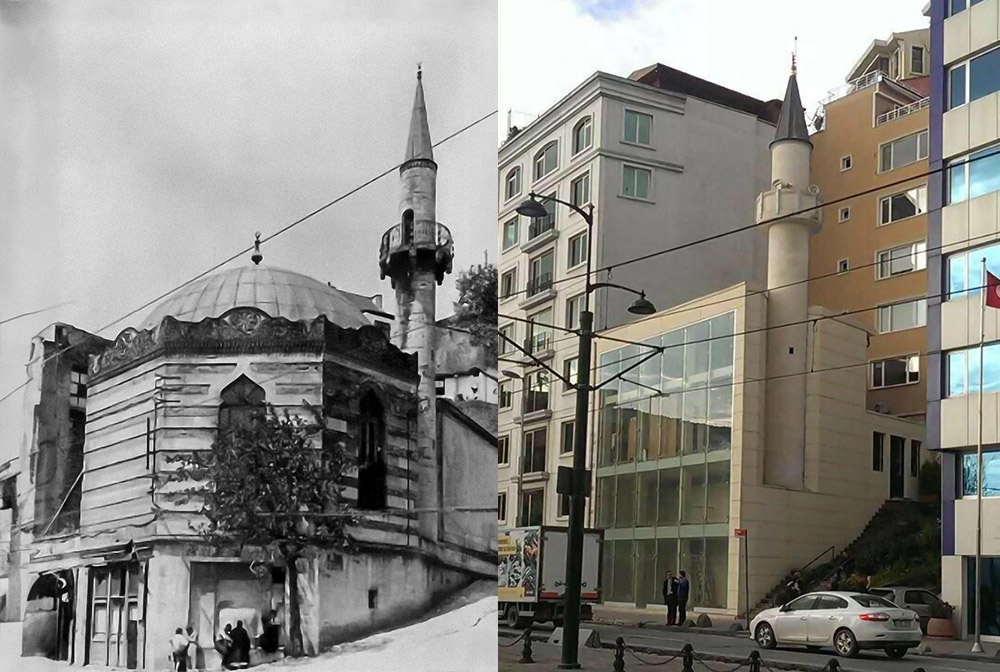
Returning to where we began, as a final remark I can say the following through examples from our own country: in the first quarter of this century, it is possible to read the restoration approach of a government engaged in never-ending “revival of the regime” projects through the restorations applied to historical monuments. The addition of what is almost an illegal extra structure to the Sümela Monastery; the “restoration” of Mimar Sinan’s Süheyl Bey Mosque in Fındıklı—partially demolished in the 1950s due to road construction—into a form “suitable for shopping”; and the renovation disasters made visible through especially the additions resembling a “tourist gate” at sites such as the Valide-i Atik Complex, the Septimius Severus Bridge, the Temple of Apollo, the Arapgir Suceyin Stone Bridge, and most recently the Hagia Sophia Mosque are among the first examples that come to mind.
If we extract the “longing for the past” from pathological nostalgia, what remains is only the pathological. The sentence “Nothing will ever be the same again,” although it shifts depending on context, always carries a sense of tension; containing both hope and fear, it becomes a point where threat and promise meet within the same phrase. In truth, it is impossible for anything to be as it once was; yet decorative restoration continues to lie to us by saying, “Look, it has become even better than before.” It is, of course, no coincidence that this slogan emerged in the course of resistance to efforts to revive the Topçu Barracks.