

Has your relationship with life changed after moving away from Istanbul? What has Çeşme brought you?
We parted from Istanbul lovingly. So, after more than thirty years, a sense of calm has been good for me. The time I can devote to myself has increased; this has also had an impact on the other things I do.
Do you think living in Istanbul keeps a person in a constant state of tension?
I guess the moment you step out of your home in Istanbul, you enter a kind of battle. I think that’s quite contrary to life. There are so many variables… If I were thirty, if I had different ambitions, we’d be talking about different things. Right now I’m in a more relaxed place. Perhaps also because I feel I’ve completed certain things.
How has this state of calm affected your production?
The time I can devote to myself has increased. That, in turn, has affected my other work as well. Television is a demanding job, but now I even go to it more enjoyably. I don’t drag my feet going to work anymore.
We know you from television, but in this exhibition you appear as a conceptual artist. How did this transition happen? What kind of thinking lay behind this process?
It’s actually like this… There may be an issue on the side of those who think this way: “This man has been on television for years, how can he do this?” There’s a problem in that line of thinking. Because anyone can have anything within them; it may simply not have emerged yet, or may not have appeared due to propriety. In my case, popularity was an important factor. Being both popular, working in television, and engaging in art made me feel as if I were using my popularity. That’s why I always kept my distance. Only after television ended, and I took a six- or seven-year break, did I turn to these works. And this is not even my first exhibition.
Did you create this distance consciously?
Yes. For instance, I didn’t even attend the Filenin Sultanları exhibition we did with Vestel. I didn’t go to the opening of my own exhibition. I didn’t want to appear as if I had descended from above. With so many artists in this country who have worked for years, I didn’t want to be perceived as someone coming from television. Now, the work at İGA Istanbul Airport is very valuable to me—and to them as well. It has become an occupation I will continue.
Do you think it’s possible to turn your popularity into an advantage at this point?
Definitely. But if I had done it back then, the work might have dissolved into other kinds of conversations. Half of what I did could have been lost. I studied Fine Arts; my family is involved in art; my circle is as well. But at that time, I would have had to explain myself. Now I didn’t have to explain much.
Do you feel you are at the right point in terms of timing?
Yes. Timing is very important. Now I’m in a calmer place, more at ease. I believe I’ve completed certain things. This state has also reflected in the sincerity of the work.
Is it a risk to exhibit your works in such a crowded, public space? Could it overshadow the value of the art? Did you have such concerns?
Let me give you a stranger answer: I wasn’t worried because it’s international departures.
What do you attribute the strong harmony between the works and this space to?
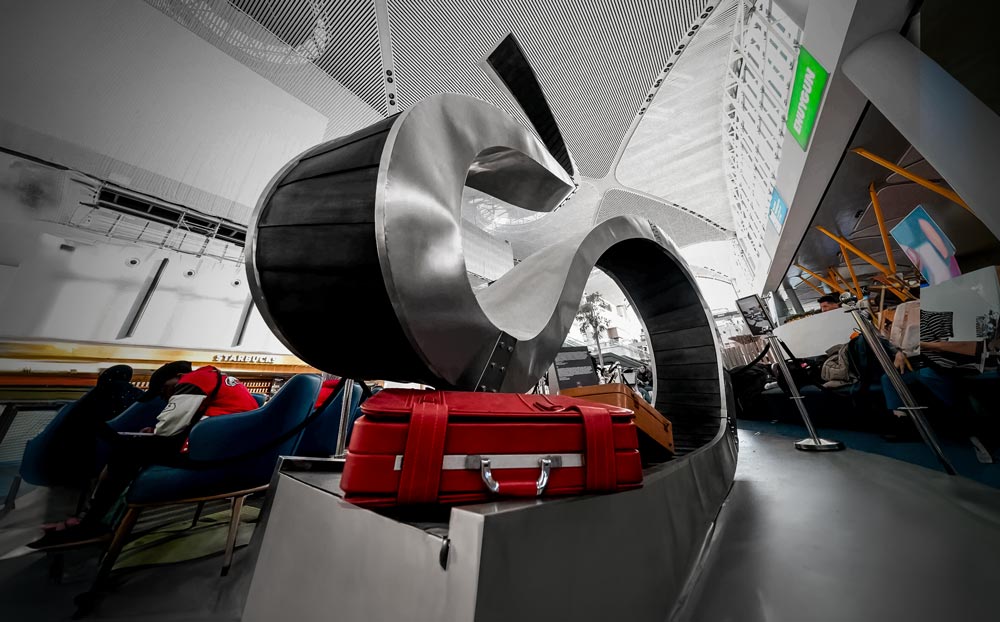
This work is made from the material of the airport itself; it tells the story of that material. One side is like a sculpture, the other like an installation. Because it is so closely tied to the airport itself, it didn’t feel out of place. Instead of people leaving their homes to go to a gallery, encountering something that belongs to that space within the airport—where they already are—was something I liked. So I think it found its place.
How did the idea of the conveyor come about?
One of the aims of the sculpture was this: I broke the conveyor. But while doing so, I initially imagined placing many suitcases on it and releasing them upward, toward the top of the airport, into freedom. Then I gave up. I said, let me place just one or two suitcases. The place where we positioned the sculpture is one where people rest, sleep, lie down, sit—throughout the night. Now I receive photos: people place their own bags, packages, suitcases onto the conveyor. In fact, the work turns into a different sculpture every day, taking on a new color. It became something reciprocal. A work that both sides—the passengers and myself—feel a sense of belonging to. At least, that’s how I feel.
So the work has an interactive dimension as well.
Yes. A space has formed where people are involved.
By the way, we also learn the word “conveyor” from you.
If I’ve had the chance to introduce anything in life, it turns out it’s the conveyor. It seems that was its fate.
The Single Suitcase, Forgetting, and the Emotional Life of Objects
The image of a single, abandoned suitcase is very powerful. Where did this idea come from for you?
This is actually something that has always occupied my mind, but its roots go back to my childhood. There was a house in our neighborhood that was being repossessed; belongings were being sold off. We were about ten years old at the time, and we were happy, saying, “It sold for a high price.” But those were actually their own belongings being sold. In the 1980s, a television set would be sold, and we’d say, “It went for so much.” I began to wonder where those objects went. Since then, the idea of the story of objects has stayed with me.
Let me put it in a more arabesque way: objects have souls too. They represent so many things—experiences, things you’ve touched, lived with. The story of being forgotten is also part of this.
Is the airport a particularly strong metaphor in this sense?
Yes, because an airport is a place where people from all over the world come. There are matches, stadiums, and concert venues—but those are usually attended by people from a particular place. An airport is not like that. Especially İGA Istanbul Airport.
It’s a place where a baby bottle from a woman from Ecuador can stand next to the shoes of a Japanese engineer. When I entered the storage area, there was already a sculpture there. What I did carried the risk of disrupting that structure.
What did you feel when you saw the storage?
When I entered, I said: I don’t need to do anything—this space has already produced a sculpture and a feeling on its own. It would be a shame to disrupt it. But then I thought: these objects shouldn’t remain lost.
The place where they are first lost is the conveyor. I said, if I disrupt the conveyor, I disrupt the order as well. The conveyor was such a perfect fit… a structure that turns around itself, connected to nothing. Like a cliché of everyday life.
“A carousel also turns, but at least there is some joy.” The conveyor doesn’t even have that. It’s metal, plastic—something uninviting. Making it inviting is an emotional matter.
Was transforming metal into such a soft form a conscious choice?
Yes. I wanted to soften a hard material. I tried to bring it close to an “S” shape. Softening the metal, softening that tension, is itself an emotional act.
How did the idea of movement develop?
While thinking about the form, I said it should move toward somewhere, break—but what kind of movement should it have? It had to be a movement connected to the airport. We watched footage from the overhead camera at the airport. When we sped up the images fifty or a hundred times, people disappeared and only linear movements remained.
The Storage, Suitcases, and the Stories of Objects
What kind of process did you follow when working with the objects in storage? Were the suitcases opened?
We did open the suitcases, but only to check if there were any colorful objects or elements we could use. We didn’t use clothes. The suitcases are already opened and inspected by the airport. Our work was not about their interiors, but about their exteriors and what they convey.
When you walk through the storage, you see it already—books, open notebooks, umbrellas, jewelry… an incredible accumulation. There’s a remarkable order. And you can’t use objects from every period; at least three years must have passed before something can be taken.
Could you take whatever you wanted from the storage?
We were told there were specific timeframes; only items that had passed their legal holding period could be used. So we couldn’t take everything we wanted. It wasn’t unlimited.
What affected you the most in the storage?
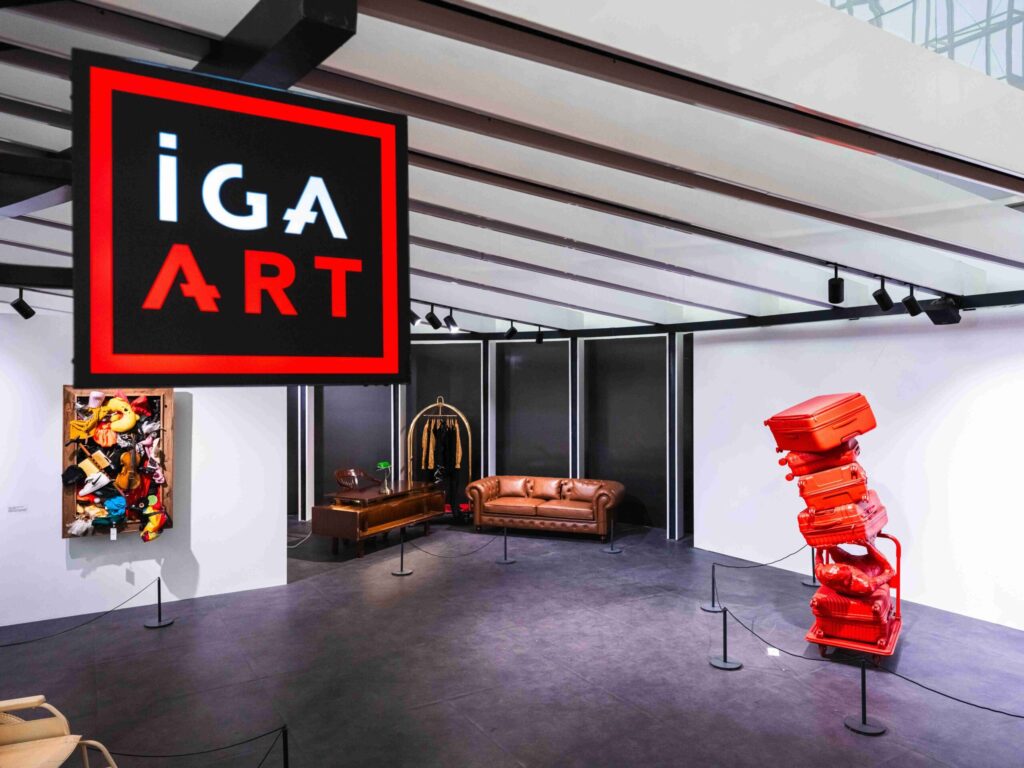
There was a note written by a girl to her father, for instance. It began, “By the time you read this, I will have been accepted to university.” There was also a sketchbook belonging to a painter; I used it in the work Departure Suitcase / Return Suitcase, placed right under the violin. I’m not sure if it’s still there, because the works are touchable.
Why isn’t there a “do not touch” warning?
So that if the owner comes, they can take it. In a way, it’s a public service.
Would you like this work to expand into a series?
Of course, of course.
Is producing a touchable work in a public space a risk?
Our people are curious; they like to tinker with things. But since it’s an interactive work and in a public space, we took that risk. It could break, it could be damaged—all of these were possibilities.
Was the exhibition planned from the beginning, or did it develop over time?
My main work was actually the large sculpture outside of İGA Istanbul Airport. The exhibition inside emerged from not wanting to abandon the objects and wanting to share them as well.
The Private Life of Objects, Humor, and the Trace of Television
One of the works was initially titled “Magazine,” later changed to “The Private Life of Objects.” How did this idea emerge?
When I graduated from fine arts, my mind didn’t work like this yet. Television and life took me somewhere else. When I began to think about what I would do, fifty thousand ideas came out. I surprised myself. For twenty-five years, every week on Beyaz Show, I tested myself in front of people. I tried to do something different each week. That constant “doing something different” kept the mind working. When I turned to sculpture, my mind immediately shifted in that direction. But what happened? My character and temperament are reflected in the work. Something slightly humorous emerged. And I say this because humor is also a form of emotion—I wasn’t trying to make something funny.
Can you elaborate on “The Private Life of Objects”?
Inside, there is a pile of objects that slightly resembles a human figure. It holds a remote control, and in front of it are items spilling out of a suitcase… and a television. What do we do in daily life? We are curious about everything and everyone. We watch tabloid shows, series, and news. Here, objects are curious about other objects. What they watch is an X-ray device. So objects, too, have a kind of voyeurism.
The works “Departure Suitcase” and “Return Suitcase” carry strong metaphors.
The departure suitcase is almost diagrammatic. The place of the shoe, the watch, and the ear is fixed. The return suitcase is chaotic, on the verge of bursting. You can call it love, or something else. The order you enter with is not the same as the order you leave with. There’s also a wheelchair—only footsteps are placed. Because if someone forgets their wheelchair, there must be a reason. Perhaps they walked away.
Seeing the Beyaz Show chair at the end of the exhibition is also a surprise for viewers.
Yes. I placed the chair used for twenty-five years. Behind it, I installed videos of world-famous guests. But in this exhibition, it’s not the guests being honored—it’s the chair. I wanted to honor objects. We placed the most elegant, glittering items from the storage on top of the chair.
The idea of objects also plays a strong role in Orhan Pamuk’s writing. How do you relate to this?
There’s a film that influenced me deeply—The Violin. It tells the story of a violin traveling through time from the 1600s, passing from hand to hand, witnessing different lives. It builds a narrative through an object. It’s a film I love and that influenced me.
Do you have a similar relationship with objects in your own life?
I’m very much an “old-things” person. I don’t easily adapt to the new. Look at the Beyaz Show sets—they’ve always been retro. Old clocks, old paintings on the walls. Even when it comes to clothing, I like second-hand shops. This isn’t just about objects. I’m fifty-eight now; perhaps things should have changed, but I missed that train. I still listen to The Beatles, Simon & Garfunkel, Leonard Cohen, Bob Dylan, Joan Baez… Timur Selçuk, Ortaçgil, Kızılok. That “old-things” spirit is everywhere. It’s a kind of gratitude toward the past—a trace we carry with us, either by preserving it or as something we bring along against what may happen to us today. A way of carrying memory.
Is this interest also a kind of defiance against death?
It could be. For years, I created a persona on television that comforted people. This exhibition comes from a similar place for me. It has been good for me as well.
How did you manage to remain visible for so long?
Beyaz Show started in 1996 and ran for twenty-two years. Then came O Ses Türkiye and new programs—I’ve completed thirty years. Every week, I tested myself in front of people. I tried to do something different each time. That constant drive keeps the mind active. I also thought: when I first became known, young people loved me. So I told them, “If you love me, then know at least one Turkish folk song—know Neşet Ertaş, know Hacı Taşan.” I even made an album for this. Years later, people say, “We came to love Turkish folk music thanks to you.” That’s another side of it.
Was studying Fine Arts something you always wanted? How did your family approach it?
It was something I really wanted. My older brother is a very good painter—the real talent in the family; my mother also paints, but he is the main one. That enthusiasm was passed on to me. In high school, I won many awards and participated in competitions. I studied ceramics at Anadolu University in Eskişehir. At the time, the department wasn’t like Mimar Sinan or Marmara; it leaned more toward industry because Kütahya Porcelain was nearby. I entered for ceramics but spent four years working on sculpture. I could have continued, but television and private radio began. I had to choose. Popularity and television prevented me from pursuing this path. In fact, I held myself back—I thought it wouldn’t look right. But it stayed inside. These things don’t disappear.
Did you completely stop producing during that time, or did it continue in the background?
I made sculptures, but mostly worked with charcoal. Maybe I’ll do something with those as well—there are hundreds, thousands. I also work with watercolor. I included some in the exhibition. So yes, I was producing.
Which of these techniques is the most difficult?
I think watercolor is the most difficult among painting techniques. You have to work very quickly and finish it before the paper dries. It requires speed and carries risk. I’m a fast person. Sculpture doesn’t move that fast, of course. This sculpture took about four to five months. But the thinking process is a thousand times more enjoyable than making it. Making, experimenting with materials—that’s a great pleasure. But thinking is truly fun. I wake up in the morning, I have a studio to go to—I don’t drag my feet. I go with excitement.
How long did the production of the sculpture take?
Five to six months. The thinking took about three months. So roughly eight months in total. We started talking with İGA Istanbul Airport at the end of March or the beginning of April. It was completed around mid-January.
Where did you produce the sculpture?
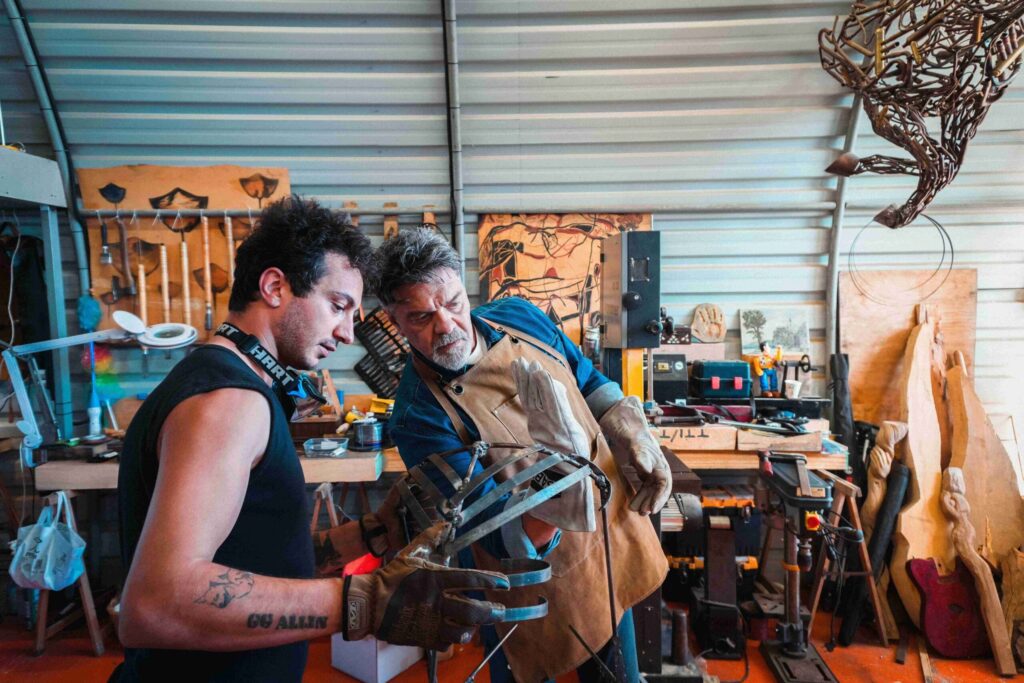
In Çeşme. My studio is in Çeşme. My old studio was in Eskişehir’s industrial district; it was very lively, but after I started living here, I moved it. We rented an old aircraft glider hangar with a few artist friends. They also work in sculpture. We did it with a good team.
We divided the sculpture into three parts because it weighs about a ton. It’s four meters high and nearly two meters wide. Since it would be difficult to transport at the airport, we brought it in parts and assembled it overnight.
This sculpture also underwent a jury process at İGA Art. How did that process unfold?
This sculpture went through a jury process. For about one and a half to two months, we met with the art jury and upper boards of İGA Istanbul Airport. I presented the work, we discussed it; then I presented it again, and we discussed it again. I went to the airport five or six times.
The jury included Professor Gülveli, Marcus Graf, Seçkin Pirim, Mehmet Ali Güveli, and Fehmi Bilge from the Turkey Design Foundation. So the work passed through a serious committee.
It is known that İGA Art invested significant effort into this process.
Yes, absolutely. Thanks to Nurçin, we handled everything together. We must have had thousands of phone calls. İGA Istanbul Airport is a very institutional structure; people come from all over the world, so it has to function that way. When something goes wrong, it can lead to serious issues.
We tried to run two different concepts simultaneously: the large sculpture outside and the exhibition inside. In that sense, Nurçin made things much easier for me; everything progressed smoothly.
Marcus Graf handled the curatorship. It was an incredible experience for me. He came to Çeşme and stayed there. Professor Gülveli also came. We evaluated the works in the studio together and discussed them. So they were part of the process—not just an external committee looking in.
How did this process affect your production?
It was nourishing. Discussing, rethinking, and defending the work… all of these became part of the production. It wasn’t a solitary process; a collective intelligence came into play.
After this work, where do you see your production heading?
I’m thinking of working on airports, stadiums, perhaps concert venues and train stations. But initially, I’ll focus on airports. I don’t want this work to remain only at İGA Istanbul Airport—I’d like it to exist in airports around the world.
Because objects are forgotten everywhere, people pass through everywhere, and emotions are experienced everywhere. But each airport has its own folklore—its moral structure, daily life, and rhythm are all different. I want to incorporate these into the work.
Could you make this idea more concrete?
For example, imagine a project at Rize or Artvin Airport. I have an idea: to contact fish restaurants in the region and collect fish bones over the course of a year. Then process them chemically and compress them into columns. After that, combine them with lost objects. In other words, I want to bring together both the material of the airport itself and the material of that specific region. These are the kinds of works that could be developed for particular airports.
Could stadiums also be an interesting field in this sense?
Absolutely. Thousands of people come, and many things are forgotten. If you collected the items left behind over a season, a very powerful installation could emerge. Places of crowds are very suitable for this kind of expression.
Have you seen Maraş in Cyprus?
I haven’t been, but I know it very well. I’ve watched many documentaries.
Does it feel like a place that could affect you deeply?
Yes, most likely it would.
That’s all I wanted to ask. Is there anything you would like to add?
I think it’s been quite fulfilling. Thank you. I hope this won’t be our first and last conversation.
Finally, I’d like to add this: we are going through a very dark period. Seeing you become visible through this production gave me hope. Maybe someone will go to an exhibition, touch something…
That’s a very important point. If I can make people say, “We like this guy—and he’s made something like this too,” and if someone takes even a spark from that, I’d be very happy.