
The idea that modernism is less a completed historical narrative than an intellectual legacy still awaiting scrutiny, reinterpretation, and transformation today forms the starting point for Bulgarian artist Krassimir Terziev’s exhibition, Midnight Conversations with My Modernist Predecessors. Terziev transforms the modernist art canon—spanning from Kazimir Malevich to Piet Mondrian, and from Donald Judd to Aleksandr Rodchenko—into the subject of a critical dialogue informed by the ecological, technological, and political contradictions of our time. The claim to universality inherent in geometric abstraction, the rationality of industrial production, and modernism’s notion of progress confront, in the artists’ works, the resistance of materials, the fragility caused by the climate crisis, and the discontinuities of historical memory. The exhibition also proposes new encounters between the visual and intellectual traditions of different geographies by expanding the boundaries of the Western-centered narrative of modernism through the work of Erol Akyavaş. In this interview with Terziev, we discussed what modernism means to us today, how the aesthetic utopias of the past can be reinterpreted in the face of today’s crises, and the critical potential of contemporary art to engage with the ghosts of art history.
The title Late Night Talks With My Modern Аncestors evokes an intimate, informal, and perhaps slightly unsettling conversation with art history. Why did you choose the metaphor of a “late-night talk,” and how do you position yourself in relation to these ancestors: as an heir, a critic, a collaborator, or an anachronistic interlocutor?
It is late-night talks first of all because it is happening after a long long day of Modern art, and in this late night I have the feeling the capacity of memory fails us. Having at our disposal the entire archive of human culture and yet suffering attention disorder and amnesia is unsettling indeed, to put it mildly. A large part of contemporary art seems to start from a clean start, again and again. On that background I aimed to reiterate a question Roger Buergel and Ruth Noack posed long ago in 2007 in their edition of Documenta: “Is modernity our antiquity?”, and see how that question vibrates from the horizon of the present.
In those late-night talks I am tempted to think I could be in all those roles you mention, for in human experience the binaries “either/or” rarely exist.


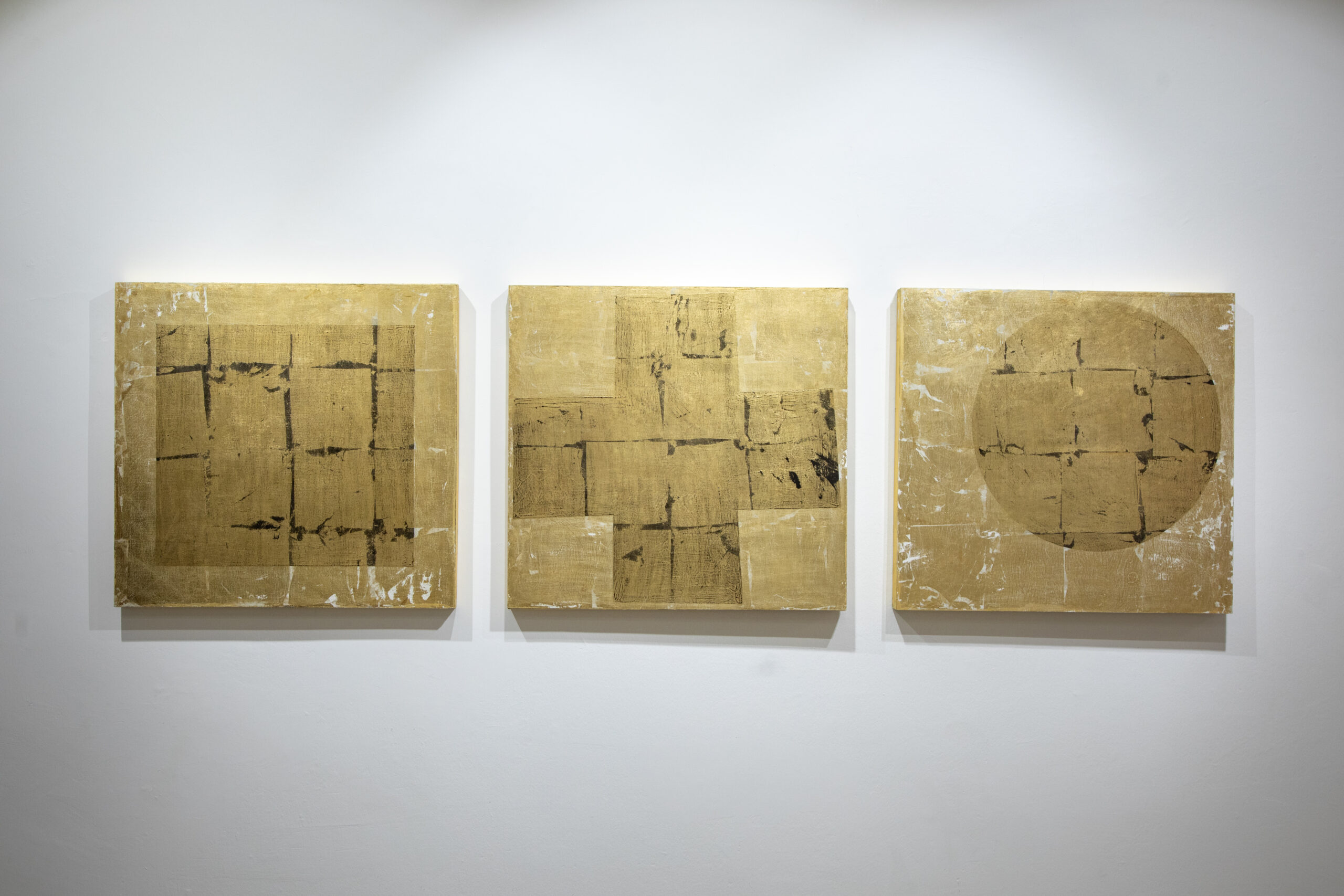
In Gold Leaf on Black Icons on White Background (After Malevich), you revisit the historical tension between Malevich’s Black Square and the Russian icon tradition. What happens to Malevich’s claim of reaching the “zero of form” when the black square is multiplied, materially worked, and placed in relation to gold leaf, sacred luminosity, and devotional imagery?
I do not want to enclose the work in the frame of any definite answer I could give here, because I will effectively shorten its life. I believe when the gold leaf surface (as a monochrome) is superimposed on the original iconic triptych by Malevich a long historical vector becomes visible. A vector drawn from the Byzantine tradition’s approach to images, the highly purified and spiritual form of Modernism Malevich proposed and the present moment in which he reached the sacred realm.
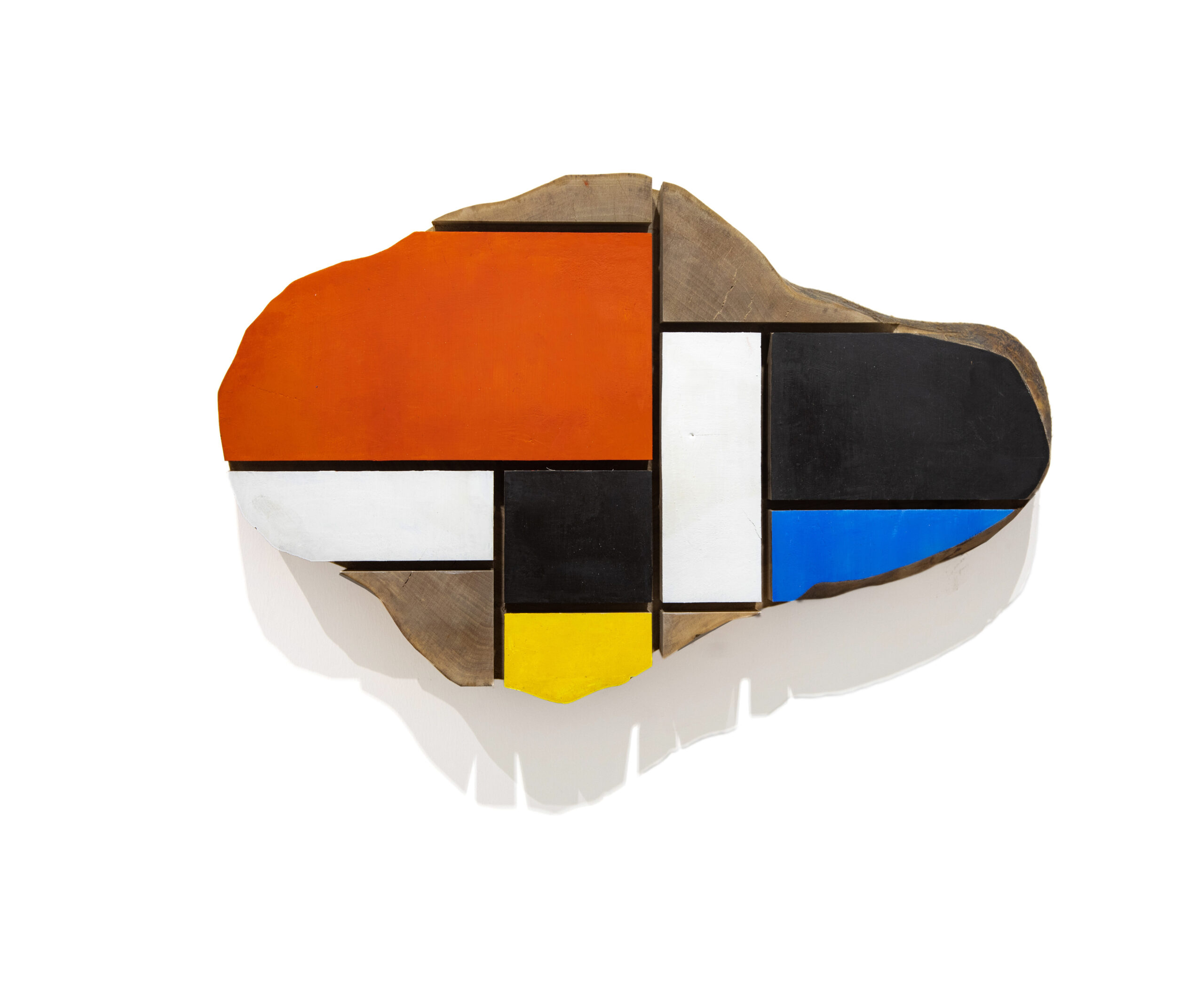
Mondrian in the Logging returns Mondrian’s geometric vocabulary to sections of walnut and beech, confronting the modernist grid with growth rings, organic irregularity and industrial cutting. The word “logging” also refers both to felling trees and recording data. How does this double meaning connect ecological extraction with contemporary systems of measurement, information and standardization?
The series originated from a simple discovery I made some time ago: it turns out that in the logging industry, a felled tree trunk—which naturally possesses an organic form, branching out in various directions and defying strict geometry—is optimized according to the same grid principle used by Mondrian and the “De Stijl“, in order to produce the rectangular beams sold as industrial material. I immediately envisioned this striking dual image projected onto the organic silhouette of the trunk’s cross-section: the high aesthetic reductionism of Neoplasticism coincides with an industrial method for optimizing the extraction of natural resources. This surprisingly convergent logic—shared by Mondrian and the logging industry—is superimposed upon the “logging” of life data inscribed within the fabric of the tree trunk. It is only from the viewpoint of contemporary ecological disaster that we could have a larger understanding on the levels of abstraction applied to the living world, inorder to see it predominantly as resources.
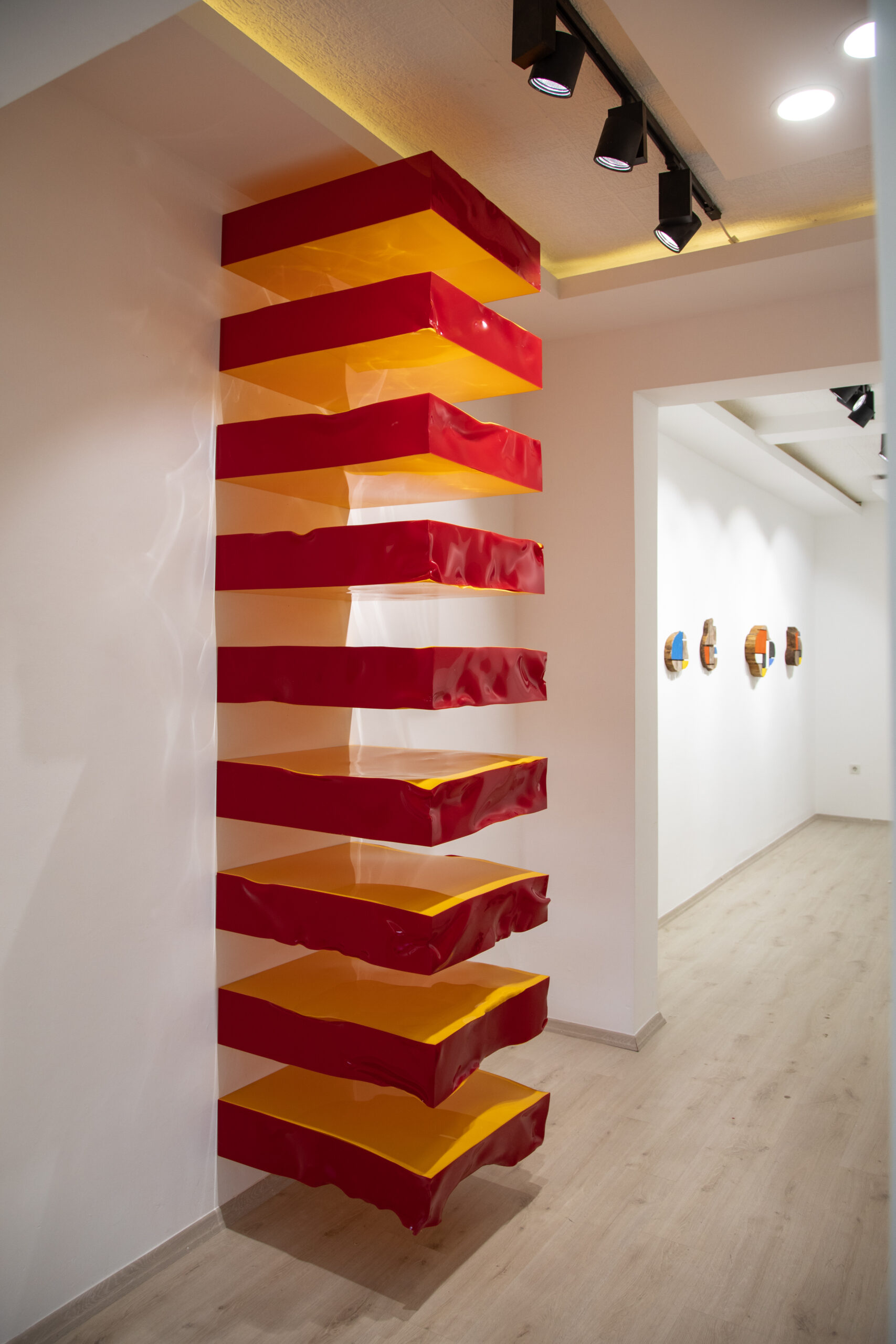
In Storm After Judd, the serial order of Donald Judd’s stack is destabilized by heat-deformed acrylic-glass units. Should we read this material transformation primarily in relation to climate catastrophe, or does it also point toward a broader crisis in modernism’s faith in industrial precision, repetition and permanence?
Judd‘s “Stacks” are a primary example of the modernist grid model. In my interpretation the purity and universality of that model got compromised. The acrylic glass out of which the boxes are made of got melted by high temperature ruining the rigid geometry of the boxes. In the contemporary moment, numerous processes are underway—most notably the climate catastrophe and global warming, but also geopolitical frictions, culture wars, political instabilities, the idiotic turn brought by technology, and so on—that are causing the grid to crack and ruination to multiply to the skies.
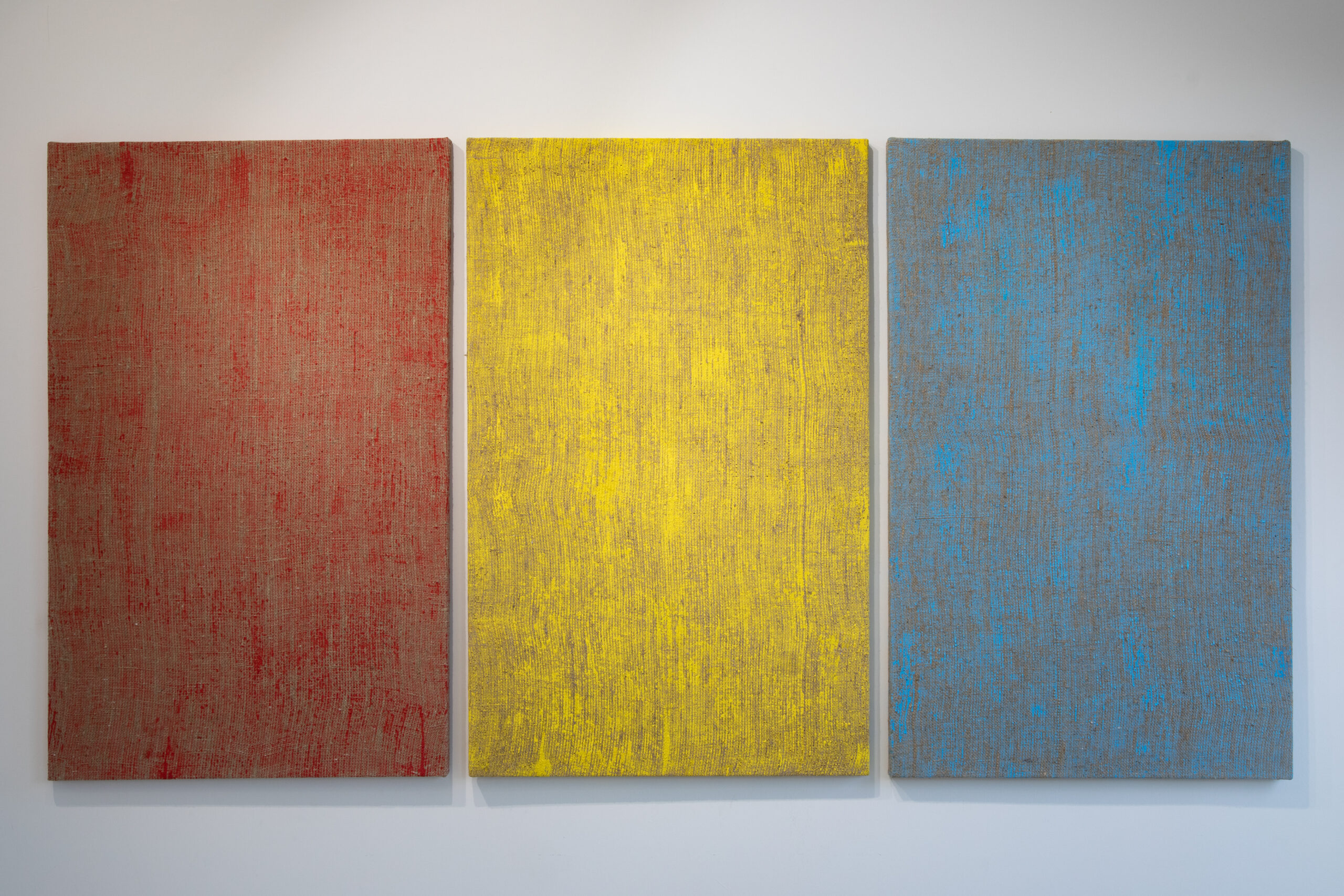
Who’s Afraid of the Other Side establishes a dialogue with Rodchenko’s primary-color monochromes and Barnett Newman’s Who’s Afraid of Red, Yellow and Blue. By applying paint to the reverse side of the sackcloth, you make color visible only after it passes through the material. What does this “other side” reveal about the concealed labor, bodily experience, and systems of production behind the apparently autonomous surface of painting?
With the seminal triptych “Pure Red, Pure Yellow, Pure Blue” Rodchenko made a claim that he reached the essence of painting: one primary color on a flat surface. American painters rediscovered the constructivist positions rather late and went further in the search for pure primacy. Through my own interpretation, I reintroduce the depth of material processes into the discourse, transforming the rich texture of burlap—which is far from a flat surface—and paint—as a viscous substance—into active collaborators; I work with them, rather than against them. The paint is bleeding and sweating through the textile thread as is the process of painting.
In Ghost Descending a Staircase, made with Daniel Kötter, the human figure familiar from Muybridge, Duchamp and Richter disappears. At the same time, cameras attached to doors and windows let the architecture itself move. What interested you in transferring agency from the human body to the building, and how does this nonhuman or architectural gaze relate to contemporary image-making technologies?
Ghost Descending a Staircase is a moving image work, resulting from a collaborative research undertaken with Daniel Kötter in the urban peripheries of Berlin and Sofia in 2016. It is shot in the 31-stories high-rise called Ideal Hochhaus in the Gropiusstadt district in Berlin, designed by Walter Gropius in 1969 as the highest (by the time) apartment building in Germany. It revisits those social housing panel blocks districts built in the 1970’s and also refers to that entire sequence of nudes descending the staircase that started with Muybridge’s chronophotography.
The piece is part of a series of works in which I aim at the same method – to produce a cinematic image not following human perspective but trying to achieve a more-than-human view point inherent to a material body that we usually do not recognise as an agent, but as a ready-to-use resource. In this case for example normally we do not recognise the presence of doors or windows in the environment, and yet they produce a perfect panning shots revealing stunning perspectival shortenings.
What I enjoy in the method applied is that I just set some rules and then the moving image happens automagically by itself without my control. At the same time in this model ethics is as important as aesthetics.
Beyond these formal experiments, the work also draws on my personal experience in this building. I lived there for a month on the top floor, and during my daily movements up and down—whether by elevator or stairs—I hardly ever encountered other people. From up there, a magnificent panoramic view of the entire city unfolds, yet one feels completely detached from life down on the ground.
Presented in Istanbul, the exhibition inevitably raises the question of whether the history of modernism can still be narrated through a predominantly Western canon. How has your dialogue with the exhibition’s curator, Fırat Arapoğlu, shaped the conceptual framework and spatial organisation of the project? In particular, how did your discussions introduce Erol Akyavaş—with his intersections of geometric abstraction, architecture, Islamic visual traditions and images of falling cities or citadels—into the exhibition’s conversation with modernism, and can this curatorial dialogue help propose not one modernism, but several historically and culturally situated modernities?
The dialogue with Fırat was of immense importance for the realization of the project. Engaging with all these giants of modernism is a risky undertaking; I needed to share this risk with him as a fellow traveller capable of viewing things from a distance inaccessible to me. Our long-standing collaboration fostered a level of trust that proved crucial in determining the right composition and tone for the exhibition. He also suggested connecting these central modernist positions with others located outside the center—a proposition I embraced. He introduced me to his research on Turkish modern art, and through the gate he opened I got touched by many fascinating names, paths and movements. The search for a figure that speaks to me and I can have a say in return led to the inclusion of Erol Akyavaş in the composition. I am particularly fond of Akyavaş series on “fallen cities”—precisely because I discovered within it a syncretism that blends geometric abstraction with pre-modern spiritual and visual traditions, but also the figure of ruins, having multiple dimensions—a figure I return to yet again many times in my own work, maybe as a result of still living among the ruins of socialist modernism.