
We are at Dortmunder U, in Germany’s Ruhr region, where buildings that once formed part of industrial production have now been transformed into spaces for art and culture. The relationship between the region’s industrial past and its present-day cultural identity invites us to reconsider not only architectural transformation, but also labour, migration, memory and belonging. The fact that Dortmunder U, once a brewery, is now one of the centres of contemporary art and experimental production is one example of this transformation. The art of Nezaket Ekici, who received the MO_Kunstpreis award under the title Dada, Fluxus und die Folgen (Follow me Dada and Fluxus) from Museum Ostwall on 11 October 2026, engages with these historical and social layers in various ways. Presented by Freunde des Museums Ostwall e.V., (Friends of the Museum Ostwall e.V.) the award aims not only to recognise Ekici’s artistic production but also to strengthen the representation of experimental art continuing the traditions of Dada and Fluxus within the museum’s collection. While the award ensures that the artist’s work becomes part of institutional memory, the solo exhibition Was bleibt, was wird (What Remains, What Will Be) which opened following the award ceremony, makes visible how personal experiences intersect with broader social issues. In Ekici’s work, questions of migration, cultural belonging, gender roles, body image and ageing do not emerge as abstract discussions, but from lived experience. The artist’s body sometimes becomes a bearer of family memory, at other times a site for questioning social norms, and at still others a means of bringing the past and the future into encounter. In Papa’s Poem, Ekici revisits her father’s migration experience through poetry and sound; in Menopause, she brings a personal bodily process into the public sphere; while in Patchwork, she explores the relationships between identity, costume and time. In the video installation Kaffeeklatsch, meanwhile, she approaches the German tradition of coffee and cake as a social ritual.
The ODE Kunstpreisträger*innen performance, which Ekici presented at the ceremony venue immediately after the award ceremony, represents all thirteen award recipients by reinterpreting, through bodily movements, the names of the twelve previous recipients, including Ekici herself. The performance transforms the award she has received from a mere recognition of individual achievement into a way of engaging with the past, acknowledging those who came before her and considering how she participates in collective memory through her art. In this conversation with performance artist Nezaket Ekici and Nicole Grothe, Head of the Collections Department Museum Ostwall Collection, we discuss the significance of the award; the artist’s relationship with migration and family memory; the untranslatable layers of language; the visibility of the female body; the possibilities art opens up between past and future; and the role of the museum.
The collection of Museum Ostwall at Dortmunder U spans a broad range, from works dating back to 1900 to contemporary artistic practices that engage with the pressing social issues of our time. As Head of the Museum’s Collection, it is clear that you think extensively not only about the selection and preservation of artistic works, but also about the contexts in which they are brought together and how they are presented to audiences. Your approach seeks to increase the visibility of women artists, foreground works that explore the relationship between everyday life and broader social issues, and address historical gaps in the collection by making more room for artists from outside Europe. The decision to award Nezaket Ekici the 2026 MO_Kunstpreis and to acquire two of her works for the collection is a concrete example of this approach. Could you begin by telling us a little about the curatorial perspective that has shaped the development of the Museum Ostwall collection and your own role in this process?
Nicole Grothe: Regarding the parameters für acquisitions we must distinguish between the Museum Ostwall’s collection strategy and the award criteria for the MO_Art Prize. It is true that the museum gives particular consideration to previously under-represented artistic voices when expanding the collection, e.g. female artists, who are under-represented among the Expressionists collection as well as in Fluxus and related art forms in our collection, or artists from countries outside Western Europe and the USA. However, the MO_Art Prize has a different background: The decision on who receives it is not made the museum on the basis of our collection strategy, but by a jury of experts. The MO_Art Prize is awarded once a year and was established in 2014 by the Friends of the Museum Ostwall e.V. to strengthen the collection’s focus on Fluxus and related art forms. The jury consists of the museum’s director, a board member of the Friends of the Museum Ostwall e.V., the curator of the museum collection, a member of the Friends of the Museum Ostwall, a member of the management team of the Ruhr Art Museums, a representative of Dortmund Technical University and an artist. The jury meets once a year, and each jury member may nominate up to two artists for the prize. This year, I nominated Nezaket Ekici, and fortunately the jury voted for her. In this context we acquired two works by Nezaket Ekici for the MO_Collection, and her exhibition “What Remains, What Will Be” is currently on display in the MO_Showcase.
About me: I am Head of the Collection, so I am responsible for the general collection management but also for the presentation of its works at Dortmunder U. As a team we develop a new presentation of works from our collection approximately every three years. Instead of a traditional permanent exhibition that focuses on the so called masterpieces, we always chose a motto that has a certain relation to every day life. We bring works from different times and art movements into dialogue, including those that would otherwise rarely be taken out of the storage. A wide variety of departments are involved in this process – not only the MO_Collection Team, but also the MO_Art Education Team and, in recent years, the MO_Advisory Board and our curator for community engagement.
With this institutional context in mind, I am curious about what this award and the inclusion of an artistic work in the collection mean from the artist’s perspective. I do not think the MO_Kunstpreis means only receiving an award or having your work included in the Museum Ostwall collection. The award’s title, Dada, Fluxus und die Folgen, establishes a historical connection with your art. The inclusion of your performances and video installations in the collection of a museum that creates space for experimental art is also significant in terms of how your art will be remembered in the future. How did you experience this process? What made the award meaningful to you?
Nezaket Ekici: Nicole Grothe, Head of the Museum Ostwall Collection, told me that she wanted to nominate me for the award. I agreed and sent her my portfolio. When I received her email last December, I had to act very quickly; I prepared and submitted my portfolio in about a week. This award is very important to me. Being included in a museum collection is significant in itself, but, as you mentioned, the name of the award also has a particular meaning for me. The award focuses on the tradition of Dada, Fluxus und die Folgen, and it holds a special place in my eyes because of its connection with Museum Ostwall’s artistic approach and collection. I also have a personal connection with Dortmund and the surrounding area. I lived in Duisburg from 1973 to 1992; I went to school there and began an apprenticeship in printing. I completed my vocational training in Munich. I stayed there to study Fine Arts and then moved to Braunschweig to study Performance Art. I lived in Duisburg for a total of nineteen years. My mother-in-law and friends still live there. So the Ruhr region is much more than a geographical location for me; it is part of my childhood, my education, my family’s migration story and my own life journey.
I would like to talk about the influences that brought Ekici to the forefront as the 2026 MO_Kunstpreis recipient, as well as the conceptual framework behind this decision. In Ekici’s work, themes such as migration, cultural belonging, family memory, gender and the body often emerge from deeply personal experiences. Yet these experiences are not confined to autobiographical narratives; instead, they open up broader questions concerning social relations, normative assumptions and mechanisms of exclusion. Moreover, she does not always address these issues in explicitly political or didactic ways. Sometimes she starts from an ordinary ritual of everyday life; at other times, she explores the possibilities of humour or the intensely tangible and sensory experiences of the body. Could we say that Ekici’s ability to move from personal experience towards broader social questions is one of the key qualities that made her particularly compelling for this award?
N.G.: In the first place, I nominated Nezaket Ekici for the MO_Art Prize because she takes everyday experiences as her starting point and reflects on them through the medium of art – just as the Fluxus artists did. Whether she is exploring religious rituals or her own history of migration in her works, they always have a very down-to-earth connection to real life. Furthermore, Nezaket Ekici works in a performative manner and uses her own body to explore various themes. And sometimes she involves humour. All these aspects link her to the Fluxus movement, whose representation in our collection is to be strengthened through the MO_Art Prize. The connection between the personal and the political in Nezaket Ekici’s work, which you mentioned, was more important for our decision which of her works should be acquired for the MO_Collection. Together with our director, Regina Selter, Nezaket Ekici and I chose the video performances Papa’s Poem and Menopause. Papa’s Poem is based on a poem by Nezaket Ekici’s father, Zıya Ekici. He came to Germany from Turkey in the 1970s as a so-called “guest worker”, settling here in the Ruhr region. In her work, Nezaket Ekici explores part of her family history, whilst also addressing a current socio-political issue: the topic of migration. There are already a few works in the MO_Collection that deal with various aspects of this theme, but none of them specifically addresses labour migration, which has had such a big impact on our region, the Ruhr area. That is why this work fits perfectly into our collection. Menopause initially deals with the artist’s very personal experiences during the menopause, but it has also an important socio-political dimension: Many women go through similar experiences at a certain stage in their lives, and it should not be taboo to talk about them. We should find a way of dealing with them – not only on an individual, but also on a societal level. It’s obvious that people who suffer from chronic sleep deprivation or migraine attacks need more flexible periods of rest than our regular working day typically allows. I am delighted that, with Menopause, we now have a work in our collection that addresses physical changes that are experienced by many women. It’s an excellent addition to a work by VALIE EXPORT on the theme of motherhood or a work by Carolee Schneeman on sexual emancipation, both of them also focussing on the female body.
I also really liked the video installation Menopause, and I find it genuinely important in terms of the parameters you have described. I will ask Ekici some questions specifically about Menopause, but first, I would like to turn to the strong connection between your personal story and the social history of the Ruhr region. During the nineteenth and twentieth centuries, the Ruhr was one of Germany’s most important industrial centres, shaped by coal mining and steel production. Industry was not limited to an economic structure; it also created a social environment in which workers, families and generations from different countries lived alongside one another. Labour migration from Turkey to Germany is an important part of the region’s history. With the decline of industry, the transformation of former production sites into spaces for culture and art became one of the ways in which the region redefined itself. Dortmunder U is one example of this transformation. The inclusion of your art, which addresses questions of migration, language and belonging, in a museum collection in a region that carries the traces of your childhood and family memory must have a particular significance. How do you assess the relationship between the traces left by migrant labour in the region’s former industrial life and the traces it carries today in its cultural memory?
N.E.: This is precisely what gives the award a personal dimension for me. Being here and seeing my work enter the museum collection is very important in terms of my own migration story. I particularly wanted my video installation Papa’s Poem to be included in the collection for this reason, because it carries my father’s experience, language and life as a migrant. I will talk about this in more detail.
Let us return to the title of the award, Dada, Fluxus und die Folgen. Dada and Fluxus have enabled us to think about art not only as an object, but also through action, everyday life, the body, sound and the relationship established with the viewer. Considering the roles of the body, everyday life and language in your work, how do you relate your own artistic approach to this historical legacy?
N.E.: Dada and Fluxus are important to me because we are talking about a tradition directly connected to the historical development of happenings and performance art. The ways in which these movements brought art closer to everyday life, their use of the body and sound, and the importance they placed on language are all very meaningful to me. The body, everyday life, sound and language also play important roles in my work. For this reason, I was very happy that the award specifically focuses on this tradition. For me, the point is not simply to continue a historical tradition, but to reconsider the space it opened up through my own experiences, my own body and the questions that concern me.
Nicole, you have described the connections between Ekici’s artistic approach and Fluxus. How does the museum approach this relationship while also taking into account the differences between the historical movement and contemporary artistic concerns? The title of the MO_Kunstpreis, Dada, Fluxus und die Folgen, suggests that the award aims not only to recognise an individual artist, but also to continue a historical tradition that challenges object-centred definitions of art. By blurring the boundaries between art and everyday life, Dada and Fluxus brought action, the body, sound, chance, participation and process to the forefront of artistic practice. These elements also play an important role in Ekici’s work, particularly in relation to the body, everyday life and the relationship between artist and viewer. However, when establishing a connection between a historical movement and a contemporary artist, formal similarities alone may not be sufficient; the artist’s specific historical, social and cultural position must also be taken into account. From the perspective of Museum Ostwall, what kind of opportunity does Ekici’s artistic approach offer for reconsidering the legacy of Dada and Fluxus in the context of current debates on migration, identity, gender and body politics?
N.G.: Although the chracteristics of the Fluxus movement mentioned above are important points of reference in Nezaket Ekici’s work, from today’s perspective it is also important to clearly highlight the differences: The Fluxus pioneers often engaged with everyday themes in the late 1950s and early 1960s, but they only very rarely addressed political issues. Exceptions, of course, include Wolf Vostell, Milan Knizak or Joseph Beuys. The themes you mentioned, which play such an important role for us today, were far less prominent in social discourse back then. An exception the gender debate, which, however, was addressed much more strongly by female artists working in body and performance art. Within the Fluxus movement, works such as Yoko Ono’s Cut Piece or Shikego Kubota’s Vagina Painting are the exception rather than the rule. The MO_Art Prize, however, is deliberately designed to feature contemporary artists as well. Their work has not, for the most part, emerged in a strict linear development from the Fluxus movement, but often they are linked to the artistic themes and practices developed within Fluxus. Some of them might not even be conceivable without Fluxus. We like to think of these artists as closer and more distant relatives: Some prize-winners could be grandchildren of the Fluxus pioneers, whilst others might be third-degree nieces or nephews…
Your performance ODE Kunstpreisträger*innen, which you presented after the award ceremony, in a sense brought this historical continuity Nicole mentioned onto the stage. By commemorating the artists who had previously received the same award through bodily movements, you positioned yourself as part of this chain. How did the idea for ODE Kunstpreisträger*innen come about? What did giving the artists’ names a physical expression mean to you as a gesture of gratitude and tribute?
N.E.: I wanted to present a performance after the award ceremony. The venue was important to me; I had only a limited amount of time to perform in the space where the ceremony had taken place. So I chose a work that suited those conditions. But the fundamental questions were these: What does an award mean? Who received this award before me? Where do I stand now? I reflected on these questions. ODE Kunstpreisträger*innen was a gesture of gratitude towards all the artists who had received the award before me. I wanted to honour them and see myself as part of this chain. Artists often focus on their own lives and their own work. But being able to thank those who came before you, acknowledge what they have done and show them respect is very important. This was the central idea behind the performance for me. I wanted to honour the artists who came before me and express our gratitude to those who will follow in our footsteps.
The word “ode” refers to a poetic form that celebrates a person, place, event or idea. In your performance, however, this tribute takes place not only through words but also through bodily movements; each name becomes part of a live encounter through the time and movement devoted to it.
N.E.: Yes, in this way, the artists’ names become part of a live encounter rather than remaining mere entries on a list. The way I encode letters and names is also important here. In Turkish, we use city names to explain letters clearly; there is a similar system in German. I wanted to take this everyday method of communication and transform it into an artistic language. For me, encoding does not simply mean making a name intelligible; it means devoting time to it and reconstructing it through the body. I have created works involving the encoding of names before. For example, in ODE 1303, which I created in 2024 for the twentieth anniversary of Kunstverein Tiergarten/Galerie Nord in Berlin, I encoded the names of 1,303 artists in the gallery window, from the morning until the evening. Another example is the performance Spelling Hagia Sophia, which I presented at Karşı Sanat Çalışmaları in Istanbul in 2005. This performance, which lasted almost five hours, was a documentation of a six-month artist residency I undertook in Istanbul with the aim of creating a performance inside Hagia Sophia. For ODE Kunstpreisträger*innen, I developed a different approach based on the cinema/theatre venue at Dortmunder U, where both the ceremony and the performance took place, as well as the history of the award. I created a specific sequence of movements for each artist’s name. I did not want simply to pronounce the names; I wanted to give each of them a physical expression.
The history of the encoding system you use in Germany is also quite striking. The old German spelling alphabet, which made it easier to distinguish letters from one another in spoken communication, used personal names. During the Nazi period, Jewish names were removed from this table, and not all the changes were reversed after the war. In 2022, a new table based on city names rather than personal names was published under the DIN 5009 standard. This history shows how even an apparently ordinary communication tool can be connected to whose names are heard, whose names are erased and which names are accepted as part of a shared language. In your performance, however, the same method becomes a way of bringing artists’ names back into existence in front of an audience, rather than simply recording them on a list. Encoding a name extends the time devoted to it and connects it with the body and the viewer’s attention.
N.E.: What mattered to me was matching the names with specific movements and devoting time to each artist. Normally, an artist’s name is written down in a group exhibition; people see it and move on. Here, however, I devoted at least one minute to each artist. Encoding a name extends time. In this way, I was able to give each artist more time. The names were placed on music stands. I thought of the music stands symbolically as the artists themselves. It was as if they were all there waiting for me, while the audience looked at them. I went up to each one. Every artist had their own music stand and sheet music. So the names were present not only as written words but also as part of an installation. I designed a separate movement for each name. For example, since caner teker is also a choreographer and artist, I encoded his name through circular movements reminiscent of dance. When encoding my own name, I jumped. As you know, I enjoy physically challenging myself; I love movement and action. That movement felt right to me at that moment. I particularly wanted the sounds of breathing to be audible, too. Ben Peterson received the award in 2015; he is a musician and artist. I made music with my feet while encoding his name. Guerrilla Girls received the award in 2025; I voiced their name in an activist style reminiscent of chanting slogans. I designed different movements for the other names as well. I tried to establish a relationship between each artist’s identity and a movement.
In this context, we could say that in ODE Kunstpreisträger*innen, your body becomes a vehicle of memory, bringing together the artists who came before you. Your costume in the performance was also quite striking. I know that you design your own costumes. What did the costume mean in this work?
N.E.: As you mentioned, ODE Kunstpreisträger*innen was a performance of gratitude for the awarded artists as well me. The costume was also part of this feeling of gratitude; it was a tribute to Maria Callas. I designed it based on one of her photographs. My use of Maria Callas’s voice from the 1940s was connected to the same idea.
The performance also raises a broader question for the museum: when art takes the form of an action unfolding over time, how can it be acquired and preserved as part of a collection? One of the questions that particularly interests me concerns the relationship between the ephemerality of performance and the museum’s claim to permanence. Performance is an art form based on something that takes place at a particular time and in a particular space, relying on the presence of the body, action and, often, a direct relationship with the audience. When the action ends, the performance itself also comes to an end. What remains may be video recordings, photographs, documentation, objects, audience memories or the possibility of the artist performing the work again. Yet none of these is entirely equivalent to the lived experience of the original performance. For this reason, acquiring a performance for a museum collection involves more than simply purchasing a work of art. It also requires us to question what a performance is, how it should be preserved and how it might be presented in the future. How does Museum Ostwall approach the question of ephemerality when acquiring performance-based works and video installations for its collection? How do you deal with the relationships between video recordings, photographs, performance documentation and the physical components of an installation? When a performance enters a museum collection, what kinds of responsibilities arise, particularly in terms of its future exhibition or re-performance?
N.G.: Fortunately, this question is not that pressing for Nezake Ekici’s work, as some of her pieces are developed as video performances right from the beginning. In these cases, the video is an independent artistic work by the artist and not only a documentation of the performance. But it is true: The question of how a museum can collect performance art has been a major concern of ours for several years. In the last few decades we acquired numerous artefacts, documents, photographs and scores for our collection which serve as references to the performances, but are of course not the performances themselves. It is important to make this distinction clear to the public: A shoe, which was dragged over the floor and fixed up with band aids in a happening by Allan Kaprow, is not a work of art – it’s a remnant of a work of art. But the situation is different of course when Allan Kaprow creates an assemblage from remnants of a happening. The assemblage bears its own distinct artistic aesthetic and is therefor to be regarded as an independent work of art. We first acquired a performance in the true sense of the word in 2023 as part of the MO_Art Prize: caner teker’s KIRKPINAR. The performance itself is the artwork, and only the performance may be exhibited as a work of art – no video, no artefact, no score. The performance setting and props may be included in an exhibition, but only if the performance is staged at least once during the exhibition. What we have learnt through this process is that the parameters of collecting and preserving a performance depend very heavily on the specific work in question. There are performances that can be performed by anyone following a set of instructions and that allow a lot of improvisation. Other performances may only be performed by the artists themselves. The latter are lost to the museum collection, if the artists are no longer able to perform themselves –actually an unimaginable prospect for a museum whose remit it is to collect and preserve works, potentially ‘for eternity’. In the case of KIRKPINAR, certain parameters must be met by the dancers when the work shall be performed without caner teker being present. The documentation of all theses aspects – not only the technical ones, but also those regarding the artistic intention and emotional aspects of the work – is indeed elaborate but also highly exciting. It is still ongoing, because with each iteration of the performance, supervised by the artist, we are be able to refine certain details in the documentation. So we are pretty optimistic that we can provide future generations with sufficient material to preserve and exhibit the performance in accordance with the artist’s vision.
The exhibition “Was bleibt, was wird”, which opened after the award ceremony, brings together Papa’s Poem, Menopause, Patchwork and Kaffeeklatsch. At first glance, these works may seem to address different subjects, but when considered together, they open up a broad field extending from personal experience to social issues. On the one hand, there are migration, family memory and belonging; on the other, the female body, ageing and the changing nature of identity. How did the museum decide to bring these works together? You mentioned that you particularly wanted Papa’s Poem to be included in the collection. Why was it also important to you to have another work, such as Menopause, represented in the exhibition?
N.E.: The works were selected from my portfolio. As I mentioned earlier, I particularly wanted Papa’s Poem to be included in the collection. Grothe also mentioned this in her presentation at the award ceremony. It was important that the museum’s collection include a work addressing the experience of migrant workers who came to Germany for employment, in other words, the Gastarbeiter experience. I had previously also performed Papa’s Poem live at Schauspiel Dortmund in 2025. For one presentation, I used the entire theatre space. Another example was my live performance of Papa’s Poem at the Live Action Performance Art Festival in Gothenburg, where I presented it as a route through the city. For the Museum Ostwall collection, Regina, Nicole and I wanted my three-channel video installation Papa’s Poem, dating from 2016, to be acquired. I wanted this work to enter the collection as a three-channel video installation. Regina, Nicole wanted to select another work as well, and Menopause was chosen. I am happy for that as well I do not want only my works on migration and identity to be shown; my artistic approach encompasses a much broader range. I want people to see works I have created on different subjects, too. I do not want to be remembered solely as an artist associated with German-Turkish culture or folkloric elements. Menopause is a special work for me because it emerges from a process I have personally experienced. But I am not talking only about myself here. I bring a personal experience into the public sphere; at the same time, I address women’s experience of menopause, the fact that this subject is still considered taboo, and the changes the female body undergoes with ageing. More is being said about this subject now, but people still cannot talk about menopause comfortably. I wanted to make it visible.
This also raises the question of what a museum collection represents. A museum collection is not merely a neutral archive bringing together accepted examples of art history; it is also a structure that demonstrates which experiences are considered worthy of being documented and passed on to the future. Including the stories of migrant workers or subjects such as the ageing of the female body, which are rarely discussed in the public sphere, is also related to how the boundaries of art history are drawn. In your art, the personal opens up towards the social, while preserving the distinctiveness of your own experience. The inclusion of Papa’s Poem and Menopause in the same exhibition is meaningful in this respect. One of your works addresses the migration and language experience of your father’s generation, while the other explores a transformation you have experienced in your own body. Although their subjects differ, both works invite us to consider the conditions under which private life becomes a public and political matter. Perhaps we can now take a closer look at the relationship between Papa’s Poem and your father. Your father, Ziya Ekici, wrote poems on subjects such as migration, family, motherhood and life in his poetry collection “Balık Baştan Kokar”, published in 2008 by your mother and sister. The poems Ziya Ekici wrote particularly from 1973 onwards invite us to reassess the history of labour migration to Germany through family memory. Poems such as Gurbette Hayat, Gurbet Mahkumları and Şişkin Avrupalı address not only the economic conditions of migrants but also questions of rights, social acceptance and belonging. The fact that these poems remain relevant today makes us think about the continuities between past and present debates on migration. Yet you do not simply reread your father’s testimony; through your own voice and body, you reconstruct the poem in Turkish, German and English. In this way, one generation’s experience is transformed and carried forward through the voice of another. Language itself also becomes one of the subjects of the performance. Using the mouth movements of German while speaking Turkish creates a bodily space that does not belong entirely to either language, showing how migration leaves traces not only across geographical boundaries but also on the voice and the body. Furthermore, translating the poem into other languages makes the limits of transmission visible. For example, when transferring the expression Şişkin Avrupalı into German and English, the irony, boastfulness and criticism of an empty sense of self-importance embedded in the Turkish phrase may not be fully preserved. Translation can carry meaning into another language, but the cultural memory of a word cannot always be conveyed with the same intensity. Considering all this, what does it mean to you today to recite your father’s poem in your own voice and in three different languages?
N.E.: In Papa’s Poem, I recite the poem Şişkin Avrupalı. My father wrote it in Duisburg in 1983, but it remains relevant in 2026. In this poem, my father says about European’s; “…in your arrogant view is neither hope nor compassion, because you have have no Idea of humanity… You separate our children in classes. Our workers live in ghettos…Our names is Ausländer, Gastarbeiter…” More than forty years have passed, but the attitude criticised in the poem has not disappeared. Looking down on people who are different from oneself, excluding them and refusing to accept them continue in many parts of the world. There is a strong similarity between the forms of exclusion in 1983 and those we see today. That is why I believe the poem has lost none of its relevance. I recite the poem in three languages. First, I read it in Turkish, my father’s mother tongue, so that I can recite his poem in his own language. I come from within this experience; I have experienced what migration and being a migrant mean in my own life. Then I read it in German. I also use English to reach more people and make the poem understandable in other languages. Here, English functions as a common language. I did not want the poem to remain a text that belonged only to my father. I wanted more people to hear what he experienced, what he felt and the social attitudes he criticised.
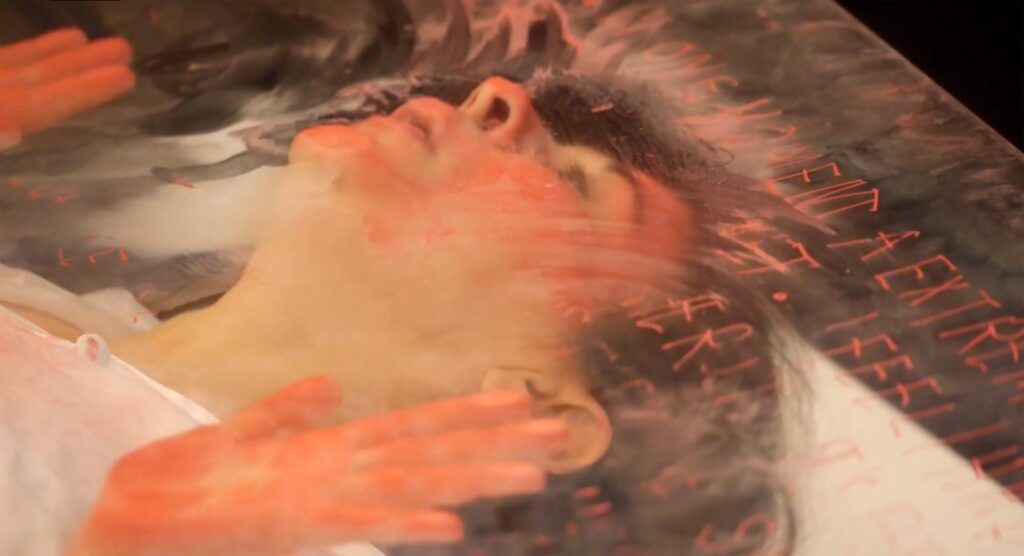
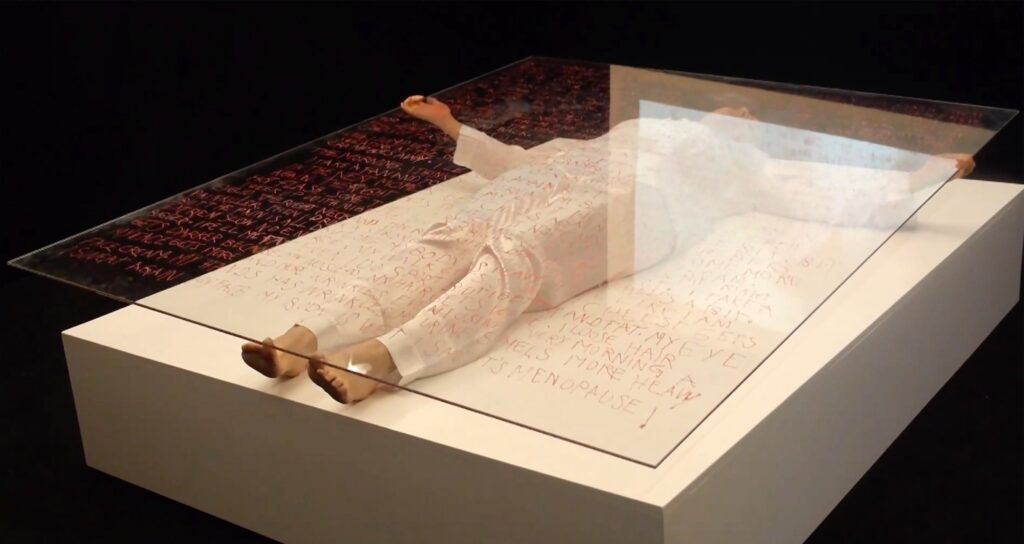
Reconstructing your father’s poem in your own voice also makes visible the second generation’s relationship with the memory of migration. The poem no longer remains solely the testimony of one generation; as it moves between languages, it takes on a new form. Another example of how personal experience becomes a public issue through art can be found in Menopause. It was one of the works in the exhibition that affected me most. At the centre of the installation is a double bed. A crumpled and compressed white satin pyjama set lies on the bed, covered by a heavy, transparent sheet of glass. You have written the physical and emotional changes you experienced during menopause on the glass in red letters. The body itself is not directly visible in this installation; the pyjamas appear like a trace left behind in the body’s absence. While the double bed is a space of intimacy and everyday life, the weight of the glass evokes a sense of physical pressure. What I find particularly significant is that the pyjamas are covered not with a bedsheet but with transparent glass. The traces that an opaque sheet might conceal remain visible beneath the transparency of the glass. This creates a tension between concealing and revealing an intimate experience. In your performances, the body does not merely represent an idea; it also engages with sensory experiences such as weight, heat, breath and endurance. In Menopause, this sensory dimension is conveyed through materials. At what point did your personal experience of menopause take on an artistic form?
N.E.: Menopause emerged in 2023 and is directly connected to an experience I went through myself. I generally make art based on my own life, situations I encounter in everyday life and my personal experiences. One night, I had a dream. In my dream, there was my bed, my pyjamas and the thin sheet covering me. But the sheet was incredibly heavy; it felt as if it were pressing down on me. I was sweating during menopause and having difficulty breathing. I felt this weight so intensely in the dream that, when I woke up, I began thinking about how I could turn it into art. I wanted to intensify the sensation of weight even further. For this reason, I used a sheet of glass weighing approximately forty kilograms. Placed on the bed, the glass took the place of the sheet. I also wrote down, in red letters and in reverse, the changes I had experienced over a period of one and a half years. I recorded many things: chills, sweating, hair loss, emotional changes, facial hair growth, ageing, changes in energy levels, aggression, stress and bodily changes. All of these were part of my experience. I chose glass not only because of its weight, but also, as you noticed, because of its transparency. If I had used a white sheet, we would not have been able to see the pyjamas and the traces beneath them. I wanted visibility. You can look through the glass; all the traces are there. Something covered with glass is not concealed in the way something covered with a sheet would be. What I actually wanted was to reveal and make visible a subject that is usually kept hidden. I also wanted to say these words aloud, but working with glass was very dangerous. During the performance, I had to concentrate entirely on the glass. So I added the audio recording later. Moreover, I am still going through menopause, and the difficulties of this period have not yet come to an end…
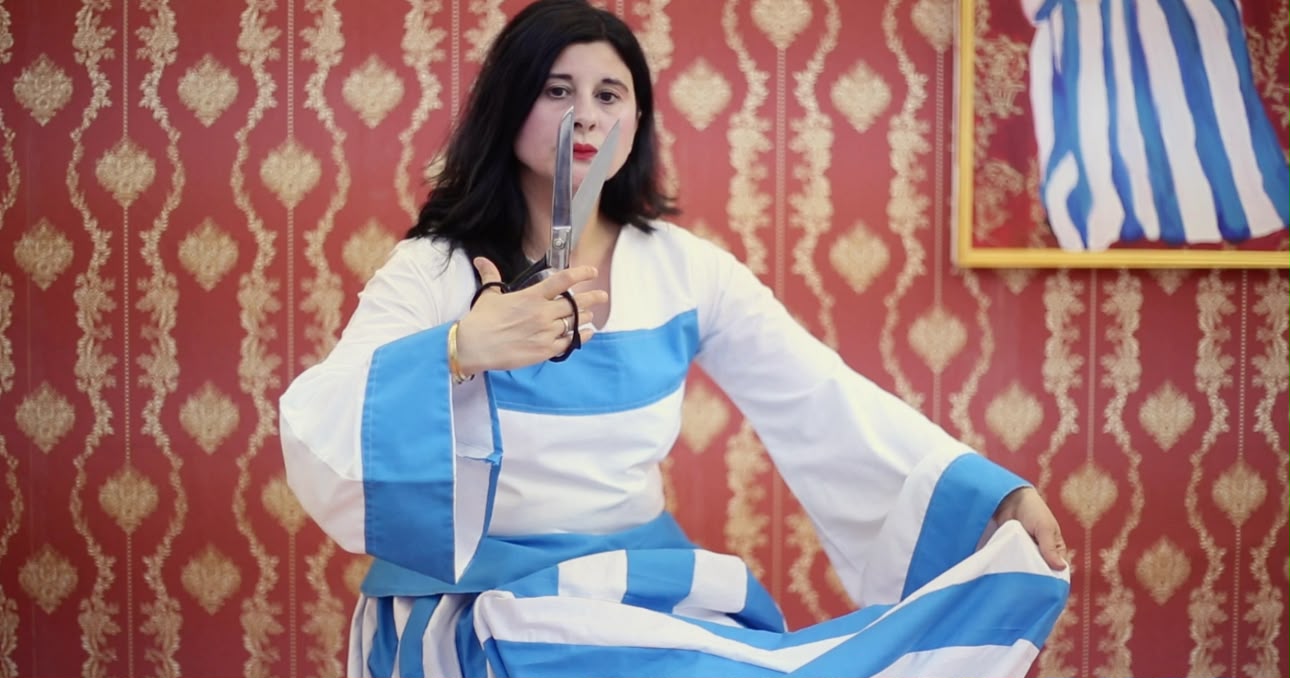
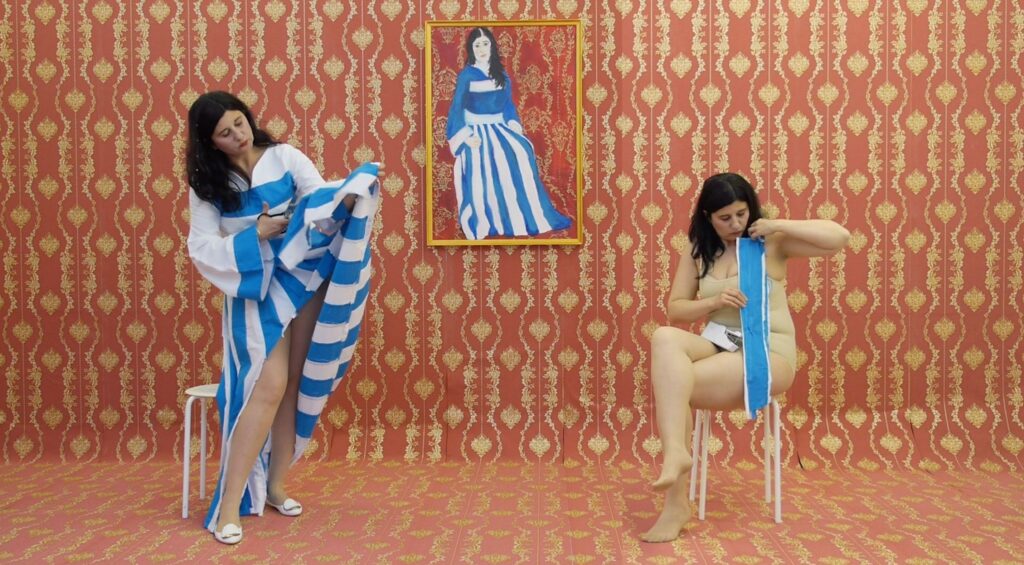
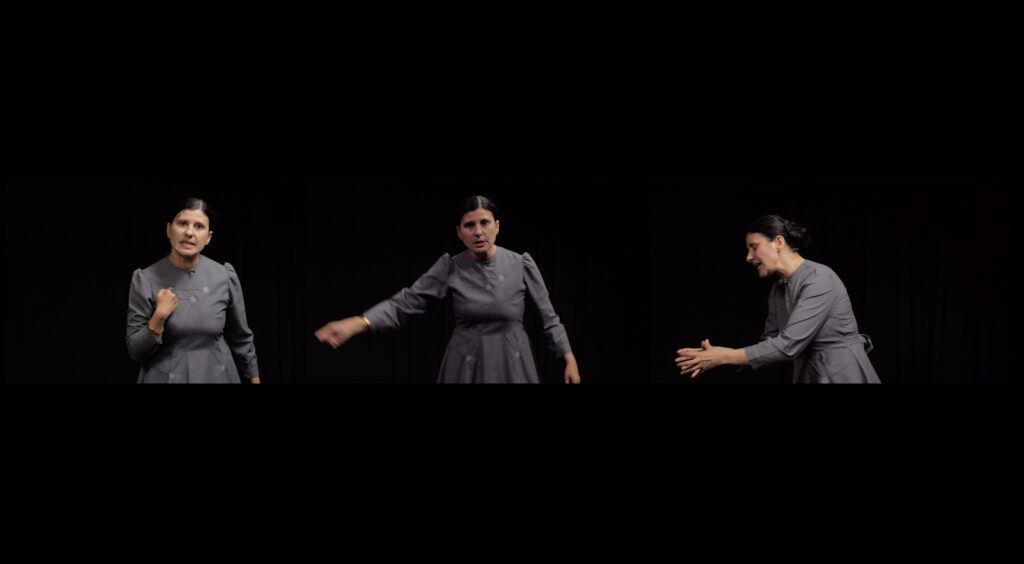
In Menopause, the weight and transparency of the glass make visible an experience that is often confined to the private sphere, both physically and socially. Without showing the body itself, you make its presence felt through the trace left by the pyjamas. In this way, you also question why women’s experiences of ageing and menopause are still regarded as things that need to be concealed. By contrast, in Patchwork, you explore the transformation of the body and identity over time through painting and video. Together with the self-portrait at the centre, two separate video images of Nezaket bring three different representations together. On one side, there is a completed, static painting; on the other, a moving body transforming the material in its hands. In one of the images, you cut your dress with scissors; in the other, you bring the pieces together to create a new garment using a small handheld sewing machine. In the way these scenes address the relationship between body, clothing and action, they also bring to mind Yoko Ono’s performance Cut Piece; yet in your work, reconstruction is just as central as fragmentation. Costume appears not so much as an object that covers the body, but as an element that transforms identity. Sewing the cut pieces back together suggests not the disappearance of an old identity, but its continuation in another form. The past fixed in the painting, the present unfolding in the video and the yet-unknown future of the newly constructed garment also establish a connection with the exhibition title, “Was bleibt, was wird”. How do you see the relationship between these three dimensions of time?
N.E.: As you know, I love art history. I come from a background in painting, but I had not painted for a long time. With this work, I wanted to bring painting back into the picture. I conceived the painting in relation to the traditions of portraiture and genre painting. There are two Nezakets in the video. They look at one another through a green screen, but confronting myself and re-enacting myself was not easy at all. You know that the person standing in front of you is yourself, but you cannot fully grasp them. Both images are me, yet they are different from one another. It was a challenging experience for me. There is a painting in the centre, and Nezaket is there too. So there are three Nezakets. I thought of them as the past, present and future. In the painting, I am wearing a blue-and-white costume. The Nezaket in the video wears a similar dress; her costume is also white and blue. In one of the images, I cut the dress with scissors; in the other, I take the cut pieces and sew them back together into a patchwork using a small handheld sewing machine. The painting, which represents the past, is something completed. In the video, I am doing something in the present, but I do not know what will emerge in the end. Costume has always been important to me. In English, there is the expression “second skin”. A costume changes a person; it affects how the body is perceived and how identity is constructed. When you put on a garment, you can become someone else. Here, too, I was thinking about the relationship between body, costume and identity. On the one hand, there is the question of what I leave behind; on the other, I do not know what will happen next. I draw my inspiration from life. What I experience, what remains behind and what has yet to happen all find their way into my work. The same questions are present in this video installation: “What remains? What will happen next?”
These video installations, which address entirely different subjects, also invite us to consider how a museum can expand its collection without reducing artists to a single identity or subject. Nicole, how do you approach this balance? The commitment to increasing the visibility of women artists and a broader diversity of artistic approaches in the Museum Ostwall’s collection policy is particularly important. I would also like to emphasise an important distinction here: a woman artist does not necessarily have to produce explicitly feminist work to deserve inclusion in a collection, and, as far as I can see, your approach takes this distinction into account. Increasing the visibility of women artists should not be limited to acquiring works that can be explicitly defined as feminist. Otherwise, women artists risk being confined to a particular representational category rather than being evaluated across the full diversity of their artistic production. How does Museum Ostwall address the historical underrepresentation of women artists in its collection policy? How can a balance be established between increasing the visibility of women artists and avoiding the reduction of their work to gender alone? Furthermore, how can the artistic rationale for acquiring such a work complement the broader institutional effort to address historical imbalances in representation?
N.G.: Of course you shouldn’t make the mistake to confine certain groups of artists to specific themes when trying to diversify a museum collection. In the worst case this would reproduce and perpetuate their marginalisation, and so achieve the opposite of diversification. In my view, discussing the question of representation has two dimensions: On the one hand, it is about WHO is telling a story through their art; on the other hand, it is about WHICH STORY is being told. If we consciously strive to create a diversity of voices when researching new acquisitions, this might mean, for example, giving greater visibility to female artists in two of our collection’s key areas – Expressionism and Fluxus. For this reason we have, for example, acquired a cityscape by Gabriele Münter and two chess sets by Takako Saito – both works that do not deal with gender issues in the slightest. However, a pluralistic approach can also mean addressing socially significant issues that have not yet featured in our collection. One example of this could be the paintings by Selma Selman, an artist from the Roma community, whose work in this case explores the economic situation of her family and, by extension, of a group that faces discrimination in Europe. Another example might be the portraits by Joséphine Sagna, which explore the self-representation of Black women in the face of stereotypical external attributions. Or, as a final example, a four-part self-portrait by Billie Zangewa, a Black artist, which focuses on the theme of ageing.
Another related question concerns the geographical frameworks through which art is classified. How does Museum Ostwall make room for underrepresented perspectives without turning artists into representatives of a particular region? What I mean is that, alongside the representation of women artists, making artistic approaches from outside Europe and the United States more visible remains an important issue. In Ekici’s work, the story of a family that migrated from Turkey to Germany, the experience of living between two languages and the fluidity of cultural belonging occupy an important place. The inclusion of artists such as Nevin Aladağ and caner teker, who are associated with different cultural and artistic contexts, in the Museum Ostwall collection also points to an effort to move beyond a single, unified narrative of art history. However, there is a potential contradiction here. Does placing artists from outside Europe in a separate category in order to make them more visible risk reproducing precisely the Eurocentric systems of classification that we want to question? The expression “artists from outside Europe” defines their position from a perspective in which Europe is accepted as the point of reference. In other words, while this terminology makes artists more visible, it can also place them within a category of difference. We rarely use an equivalent classification that takes another geographical region as its point of reference, such as “artists from outside the Middle East”. This raises the question of who has the authority to classify artists and define their artistic positions. Including historically excluded or underrepresented artists in museum collections is, of course, extremely important. Yet efforts to become more inclusive should not lead to artists being continually defined through their origins, geographical backgrounds or identities. How do you address this tension at Museum Ostwall? When making room for artists from outside Europe, how do you assess the boundary between challenging Eurocentric narratives of art history and creating new categories through which artists are defined? How can the collection make different cultural and artistic positions visible while preserving individual identities and artistic distinctiveness that resist such classifications?
N.G.: When you visit our exhibitions or presentations of our collection, you’ll see that these categories – intra-European, extra-European – are not used to contextualise an artist’s work. We also neither regard artists from specific regions of the world as representatives of the whole local art scene, nor female artists as representatives of ‘women’s art’. But yes, we remind ourselves of consciously looking for artists from backgrounds that are not yet part of our collection. We try and stray from the beaten track during our research and broaden our perspective, so that we do not accidentally perpetuate existing mechanisms of exclusion out of sheer convenience. In this way, we aim to gradually build a more diverse collection that is not based solely on works by artists from Western Europe and the USA. It is a fact that the collections of most Western European and US art museums are Eurocentric and US-centric, and also predominantly white and male-dominated. In order to convey this to our audience but also to change this, we do indeed sometimes use, as a stopgap, terms that may be somewhat simplistic. For example, when referring to our Expressionist collection, we often say that it is male-dominated and that we want to give more visibility to female artists. We are fully aware that these terms do not encompass the full range of sexual identities, but the fact is that for most of the artists we are discussing in this context, there is no record of how they would have identified themselves using our current vocabulary. Nevertheless, it is important to make it clear that, in Classical Modernism, the possibility of building a career as an artist was strongly shaped by the gender attributions of the time, and those were based on a binary gender system. To make this fact accessible to a wider audience, we sometimes make provisional use of terms – in this case ‘men’ and ‘women’ – with which they are familiar, without complicating the message with the entire contemporary discourse however right and important it may be. The same essentially applies to artists from Asia, South America or Africa. For a long time, they weren’t mentioned in European art history because, to put it simply, the prevailing narrative was that modernism had been invented in Europe. It was only with Abstract Expressionism and Pop Art that relevant modern American movements were subsequently included. Thus, ‘non-European art’ is less a term that attempts to encompass the countless international art movements than a makeshift concept intended to highlight that the Eurocentric perspective simply failed to see the rest of the world. When acquiring new artworks for our collection, the focus is always, first and foremost, on the content of the work. In the case of caner teker’s KIRKPINAR, for example, for me the most important is how they engages with traditional gender relations from the perspective of a queer person. Of course the artist’s connection to Turkish culture is also relevant for KIRKPINAR, but caner teker wasn’t included into our collection as a “representative of Turkish culture”. That would be a highly reductive characterisation of caner teker’s work. When we talk about ‘non-European’ art during our research for new acquisitions, it’s about finding works that introduce artistic perspectives into our collection which are not yet represented there. For example, if we are exploring the theme of ecology and already have a number of works by artists from Germany or the USA that shed light on certain aspects of the phenomenon – why not acquire a work by the Isuma Collective from Canada that addresses the impact of climate change on the everyday lives of the Inuit in the Arctic? We are of course aware the viedeo work “Inuit Knwoledge and Climate Change” is a very specific perspective on a very specific problem – and not THE “non-European” perspective on climate change.
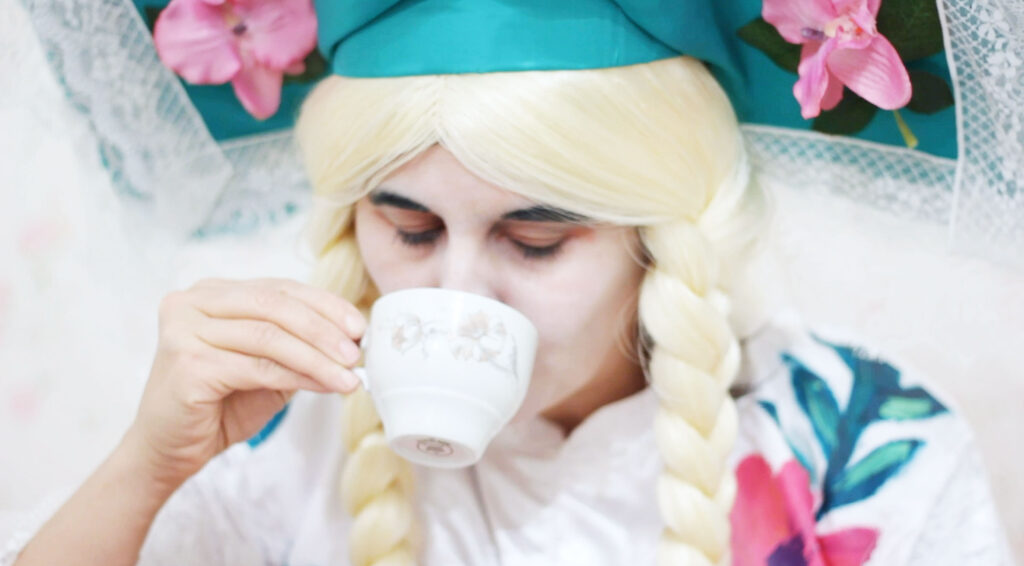
Since we are already discussing the concept of “non-European”, I would like to turn to the video installation Kaffeeklatsch. Here, figures of Nezaket dressed in traditional German clothing portray women drinking coffee and chatting. A ritual that initially appears familiar also becomes a means of questioning how cultural identity is represented. Women coming together and taking time for themselves also allows us to consider everyday life from a feminist perspective. But what is particularly interesting here is that I know you have previously worked with rituals belonging to Turkish culture. This time, however, you turn towards the German culture in which you live. How does your perspective on this culture differ from observing it from the outside?
N.E.: Kaffeeklatsch is indeed a ritual specific to German culture. While developing this performance, I thought about conversations over coffee and cake, particularly the figure of the mother-in-law, because my own mother-in-law also maintains this ritual. I had previously worked extensively with Turkish rituals. Looking at a culture from the outside and recreating it was interesting to me, but I had never approached German culture, the culture I live in, in this way. This time, I wanted to experiment with the German coffee ritual. The idea began with a figure I saw in a tourist area around Lake Titisee in the Black Forest region. I found a figurine in a souvenir shop called a Schwarzwald Puppe, or Black Forest doll, but it had a label saying “Made in China”. The doll depicted a person wearing traditional clothing. It caught my attention, but I was also interested in how the clothing and the figure were represented. Traditional clothing in Germany is called Trachten. It varies from one region to another. However, the doll I saw was a representation that greatly simplified these garments and even depicted some details incorrectly. This was what really made me think. How are a culture’s traditional clothes reinterpreted when they are produced elsewhere? What is the difference between a culture itself and its representation? I developed my own interpretation based on this doll. I did not reproduce it exactly, but I continued to work from the idea of traditional clothing. While researching the concept of “Kaffeeklatsch”, I was also interested in women gathering around coffee. The idea of women taking time for themselves, meeting friends and talking among themselves was important to me. Coming together does not simply mean drinking coffee; it can also mean creating a social space of their own within everyday life, sharing their thoughts and spending time together. The feminist dimension here comes not so much from declaring the ritual itself a political act as from making visible relationships that often go unnoticed in everyday life. There is also an issue concerning the traditional clothing worn by the figures. The traditional costumes I use here are particularly interesting as well. Alongside the Black Forest doll and the Thuringian doll, you can also see the Spreewald doll. I ordered the Thuringian and Spreewald dolls online. Both were original, handmade dolls produced in Germany: “Made in Germany”. The Spreewald doll I mentioned is particularly interesting. The traditional clothing of the Spreewald region is connected to the region’s Sorbian/Wendish culture. Seeing these clothes merely as an example of general “German folklore” can make the region’s multilayered cultural history invisible. This detail makes the question of representation in my work even more complex. The fact that a figure wears traditional clothing does not mean that it accurately conveys the entire history of the culture it represents. Sometimes cultural diversity is gathered under a single national identity, and the histories of different communities become mixed together within that representation. Working with dolls actually offers me a very powerful opportunity to reflect on how cultural identity is produced and circulated. At first glance, the Spreewald doll appears to be wearing German folkloric clothing, but in reality it is connected to Sorbian culture. These details were important to me. I researched the figures, examining how they were produced and how they were represented. In other words, the objects representing a culture had been produced in different places. The object representing a culture had itself become part of another cultural and economic circulation. I took this contradiction as my starting point.
paintings, dolls
In Kaffeeklatsch, we can read the coffee ritual not only as a cultural tradition but also as one of the ways in which women create space for themselves in social life. Although domestic life is generally associated with the private sphere, women coming together can create opportunities to share experiences and discuss their everyday roles with one another. The coffee table is therefore not merely a setting but a space for social encounter. At the same time, traditional clothing and figures produced in different countries reveal how cultural identity is represented and sometimes simplified. The three Nezakets chatting among themselves present an initially familiar and humorous image, yet the humour does not diminish the criticism directed at the standardisation of cultural representation. The fact that you are both part of the culture in which you live and able to look at its images from a certain distance is one of the striking tensions in this video installation.
Finally, I would like to ask Nicole a broader question about how collection policies shape art history. A museum collection is not simply an archive bringing together artworks produced in the past; it also functions as an institutional structure that helps determine which artists and experiences will be remembered in the future. Acquiring a work for a collection indicates not only that it is considered valuable today, but also that it is deemed worthy of being researched, exhibited and reinterpreted in the future. However, including artists who have been underrepresented in art history may not be sufficient in itself. How these works are exhibited, the contexts through which they are interpreted and the relationships they establish with other works are equally important. Otherwise, even if the collection becomes more diverse, the historical framework through which the works are understood may remain unchanged. How does Museum Ostwall address this issue through its collection policy? How can the acquisition of works by new artists provide a starting point for transforming established narratives of art history? More specifically, can increasing the visibility of women artists, artists whose work has been shaped by experiences of migration, and artistic approaches that have remained outside dominant Eurocentric narratives transform not only the museum’s collection but also the way we tell the story of art history?
N.G.: I believe that Eurocentric narratives in museums cannot be dismantled simply by more diverse acquisitions. I consider it necessary to critically examine the history of our own collections and to make this examination publicly visible. In our MO_Collection Presentation “Art –> Life –> Art. The Museum Ostwall yesterday, today and tomorrow” (2023-2026), we included, for example, a section in which we examined how the founding director, Leonie Reygers, collected art in the 1950s and 1960s, and why. Her collection policy was rooted deeply in the very specific historical situation Germany was in after National Socialism and then during the Cold War. We also discussed how the writing of art history has changed since then. We explained why art history had been Eurocentric and how art from, for example, India or Egypt was preceived in the 1950s or 1960s. And we pointed out how e.g. postcolonial studies have transformed art history in recent decades. If we want to change things, these aspects have to be addressed explicitly and in a way that is accessible to the audience. An example from the current presentation of the MO_Collection “let’s talk. discUSsing art” are the ‘context labels’ for selected works. In addition to the main theme of the exhibition, they provide further information about issues that we engage with in our critical museum work, e.g. institutional issues but also critical reflections on the relationship between an artist’s work and their biography. However, our engagement with critical reflection on the structure, role and purpose of the museum extends to our entire museum work, not just the expansion and presentation of our collection. Our temporary exhibitions and the educational work of the MO_Art Education Team also incorporate an examination of issues such as these. It’s like a guiding principle, which is also endorsed by our museum director and and further developed by her in collaboration with all departments. In addition, we have been working with the MO_Advisory Board for the last three and a half years. This is a group of eight people from Dortmund with very diverse backgrounds, who contribute their critical perspectives to the museum’s work. Their current project, fricti:on, for example, features artists from different disciplines like music or literature who create a work of art in dialogue with a piece from the collection.
In this way, it is possible to gradually develop a polyphony that may not entirely break with the historically established narrative, but which can highlight its weaknesses and enrich it with different perspectives.
Nicole, thank you very much for your thoughtful and detailed answers. I would like to end the conversation with the question to Nezaket raised by the exhibition title, “Was bleibt, was wird”: As an artist, what remains of your personal memory? How does this memory change when it is passed on to others? And how does art create a space for experiences whose forms we cannot yet know?
N.E.: For me, the starting point of art is often my own life, what I have experienced and what I have observed. Sometimes it is a dream, sometimes the story of a family member, sometimes an object I encounter in everyday life or a change I experience in my own body. I start from these things, but I never know exactly what will emerge in the end. Certain things remain from the past, but I do not repeat them as they were. I return to them, transform them and present them in another form. Sometimes I recite my father’s poem in my own voice; sometimes I turn a process I have experienced myself into an installation. What matters to me is that these experiences can reach other people, too. That is why the question “Was bleibt, was wird” is so meaningful to me. I do not always know what I am leaving behind or what will happen next. But when I make art, I continue to live with this question.