

A quarter century has passed since his early work White Collars (2001), and Burak Delier—whom we know through characteristic, political, and oppositional works such as Untitled (2004) (also known as the EU Veiled Woman), Parkalinç (2007), and Madımak ‘93 (2008)—now presents his latest work Catastrophe Agreements, documented in a video that has been available on Vimeo and circulating on social media for about a month.
In his works, Delier operates like an endless canvas whose conceptual space evolves through his ideas, engaging with notions such as value, exchange, public truth, and autonomous aesthetics. In this new project, departing from Istanbul, he opens up for discussion the “value” of catastrophes around the world and the possible forms of their exchange.
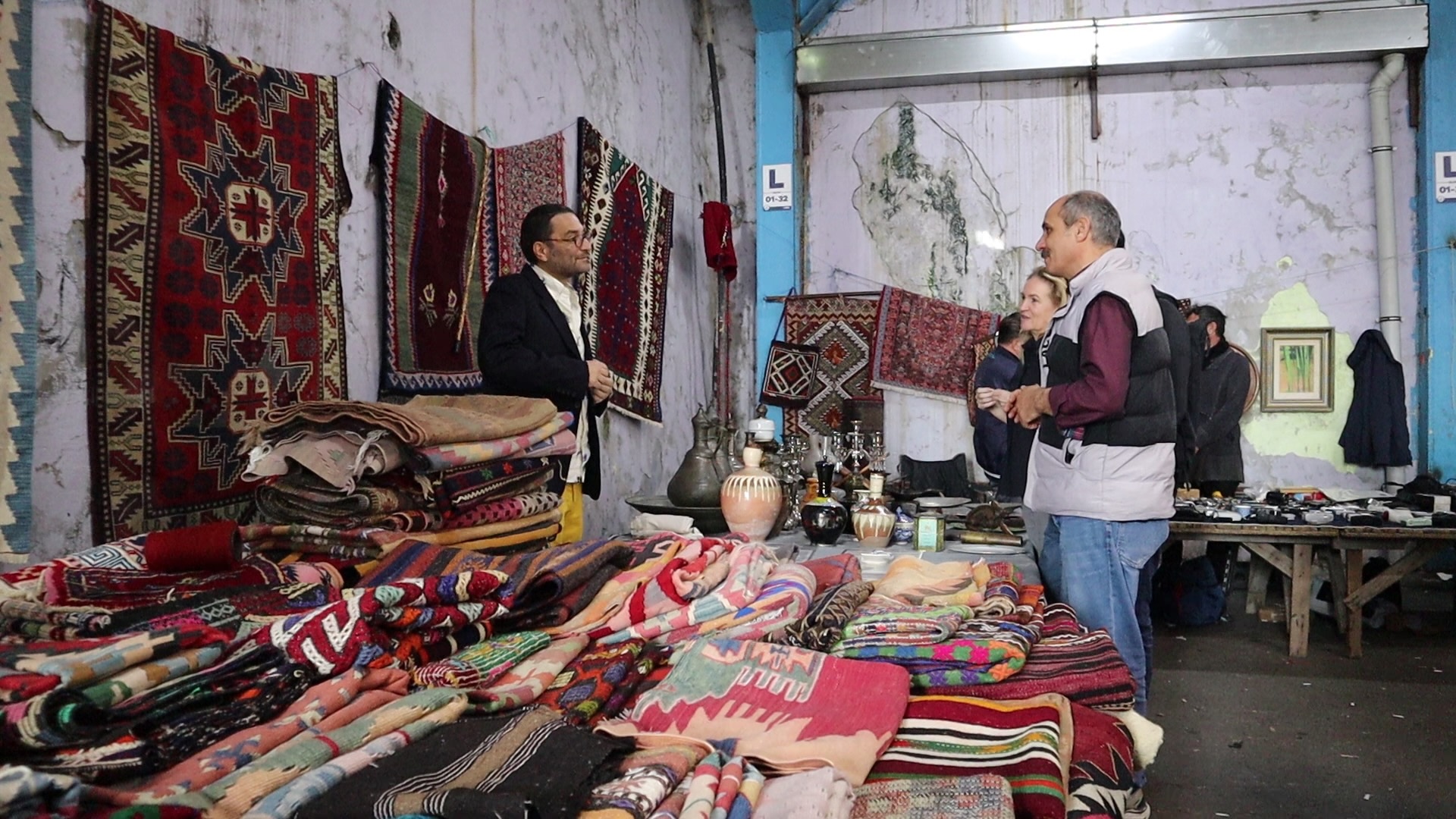
With its 10-minute duration, the work carries the composure of an official documentary. Yet in this piece, the artist assigns six disaster scenarios to the six fragments of a family plate that was “accidentally” broken, and distributes these to citizens at the Feriköy Flea Market in Istanbul through bonds/agreements of his own design.
With its investigative, ironic, and critical form, the work maintains its affinity with earlier projects in the artist’s career, such as Artistic Risk Transfer Contract (2022) and The Artist as a Fraud (2015). In Catastrophe Agreements, camera and sound are by Mevtan İpşir, while the text and editing are undertaken by Delier himself. The artist also includes official sources he references in the work, with the aim of activating the viewer. Among these sources are the Istanbul Tornado videos on YouTube, catastrophe investments known as CAT bonds in financial markets along with Yahoo! Finance content, as well as records of the August 17 Gölcük Earthquake and the Istanbul Metropolitan Municipality’s booklets on potential earthquake losses.

Under these circumstances, at a time when both Turkey and the world are living each day at the level of disaster and are unable to lift their heads from war, earthquakes, floods, and drought, it becomes inevitable to speak with Delier about his latest work and its resonances.
Burak, your latest work Catastrophe Agreements, which you’ve begun sharing with audiences in video format on Vimeo, seems to present itself almost like a fictional character introduced into mass communication networks—like those seen in public transportation systems. The work, which carries the tone of a warning film, appears to deliver information to viewers in a composed, almost clinical manner. For some time now, we’ve also been observing an increasing engagement with this 2025 work through social media. Wars and disasters have become routine. That’s precisely why I wanted to meet with you. What made you feel the need to produce and edit this video?
Ah, like a “public service announcement”—you’re right! I suppose the documentary tone creates that effect. Honestly, as people living in Istanbul/Turkey, we already know and experience that the disasters to come generate a certain kind of economy, and that this economy shapes our lives. Some of us are moving away from Istanbul, some are unsure about their homes, some lose their homes. It’s also evident that this economy is, in a way, “two-faced” and reproduces certain class relations.
What I mainly focused on was the strangeness of the financial instrument known as catastrophe bonds, as a phenomenon that essentially describes capitalism. Catastrophe Agreements became a work that tries to explain what it means for an upcoming disaster to be mediated through a capitalist framework.
We know that capitalism destroys—nature, people, cities… But we also see that it can generate profit through destruction. It “plays with death” and wins! Moreover, it turns what it destroys into a bet, a game. I wanted to discuss this—to make it discussable.
It’s a work that almost asks us whether “evil” itself can have value, and whether that could even be considered a legitimate right: Catastrophe Agreements. What do you think?
Capitalism seems deeply intertwined with gambling behavior. Perhaps we used to think in terms of labor-value, but today gambling appears to have spread into every aspect of life. Contemporary capitalism produces “value” through play, through betting. That’s also what the financial system does. Of course, workers still labor and produce in the traditional sense—we witness the deaths of miners in Turkey, the resistance of workers against injustices in markets. But financial operations overwrite all of this.
The “catastrophe bonds” traded in markets—some of which are not even accessible to individuals but operate within a B2B (Business to Business) framework—function in this way. If you are a large fund, you enter these kinds of bets and generate massive profits over three or four years.
And typically, investors do not lose their money; even when a disaster occurs, debates begin afterward: Was the earthquake really a 7.5? Did the damage really exceed a certain amount? Law, mathematics, and calculations come into play—and as you might expect, these processes often favor the funds. When I was thinking about this work, the hurricane in Jamaica and catastrophe bonds became the subject of exactly such a debate. My impression is that, one way or another, this money does not return to the people affected by the disaster—investors win. Very familiar, isn’t it?
Does Catastrophe Agreements also raise an eyebrow at the sector known as “insurance”?
Of course… “Reinsurance,” that is, the insurance of insurers, is one of the main points of discussion. When you look at the development of financial markets, insurance is actually the point of departure. Financialization first develops out of securing risks in agriculture. Take corn or cotton, for example; since you cannot know what the yield will be—whether there will be drought or flooding—you sell next year’s yield in advance at an average price in order to secure yourself. When that day comes, you might have made a large profit, but you give that up in exchange for protecting yourself today against potential losses from drought or flooding.
But then something else happens: let’s say someone buys it for 2 lira. When bad weather is anticipated, the value of cotton increases and rises to 10 lira. So they can sell that 2-lira paper for 10 lira. Then someone else, and then another… the paper changes hands speculatively over time, and the matter moves away from cotton, climate, or production altogether—it begins to circulate entirely within a speculative field.
Well, in this sense, I think the work says a lot about the “art market” as well. Because the artwork is also speculative; it has a value determined by the narratives surrounding it. This doesn’t mean it isn’t real—it is absolutely real—but reality is not where we expect it to be. Today, for instance, the “Anthropocene” is fashionable and functional, or “identity”… without these discursive fields, a work of art or an artistic stance has no value. Curators and artists compete by acting like DJs among the narratives, discourses, and concepts of the day, making themselves valuable and “contemporary.”
Since your work The Collector’s Wish (2012), I see that you have been engaging with this subject through different forms and arguments. When I think about disaster probabilities, global warming also comes to mind. How close is this work to global warming, which is overturning the world and the seasons? I would also like to think about this as a mirror for the art market: to what extent does this work anticipate unpredictability?
In fact, this is a work deeply related to unpredictability and global warming. For instance, tornadoes used to be rare in Istanbul. Today, they have become ordinary.
So can we say that today we are exposed to both natural and “supernatural” disasters?
That’s exactly why I call it a catastrophe. The state calls it a “disaster” (âfet), because then it appears as something natural! But what we are experiencing—storms, tornadoes included—is no longer natural. Istanbul is no more “natural” than they are. Everything is in our hands.
Let’s think through Catastrophe Agreements: For example, there is a fund that has been accumulated for about 25 years through DASK, right? That money could easily be used to rebuild places like Avcılar in Istanbul, to construct earthquake-resistant buildings. But this is not being done; instead, the earthquake is being awaited—and in fact, the construction market that the earthquake will trigger is being anticipated.
The “public service announcement” feeling you pointed out in the video could have been amplified even more. This is actually a shortened version. I needed to show how materially concrete the conditions that determine all of our lives are. That’s why the film carries that “educational documentary” tone, and I value that aspect.
“The state and financial reason do not approach this from a social perspective, as an urban right on behalf of citizens.”
Can we say that your project also exposes the lie of disaster preparedness between poor and wealthy neighborhoods in Istanbul and across the world?
Of course. When you walk along Bağdat Avenue in Istanbul, you see that the opposite side has been completely renewed, with extremely expensive buildings constructed. It can be said that all of Kadıköy, Fenerbahçe, and the surrounding areas have been demolished and rebuilt—but there was no need for this. Those buildings were three or four stories high and would have suffered less damage in an earthquake, yet they were replaced with twenty-story buildings. The number of floors indicates rent, not need.
On the other hand, when you look at places like Avcılar or Zeytinburnu, you see a different kind of transformation. This operates entirely as “gentrification,” as a form of demographic change. If you have money, you can renew your building. The state is very clear on this: the central subject is contractors and facilitating their work. Those of us living in those buildings—tenants, residents—are not the focus. There are no financial instruments that prioritize us. The state and financial logic do not approach this from a social perspective, as an urban right for citizens.
In this work, with the Catastrophe Agreements “stall” you set up at the Feriköy Flea Market, you give bonds to customers in exchange for broken pieces—bonds that have become increasingly familiar in the art market through the crypto era and Bitcoin. Well, the “Flea Market” and “Bitcoin” also come together. That’s ironic. In this sense, editions can even be read as a kind of creative bond—you sold a few pieces too, what do you think?
Ah, honestly, I had never thought about the “Flea Market and Bitcoin” connection! My focus wasn’t the market, but inevitably, while working on this piece, I went there frequently for observation. And there is a very clear connection between the flea market and catastrophe and death. For example, at the flea market that gathers around the church perimeter in Dolapdere, you can encounter a much more “catastrophic” scene compared to the Feriköy Flea Market. In Dolapdere, everything is more fragmented. In that sense, it relates more directly to my other works. You see a complete state of plunder there. In fact, as you know, I also made an artist book titled Mystic Conference in 2024 on this subject.
Although the Feriköy Flea Market is more orderly, the underlying narrative is the same: these are things left behind by the dead—objects that have been somewhat sanitized, kept intact. Normally, broken pieces are not sold at the Feriköy flea market! But the items there have survived whatever catastrophe they encountered with a few scratches; perhaps they have been repaired and made ready for use again.
Since it is a place of things that have passed through death and catastrophe, presenting these fragments there—within a new narrative—to viewers and buyers felt very fitting. At the same time, of course, this is also a market, just like the stock exchange—but face-to-face, tactile. In terms of the pleasure of trade and the impulse of gambling, it is more direct, in a sense more honest…
Can we say that you operate not as an artist but more like a kind of NGO?
In a way, yes. All of these elements come together.
If this work were to be viewed in geographies such as Japan—where earthquakes have been normalized on a mass scale—or the Russian Federation, where massive gray housing blocks have become routine, it seems it would open up entirely different readings and perceptions. It is a work that also puts its own meaning into speculation and transforms it depending on where it goes.
Of course, at the same time, it’s something like this: I’ve started to think that I could even make a second version—for Norway, for the Netherlands. It could of course be updated with floods, snow, cold. Like the global warming element you mentioned, it could also be made for wars; as the number of catastrophes increases, catastrophe markets also evolve and can be further developed. It was very important to present the video together with its context. Otherwise, it would have dissolved like a one-day performance, a fleeting artistic gesture. But by establishing the context, by demystifying it, the work settles more firmly—although the art world doesn’t really like this kind of directness; it is more enamored with artificial mysteries… but I value it.
Let’s move through speculation: this is also a work that gestures toward the “auction” institution of contemporary art. You continue to discuss, through this work, the question of who determines value—and even non-value. Again, what is your view on the question, “Who owns property?”
Today, in the field of art, the narrative that surrounds and determines the work—from the curator’s and artist’s discourse, to the label of the work, the prestige of the museum or gallery, the photographs and videos circulated on social media, interviews in magazines, the artist’s social media accounts, poses, and recent political posts—is far more important than the work itself. Value and meaning emerge from this visual-auditory, discursive cloud that we assume to be secondary; they are formed there. In fact, objects—the material artworks—are secondary. And because of this, art already directly resembles the “stock market,” the logic of finance.
Recently, we have witnessed the weakening of artists, initiatives, and small galleries in Turkey and around the world. The art world reproduces the extreme inequalities of the global system. Our contemporary art institutions, in particular, have performed very poorly in recent times—and continue to do so. But that is another matter. I am trying to see what I can do outside these networks of power and the issues on their agenda, which are often not mine. I think that if artists and curators want to do something even slightly meaningful, they must attempt to act outside these networks and institutions—even if it is risky and painful.
İstediğin gibi birebir, akıcı ve ArtDog tonuna sadık çeviri:
Based on what you’re saying, can we say that Catastrophe Agreements is also a work that helps us understand who appropriates and transforms “value”? Because there is a significant difference between owning the object of a narrative and standing behind its transformative potential.
Yes, the way the work is realized and the way it enters circulation are the main issues. It emerges from the market, enacted by a singular subject—a person. Yes, an artist or an artist-like figure, but still acting in an uncontained, unpredetermined, uncoded way. Then the work continues through social media via its video. From that point on, we don’t know where it will go, or whether it will go anywhere at all. It is now in the hands of the general audience. But I imagine that my dual position (artist and street-level financier) will provoke certain reflections.
So how many pieces / agreements did you sell at the Feriköy Flea Market?
The plate broke into six pieces. This created six scenarios: “Flood,” “Hail in August,” “Storm,” “Earthquake,” “Tornado,” and “Heat.” Disasters that could occur in Istanbul. The point of the work lies in the requirement that the buyer of the piece/agreement must return it to me after the specified disaster occurs. In other words, the buyer is essentially placing a bet on their own life or on the damage they might experience.
If they survive or get through it with damage, they will earn some money. Or they may choose to own a work of art and its certificate—perhaps that is more valuable, of course, if they are still alive. Since I don’t know my own market value, perhaps it might help them a little after the catastrophe—I don’t know. Whether they sell it as art or bring it back to me to receive money, in both cases the buyer needs to survive. If the buyer dies and I survive, then I will be the one who wins—assuming I’m alive!
“There is a strange pleasure in the moment of bargaining; the phenomenon of betting has an existential, deeply unconscious dimension related to life and death.”
Through your projects, you seem to insert yourself—like a Trojan horse—into certain sociopolitical mechanisms, especially cultural institutions, making their existence, consistency, fairness, and value debatable. There is also a desire to transform the world in this. For that, you instrumentalize art. Is there “good intention” or idealism in this stance? I also sense an anarchic aspect. You “baste” yourself into the system. What do you think?
Yes… art itself is also a socially and historically constructed field, one that emerged under certain conditions; it has existed for at most two or three centuries—like nationalism, capitalism, or the family. There is a parallel between the historical formation of capitalism and the formation of the art field. I understand the Trojan horse metaphor, but “basting” fits better. I move like a messenger or a bee between different fields, carrying things from one place to another. I don’t always work in the same way—I have various hats, it’s difficult to summarize quickly. Sometimes it may function like a Trojan horse.
In this latest work, an issue emerged regarding our behaviors and the systems we are part of. I thought we would talk about catastrophe finance in the market. Bargaining was, of course, part of the work. But people are really quite strange! Our entire time at the flea market was spent bargaining! This was deeply alienating. There is a peculiar pleasure in buying and bargaining; the phenomenon of betting has an existential, deeply unconscious dimension tied to life and death. It feels strange, yet also human.
Erwin Goffman, who writes on patterns of behavior, has interesting ideas on this. He touches on aspects that Marx left incomplete: he emphasizes the “gambling behaviors” embedded in every decision we make. Risk and unpredictability inevitably trigger a gambling mentality and consciousness, and there is a certain pleasure in this. It is impossible not to recall Mallarmé’s “A Throw of the Dice Will Never Abolish Chance.” This also explains why the agreements suddenly generated such excitement in the market. Against my rather “NGO-like,” well-intentioned, naïve stance, people come and say, “Oh, how interesting—art, catastrophe, and it’s cheap, I should buy it!” Some even wanted to price the agreements very high and buy them all! That’s probably why I will make a second one!
We say that there is improvisation in the project, the roles we knowingly or unknowingly perform—and this brings Beckett and Brecht to mind. Existentialism, Kafka, otherness, Marxism, anarchism, and anti-capitalism follow one another.
That circulation is appealing… Godot is also awaited in a post-catastrophe landscape… post–Second World War Europe? Probably. But would Godot’s arrival be the catastrophe, or his absence? It feels like his arrival would be the greater catastrophe…
Compare a shopping mall with a flea market: in a mall, everything appears as if life is perfect. No disasters occur. A flea market, on the other hand, is established at the end of disasters. Either the belongings of the dead change hands, or people are forced to sell everything in desperation. That’s why we discussed this with the antique dealers there. Some even brought me shattered plates, saying, “You can sell this too, brother.” Because for them, a broken plate is something unsellable.
Perhaps this is where the magic of art lies. In the end, I sold a broken plate. Yes, it didn’t amount to much money, but in terms of value, money is secondary here. Those broken pieces have now become the protagonists of another story; at the same time, it is a story that can be converted into money. That’s what art can do. We sell this broken piece through that agreement, and that story gives it its singularity—it produces meaning and value.
We create that meaning together with people. This is something we have lost today in institutions and galleries. A problem similar to finance also exists in the art market: pre-packaging works, artificial sophistication and mystification, determining in advance what should be understood… very common. Artists and curators also produce in this way—imagining a viewer in advance, probably a famous curator or a prestigious collector, and producing accordingly. Risklessness spreads everywhere—there is no gambling, no throw of the dice. Works become sterilized. The sense of surprise is exhausted.
Now the owners of these agreements must be looking at them and thinking: “I bought this—what do I do with it now?” That creates many questions and strange emotions—which is something quite beautiful.
Did you produce a text before preparing this project?
No. But the issue of earthquakes and catastrophe was constantly circulating in my mind. I was looking at old Ottoman Bank bonds and securities at the Archive and Research Center in Salt Galata. I was very drawn to their ornamentation, their minor art, their graphic aesthetic. They were already made unique through craftsmanship to prevent counterfeiting—locking value by artificially singularizing it. Starting from the uniqueness of the artwork, I also moved toward designing the agreements as unique objects. Art and money run in parallel here as well. So when I began by designing bond patterns, the idea that catastrophes are also unique—after all, every crack resembles another but cannot be replicated—emerged from this. Then I saw that old bonds and securities were being sold at the flea market. The project developed from there.