

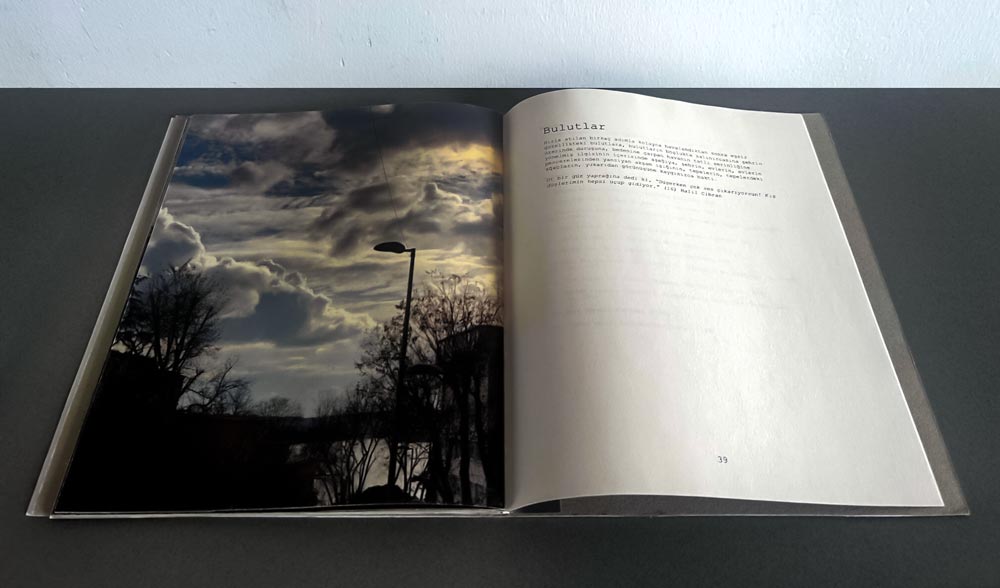
The exhibition “İçeriye Doğru” (Looking Inward) by Turan Aksoy is on view at ARUCAD Art Space in Lefkoşa between 12 March and 11 April. Centering on the artist’s long-standing practice of handmade artist books, the exhibition unfolds the images, texts, and conceptual layers emerging from these books as a narrative that expands into space. Here, Aksoy’s books are no longer objects merely to be read or viewed; they transform into experiential fields that establish their own internal systems, slow the viewer down, and turn the act of looking into a process of thinking.
In this exhibition, the book is not treated as a form that is closed and placed on a shelf. Instead, it appears as a structure that expands as it opens and multiplies as it comes into contact with space. The gaps between pages resonate with the spatial voids of the exhibition itself; the pauses within the books merge with the visitor’s movement through the gallery. In this sense, İçeriye Doğru becomes not simply a collection of works but a state of reflection in which the viewer participates with their own body.
A Book as a Field of Thought
For Aksoy—who works across multiple disciplines—the artist’s book is not a secondary practice but a primary mode of expression. An idea may appear at times as a painting, at other times as a three-dimensional object, a photograph, or a book. This fluidity can be understood as a consistent method within the artist’s practice. In the exhibition, books are presented as open pages that expand into the space through enlarged visuals and textual fragments, turning each book almost into a micro-exhibition of its own. As viewers move between the pages, they also navigate within a physical narrative.
Aksoy’s handmade books push boundaries not only formally but conceptually. Pages occasionally transform into three-dimensional objects; layers overlap, and some surfaces invite not reading but sensing. Collages, photographs, aphorisms, and found images come together to form a fragmented yet dense visual universe. Rather than following a linear narrative, this universe operates like an internal monologue shaped by associations. The book form becomes not simply a carrier of ideas but a space that shapes thought itself.
The Shadow Trilogy: Fault Lines of Representation
A significant part of the exhibition is devoted to what the artist calls the Shadow Trilogy: Minyatürün Gölgesi (The Shadow of the Miniature), Yanıltıcı Bir Gölge (A Deceptive Shadow), and Durmaksızın Değişen Gölge (The Ever-Changing Shadow). These books revolve around a concept Aksoy has long explored: shadow. Here, shadow is not merely a physical phenomenon but also a key to thinking about representation, presence, absence, and intervention.
The Shadow of the Miniature examines the historical and political background of Eastern visual traditions while subverting the shadowless, two-dimensional world of miniature painting. Images embedded in cultural memory are reconstructed through ironic arrangements and visual insertions. By revisiting the symbolic language of miniature painting from a contemporary perspective, Aksoy makes visible the political weight carried by images that exclude shadow, corporeality, and depth.
A Deceptive Shadow is based on anonymous photographs the artist collected from flea markets and antique shops. The common feature of these photographs is the accidental appearance of the photographer’s shadow within the frame. Aksoy focuses on this involuntary intervention that reveals the invisible. Although the photographer’s shadow may initially appear as a flaw disrupting the purity of the image, it gains meaning precisely through this disturbance. It reminds us that representation can never be neutral; every image inevitably carries the trace of a subject behind it.
The final part of the trilogy, The Ever-Changing Shadow, takes inspiration from Claude Monet’s idea of “constantly changing light,” exploring the fluid nature of light and shadow. Images in which figures and objects merge create an impressionistic atmosphere, while words integrated into the book structure multiply this sense of transience on the level of language. Here, shadow is no longer a fixed trace but a presence that continuously transforms and shifts.
Within Aksoy’s practice, shadow can also be read as the trace the subject leaves upon the world. What interests the artist are the small ruptures created by shadow—the glitches in the image and the emotional intensity carried by those disruptions. Shadow appears simultaneously as intervention and testimony, as absence and excess.
Istanbul: A Fragile Dialogue with the City
The exhibition also brings together works focusing on Aksoy’s urban experiences, particularly through the books Deplasman (Displacement) and İçeriye Doğru İmkânsız Bir Köprü (An Impossible Bridge Inward). Produced largely in the context of Istanbul, these works reveal the artist’s distant and fragile relationship with the city. Deplasman approaches displacement as a strategy of artistic production, demonstrating how context dissolves or transforms through objects encountered in unexpected places. Photographs, stencil-like imagery, and short texts carry traces of a restless gaze wandering through the city.
An Impossible Bridge Inward, named after the metaphor of the bridge, narrates a more internal journey between the two sides of Istanbul. Here, the bridge is not only an architectural structure but also an image carrying notions of transition, separation, and solitude. Aksoy’s empty streets, misty roads, and ghostly bridge silhouettes transform the city from a lived environment into a state of mind. The silence of public spaces resonates with a sense of personal withdrawal.
The Exhibition as an Open Process
With their material experiments and irregular structures, Aksoy’s handmade books create a visual flow that resists control. These works deliberately disrupt expectations of a conventional narrative, inviting viewers not into a completed story but into a field where fragments circulate freely. The language built through abstraction, repetition, and reduction reflects a world in which things no longer form a coherent whole.
By bringing together these diverse productions, İçeriye Doğru frames the exhibition not as a final result but as an open process. Aksoy’s books open a wide field of thought stretching from the city to shadow, from anonymous images to personal experience. The exhibition invites viewers into a slow transition—from the external world to the interior, from images to emotions, from objects to memory.
Perhaps for this reason, İçeriye Doğru can be read less as a conventional exhibition than as a threshold: an in-between space where shadow, the city, and personal memory intersect—where looking becomes, at the same time, a turning inward.