
In 2001: A Space Odyssey (1968) by Stanley Kubrick, an ominous black monolith marking key turning points in humanity’s evolution appears repeatedly throughout the film. Maurizio Cattelan’s America (2016)—a fully functional toilet cast in 18-karat solid gold—essentially performs a similar function in reverse, evoking the sense that it emerges at the lowest depths of cultural collapse. First exhibited in a restroom at the Guggenheim Museum in 2016, the year Donald Trump won the U.S. presidential election, America disappeared after being stolen from Blenheim Palace in 2019.
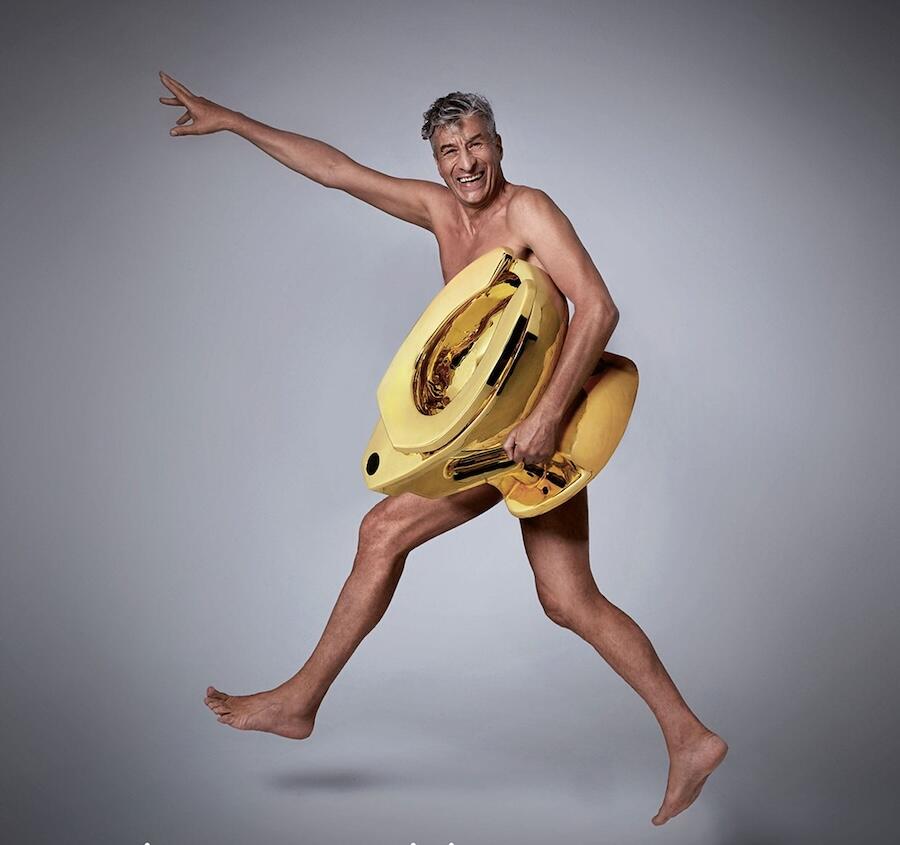
Amid the chaos of Trump’s second term, a second version of the work resurfaced at a Sotheby’s auction in November, selling for a price just over its weight. Today, at a moment of overwhelming global economic crisis, this $12-million golden toilet stands as a perfect symbol of a society obsessed with spectacle and stripped of function—or, more simply, of a disastrously bleak year. Whether or not one believes in prophecy, America’s return coincides uncannily with a pervasive sense of social regression, in which economic turmoil and rising authoritarianism increasingly threaten the space of artistic expression.
This year, the Trump administration’s hostile attempts to bring American cultural production under control included efforts to cut funding to the National Endowment for the Arts and a presidential executive order aimed at purging museums of ideologies labeled “inappropriate, divisive, or anti-American.” While the president did not directly cancel American Sublime (2025)—an exhibition centered on Amy Sherald’s Trans Forming Liberty (2024), which depicts the Statue of Liberty as a transgender African American woman—he framed the artist’s withdrawal from the National Portrait Gallery as a personal victory. Moreover, the Trump-backed American Arts Conservancy selected Alma Allen, a white male artist working within the supposedly apolitical realm of abstract sculpture, to represent the U.S. Pavilion at the next Venice Biennale.
A development seemingly less political but no less unsettling unfolded on the eve of Art Basel Paris. Thieves hacked the security system of the Louvre Museum—it soon emerged that the password was simply “Louvre.” While the culprits remain at large after fleeing with jewels, museum authorities declined to accept the resignation of director Laurence des Cars. The incident took on an eerie pop-cultural afterlife when the thieves quickly became one of the year’s most talked-about contemporary Halloween costumes.
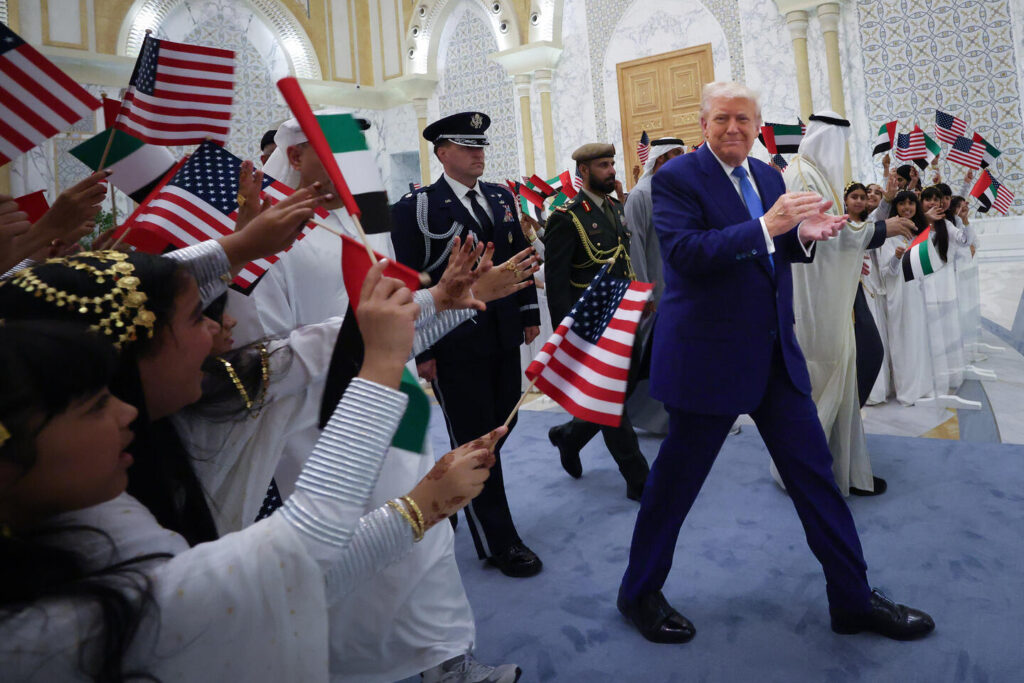
Uncertainties surrounding the global economic downturn in 2025 were also keenly felt in the commercial art world. As fairs adjusted to shrinking market conditions, canvases grew ever smaller, while high-profile galleries such as BLUM, Clearing, and Sperone Westwater closed their doors permanently. In May, Western CEOs in search of new investment turned with Trump toward the Gulf states, securing billions in funding for ventures ranging from artificial intelligence to healthcare. The art world soon followed suit, with the first editions of Art Basel Qatar and Frieze Abu Dhabi announced for 2026.
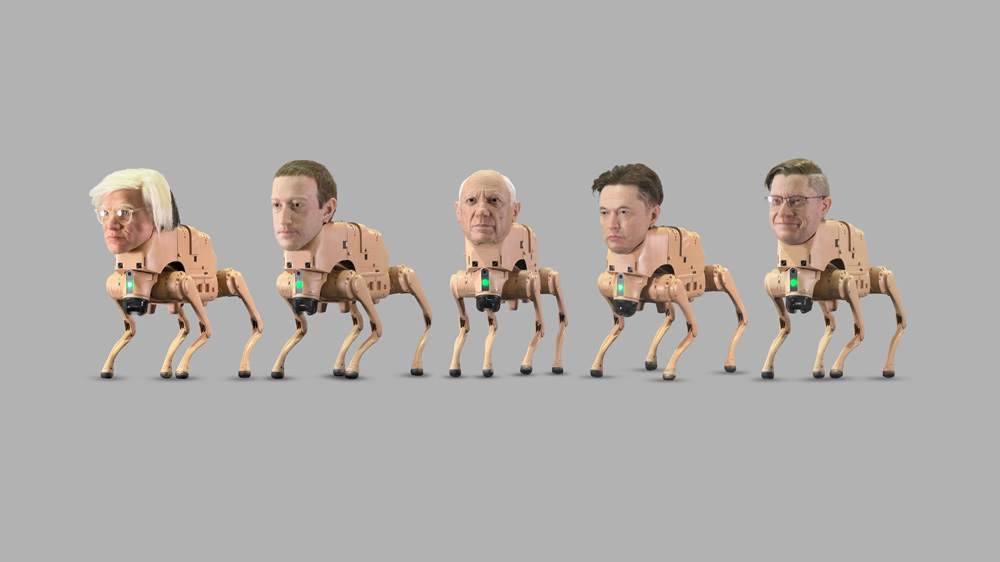
Looking back to the visionary aesthetics of A Space Odyssey and Kubrick’s meditations on humanity’s place in the universe, it becomes clear how profoundly the rapidly advancing technologies of the Cold War era shaped the cultural imagination. By contrast, today’s AI-driven global competition offers an artistically barren landscape. Among the works to emerge so far, Beeple’s Regular Animals (2025) stands out: a kind of artificial zoo populated by robotic dogs bearing eerily realistic models of Mark Zuckerberg and Elon Musk. To be frank, it is not a good artwork. Yet in its commentary on the infiltration of tech oligarchs into everyday life, it remains one of the few pieces at Art Basel Miami Beach that genuinely captured the spirit of the moment. As the ultra-contemporary art bubble deflates and the market’s focus shifts toward artists of the past, collectors’ growing reluctance to invest in today’s artists is becoming increasingly apparent.
It is possible to empathize with the desire to reclaim time without embracing the slogan “Make America Great Again.” Exhausted by the everyday instability of 2025, we seem to have collectively lost our ability to imagine the future. Pantone’s decision to select a shade of white as its color of the year for 2026 felt like a visual equivalent of saying, “Sorry, nothing came to mind.” Artificial intelligence, meanwhile, has functioned less as a generator of creative momentum than as a mechanism for recirculating existing intellectual property.
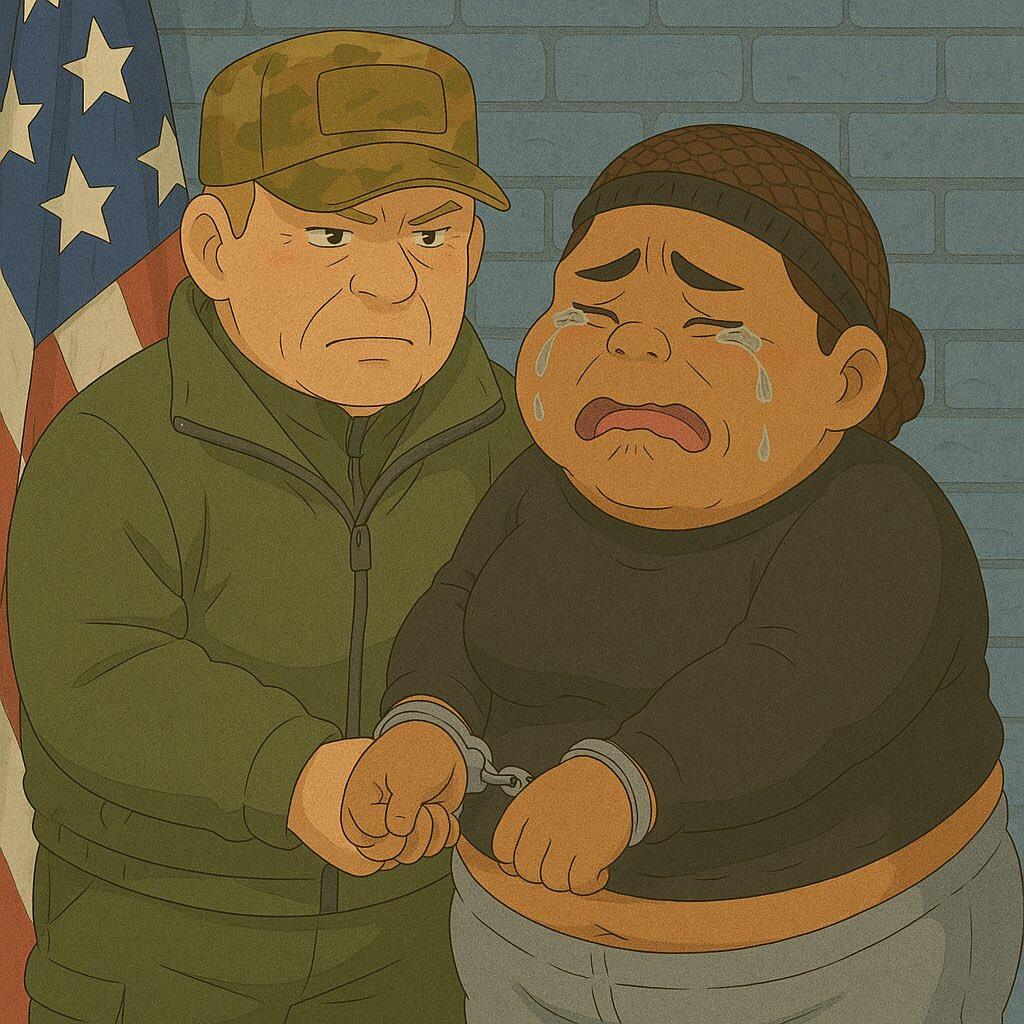
The most striking example of this tendency was the “Studio Ghibli–ification” craze, one of the most viral trends of 2025. Users uploaded their images to ChatGPT, instantly producing a superficial imitation of the aesthetic that Hayao Miyazaki built painstakingly by hand over thousands of hours at Studio Ghibli. The trend offered an almost perfect illustration of how the artistic process is devalued: art became an automated object, easily consumed and just as easily discarded. For two weeks it was everywhere online—then, almost overnight, it vanished, leaving barely a trace behind.
Fortunately, Vincent van Gogh’s Sunflowers survived. After the United Kingdom announced in March that it would halt the issuance of new licenses for oil and gas exploration, activists from Just Stop Oil brought an end to their long-running protest campaign that had involved throwing soup at iconic paintings.
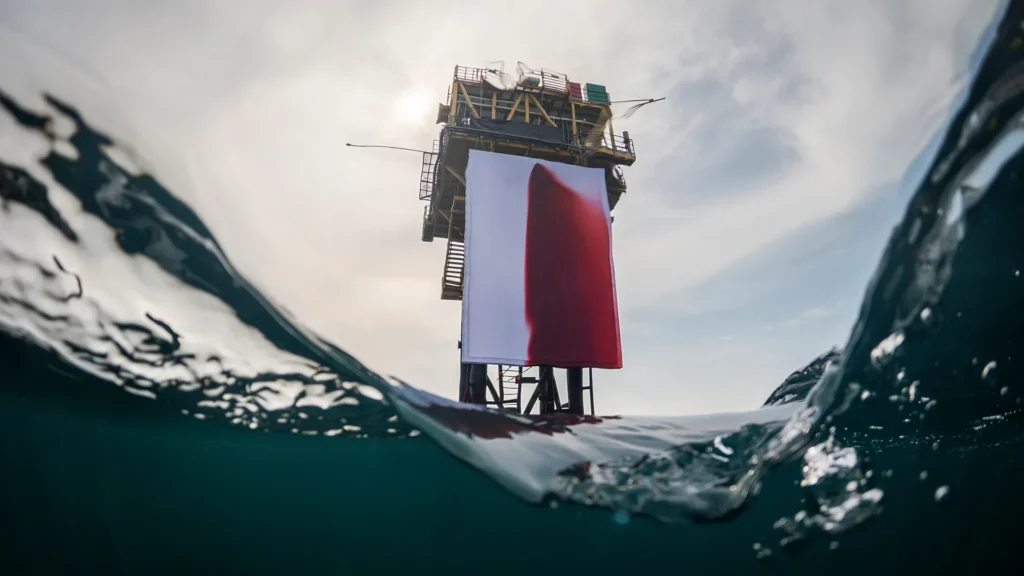
In August, however, the banner of climate protest was taken up by Anish Kapoor. In Butchered (2025), a performance staged in the North Sea by Greenpeace activists, a vast white canvas was unfurled from the top of an offshore gas platform, releasing one thousand liters of biodegradable, blood-red liquid. The resulting 96-meter crimson streak felt like the visual equivalent of a scream.
Would this action bring offshore drilling to a halt? No. Art’s impact rarely operates so directly. Rather than solving problems, art excels at translating them into forms that speak to emotion rather than reason. As Louis Bury wrote in Art in America, “The time when traditional artistic media could tell us something about the future may largely be behind us.” Yet a closer look at the cyclical nature of human history reveals that the past and the future are not, in essence, so different. The authoritarianism that threatens to drag us back into a new Dark Age is hardly unprecedented. The brighter side of 2025 lay in the way artistic imagination turned us toward the past—inviting us to relearn from history and to reconnect with older, more tactile and instinctual forms of expression at the very origins of art.
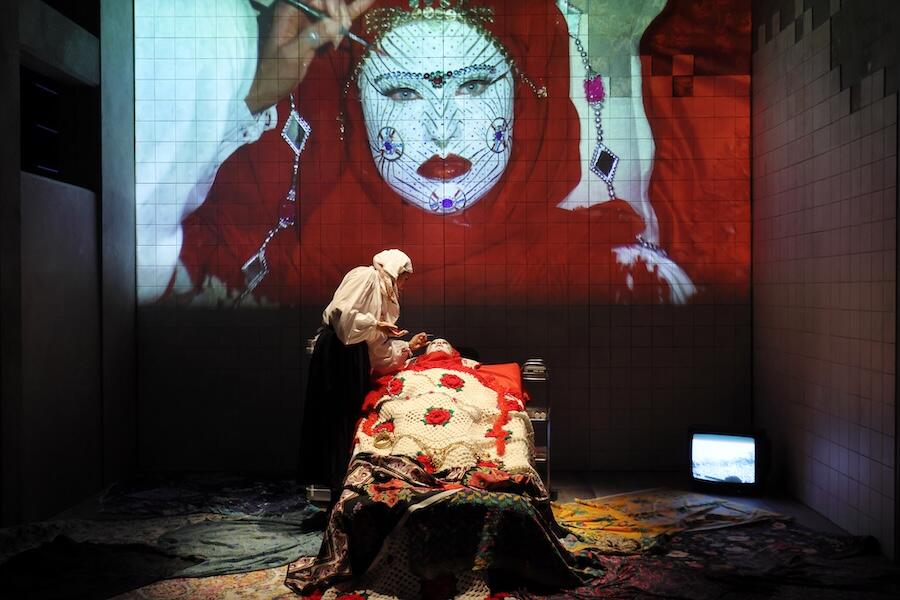
One of the most striking examples of this tendency was Marina Abramović’s Balkan Erotic Epic (2025), staged at Factory International. Lasting four hours, the work unfolded as an immersive, stage-bound experience that reinterpreted Balkan rituals of death, pain, and rebirth. In recent years, Abramović’s practice had gravitated toward distance from the body and the moment, centering on crystals and silent meditation; here, however, she invited the audience directly into the dark. Viewers encountered performers who screamed in the face of death, existing in a state of collective mourning through their naked bodies. Throughout the performance, dancers made love to skeletons and, in keeping with ancient Balkan beliefs that such gestures could drive away storms, defiantly exposed their genitals to nature.
The work carried no explicit political message, yet it clearly modeled survival as a practice of resilience. As Anastasia Fedorova noted in her review published in Frieze, such a forceful reclamation of bodily autonomy is among the greatest threats to authoritarian systems. This, precisely, is the energy that needs to be carried into 2026.
This text is a translation of an opinion piece by Janelle Zara, originally published in Frieze on December 12, 2025.