

When Osiris’s body was torn into pieces, time was scattered along with it. Set’s violence was not merely a murder; it was the disruption of the cosmic order. Isis’s act of gathering the pieces one by one and reassembling Osiris can be read not so much as a miracle that denies death, but as the invention of continuity. Mummification, therefore, is not merely a technique of preservation; it represents the body’s resistance to time, a desire for togetherness against dispersal. The Grand Egyptian Museum offers a narrative construction in which this mythological framework persists not merely as a historical narrative, but as a mode of thinking still in circulation. Here, time is not linear; it takes the form of a layered, interwoven structure that comes into contact with the body.
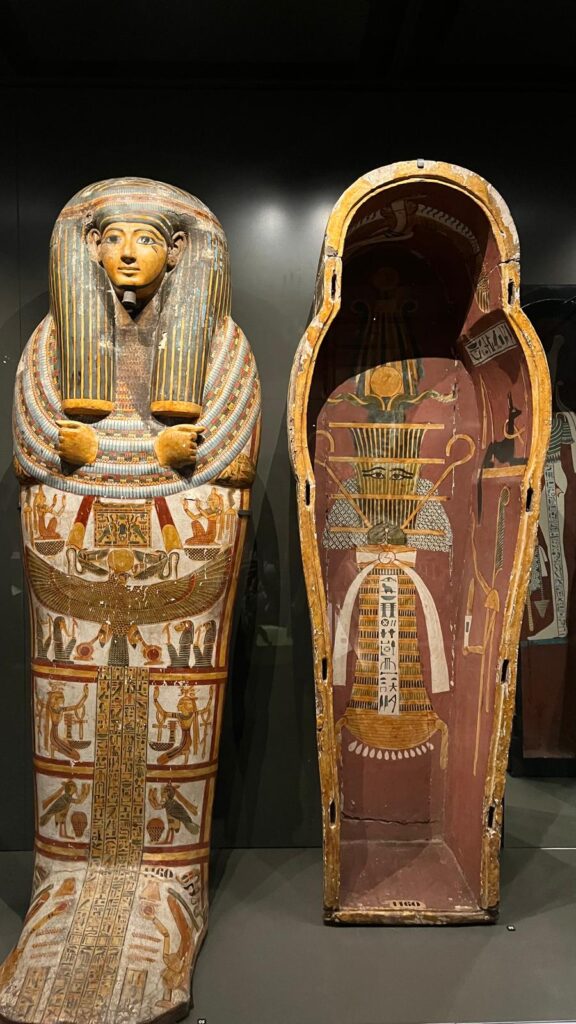
The museum does not merely narrate time; it spreads its flow into space. Time seems suspended, slowed down, as if it has settled into the architecture. Across nearly five thousand years of history, questions about how the body, memory, and permanence have been conceived are brought back into the present through the language of display. Mummified bodies, tombstones, and advanced technical inventions stand side by side as powerful evidence of how fragile the things believed to last forever can be. The museum does not conceal death; without aestheticizing it and without avoiding it, it renders it directly visible.
From Dispersed Collections to a Return Home
After years of research, documentation, and recontextualization, bringing together works that had been scattered across different collections can be read not only as a curatorial act but also as a political gesture. In contrast to objects presented in European museums detached from their contexts under the pretexts of “preservation,” “scientific value,” or “security,” here the objects are invited to speak again within their own historical and geographical contexts. A gathering on this scale and with this degree of integrity renders the exhibition not only mesmerizing but also dizzying. The museum places directly into space the question of on whose behalf, by whom, and from which perspective history is narrated.
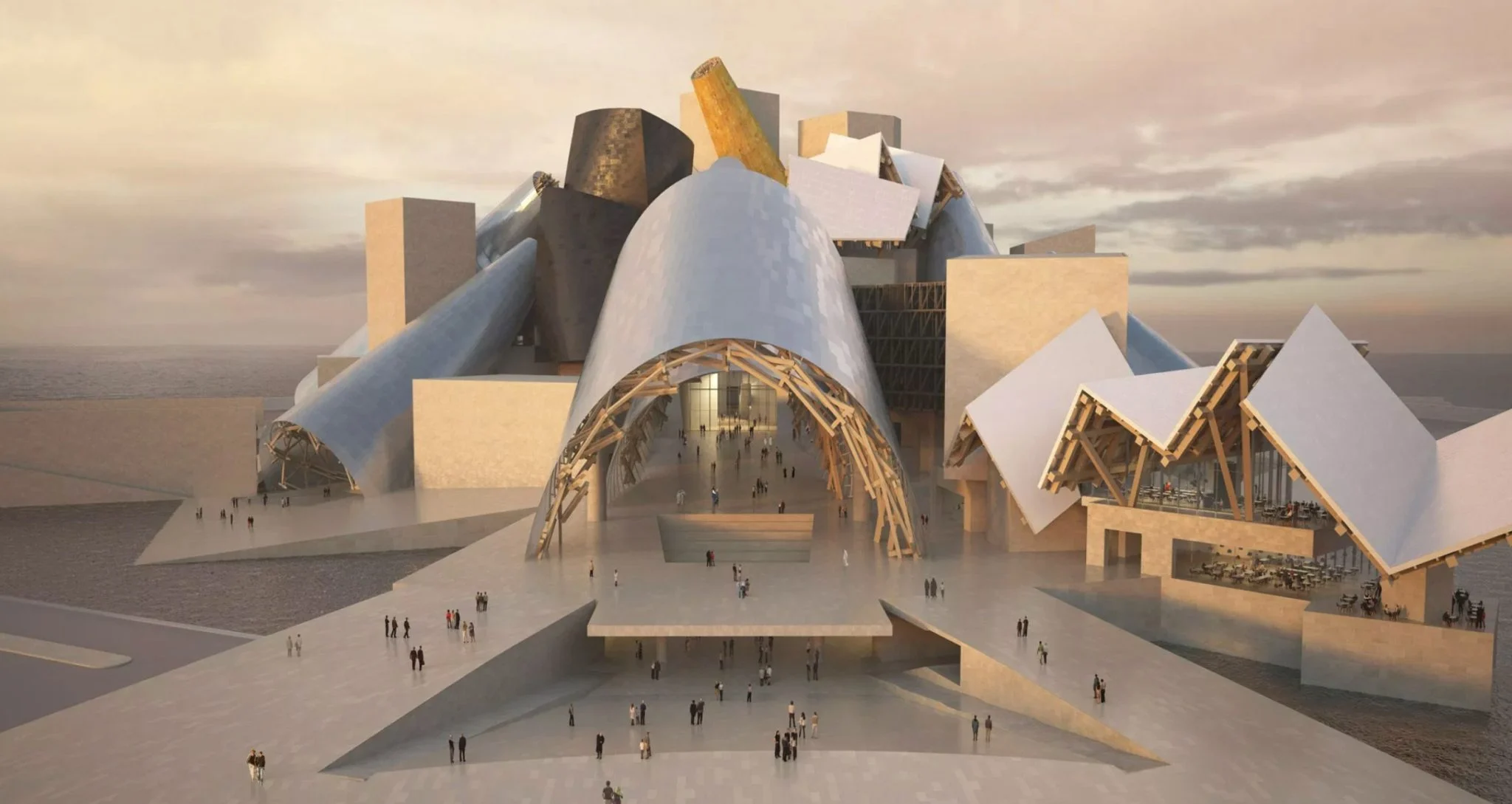
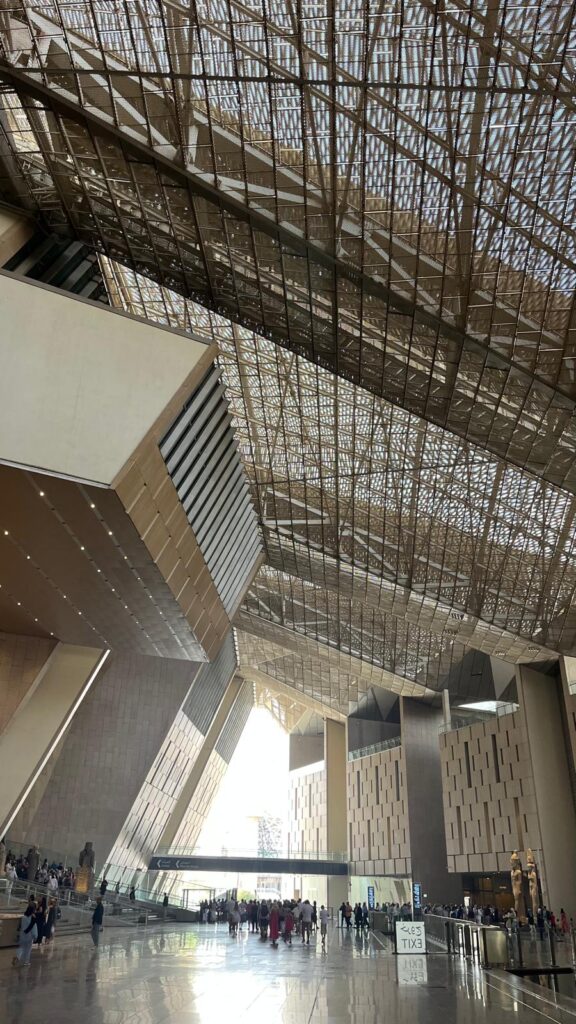
The architectural narrative deliberately avoids producing a single answer to this question. Broad axes, controlled perspectives, and intentional voids transform the viewer from a passive spectator into a body moving through time. The scale of the building initially creates a sense of weight; yet this weight is not a one-to-one reproduction of ancient grandeur but the result of a contemporary arrangement. The architectural language oscillates between the splendor of the past and the distanced coolness of modern museology.
The Petrified Form of Power: Ramses II
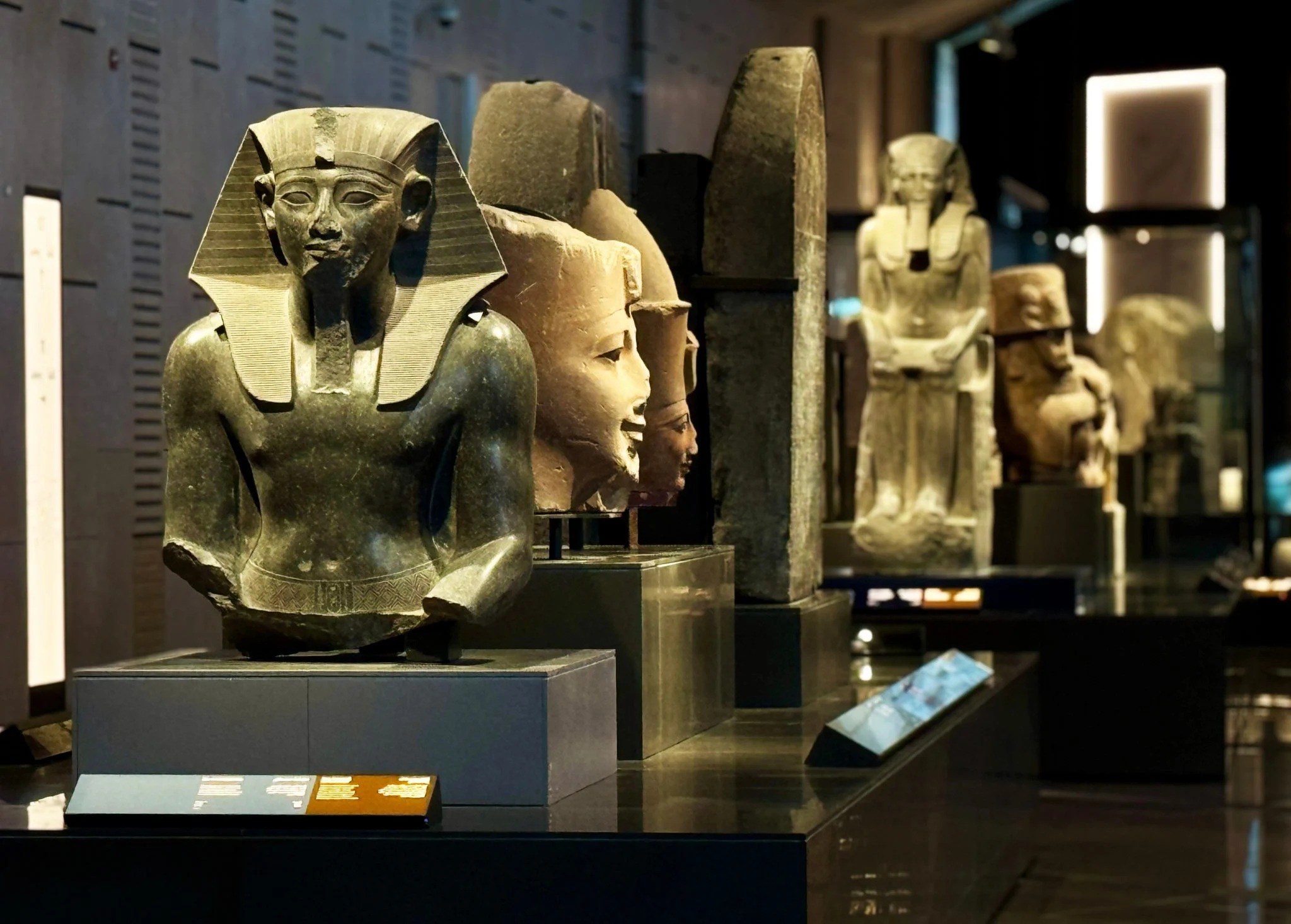
The colossal statue of Ramses II encountered at the entrance is one of the first nodal points of this encounter. Depicted together with his daughters, Princesses Meritamun and Bintanath, positioned as if entwined at his feet, this statue is dated to approximately 1279–1213 BCE. Here, power is conceived not merely as a force flowing from top to bottom, but together with the network of relations established around it. One of the elements that stands out throughout the museum is the way female figures—often relegated to the background in historiography—are quietly yet insistently drawn toward the center of the narrative. These ruptures create small but effective deviations that break the straight line of the narrative.
One of the hundreds of statues commissioned by Amenhotep III for the goddess Sekhmet carries a particular intensity in this context. Whose name means “the powerful one,” Sekhmet is associated as much with fire and destruction as with the protection of the king. The color of this black granite statue evokes not death so much as the idea of life and rebirth. The figure of Sekhmet reminds us that power is sustained not only through destruction, but also through the production of balance and protection.
The story of Hatshepsut appears in the museum not merely as chronological information, but as a concrete example of the complex relationship power establishes with gender. Beginning her political journey as the daughter of Thutmose I, the wife of Thutmose II, and the regent of Thutmose III, she rose to the position of co-ruler and then “king.” Her peaceful rule and foreign policy prioritizing trade over war open up space to think about an alternative model of power.
Stone Staircases and Bodily History
The stone statues lined up on the broad staircases at the entrance create a physical sense of passage between the layers of history. Although some critics find this arrangement theatrical or didactic, this configuration offers a spatial experience that aims to establish a bodily intimacy between the viewer and history. As one moves upward, time grows denser; each step touches a different century and a different body. This encounter between the visual coldness of stone and the bodily presence within the space reminds us that history is a material experience rather than an abstract narrative.
One of the spaces that stands out within this density is the room where Khufu’s first boat is exhibited. The wooden pieces tied together with halfa ropes carry the traces not only of a boat but of collective knowledge. The wooden fragments discovered during the reconstruction process, bearing hundreds of hieroglyphs on them, make visible the guidance systems used by ancient shipbuilders. While the monumental boat materializes the symbolic relationship established between the cyclical understanding of life along the Nile and the pharaoh’s journey after death, it also reveals the advanced engineering knowledge of the period.
The narrative of the tomb of Hetepheres I, on the other hand, is shaped around the ideas of fragmentation and displacement. After the original tomb—probably located in Dashur near the tomb of her husband Sneferu—was looted, her body is thought to have been lost. The relocation of her belongings to Giza, near the pyramid of her son Khufu, offers a striking example of how objects carry memory in the absence of the body.
The Archive of Everyday Life
Objects of everyday life constitute some of the most vivid sections of the museum: brightly colored jewelry, ornate beds, game boards, a mummified wig, chairs, footstools used to rest one’s feet, and chariots. On a long papyrus scroll, the names of palace employees, inter-office financial agreements, and food exchanges are listed. These documents show that the circulation of economy, labor, and value was already complex thousands of years ago. The calendar of lucky and unlucky days is based on the idea that each day is charged with positive or negative energy. The calendar reveals not only ways of avoiding dangers, but also how time was conceived not as linear but as cyclical and rhythmic.
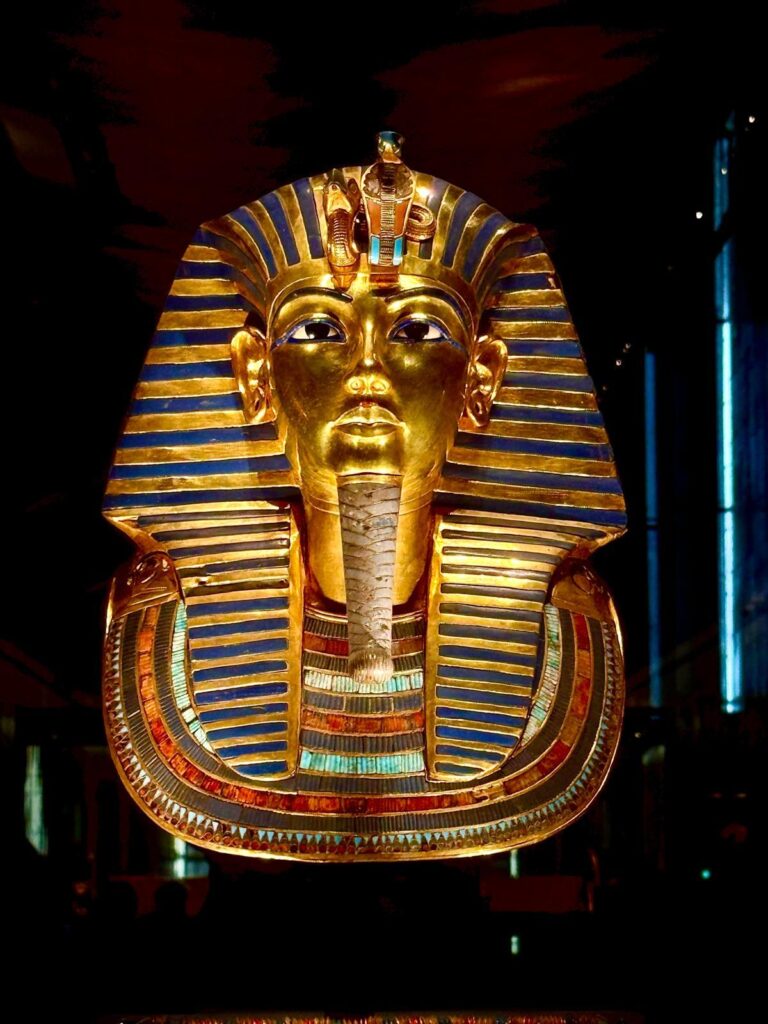
In the section dedicated to Tutankhamun, splendor almost acquires a physical weight. The nested coffins, intricate gold ornaments, and protective figures surrounding the mummy reflect a worldview that imagines death not as an end but as the beginning of another order. Gold here is the material not only of wealth but also of the desire for eternity. The overall splendor of the burial chambers, the extraordinary craftsmanship of the soldier statues, and the miniature details make visible the aesthetic and technical strategies developed against the disappearance of the body. In this narrative, death is not a dark void but a carefully constructed zone of passage.
Deciphering Writing and Translation
One of the museum’s striking narrative headings is the section devoted to the decipherment of writing. The deciphering of Ancient Egyptian script shows that knowledge is produced not through a single language or a single genius, but through encounters between languages. Translation here is treated not merely as a linguistic operation, but as a historical threshold.
The visibility of the pyramids from certain points within the museum establishes a visual relationship that links the time inside with the time outside. Bodies, objects, and narratives—at least temporarily—meet on the same plane in the Grand Egyptian Museum. Time does not stop here; it simply begins to flow differently.
This different perception of time is also shaped by the museum’s distant yet conscious relationship with colonial history. The Grand Egyptian Museum deliberately avoids reproducing a Western-centered universal narrative. Objects are presented not as silent witnesses of a conquered past, but as entities that are still speaking and open to debate. This approach turns the museum into not merely an exhibition space, but a site that questions historiography itself. The exhibition language establishes a deliberate contrast with similar objects that were presented for many years in European museums detached from their contexts. The aim here is not to produce a nostalgic narrative of “returning home,” but to propose a critical beginning that reminds us how the past shapes the present.
The narrative around the decipherment of writing reinforces this sense of responsibility. The deciphering of hieroglyphs does not rest on a single moment of enlightenment, but on contacts established over centuries between languages, cultures, and geographies. Meaning in this account is not fixed; it is in constant motion. Translation is considered an ethical mode of transmission established between past and future.
The Cocoon of Time
This question of transmission reaches its most intense form in the section devoted to Tutankhamun. The layered structure of the tomb is not only a physical system of protection; it also embodies a way of thinking about the gradual unveiling of knowledge and the sacred. The nesting of gold-covered coffins is like a cocoon of time woven around the body. Each layer is both protective and delaying; the confrontation with death is not rushed—time is deliberately extended.
When looking at the pyramids from inside the Grand Egyptian Museum, this sense of extended time becomes even more palpable. The relationship between the modern structure behind the glass and the ancient stone masses outside invites reflection on how thin the distance between past and present really is. The Grand Egyptian Museum does not propose to close this distance, but to learn how to live with it. Perhaps this is precisely why the myth of Osiris remains meaningful: the fragments never fully come together, but they can continue to be held together.