
The historic Casa Botter Apartment, located toward the Tünel end of İstiklal Street, has been revived thanks to the efforts of İBB Kültür and İBB Miras under the umbrella of the Istanbul Metropolitan Municipality. This Art Nouveau architectural landmark has been restored and brought back to life as a vibrant cultural venue.
Once home to the distinguished critic, poet, and writer Ferit Edgü, the building now serves as a space where knowledge, design, culture, and art meet the public through an aesthetically refined and functional infrastructure. The thematic, solo, art-historical, and contemporary exhibitions that have been organized here in recent years offer distinctive alternatives within Istanbul’s cultural calendar.
And now, Bedri Rahmi Eyüboğlu—one of the most prolific figures of modern Turkish art and one of the most vibrant, polyphonic voices of Turkish poetry—greets us all with his latest exhibition, “Sevgilerle” (With Love), on view at Casa Botter until 29 March. The artist once opened his own small gallery in nearby Narmanlı Han, making this return to the neighborhood all the more resonant.
The exhibition opened on the evening of 27 January with the participation of Volkan Demir, Oktay Özel, T. Volkan Aslan, the artist’s grandson Rahmi Eyüboğlu, as well as artists Mustafa Pilevneli and Sinan Yenilmez.
Among the highlights of the exhibition are a letter written by Fikret Mualla to Bedri Rahmi Eyüboğlu, and the handwritten manuscript of Eyüboğlu’s poem written for Nazım Hikmet—known as “Yiğidim Aslanım”, originally titled Zindanı Taştan Oyarlar.
The World of Envelopes and Letters
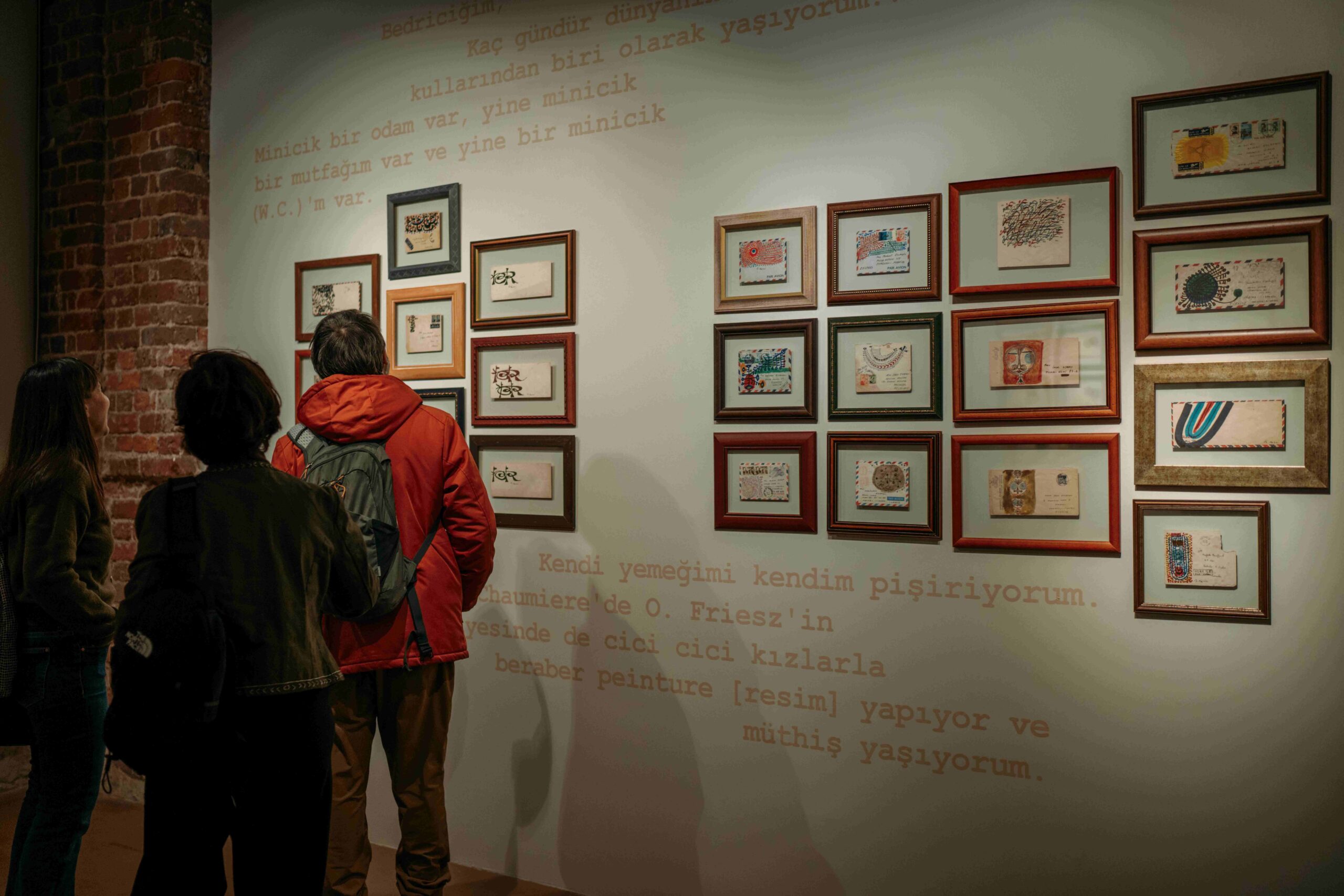
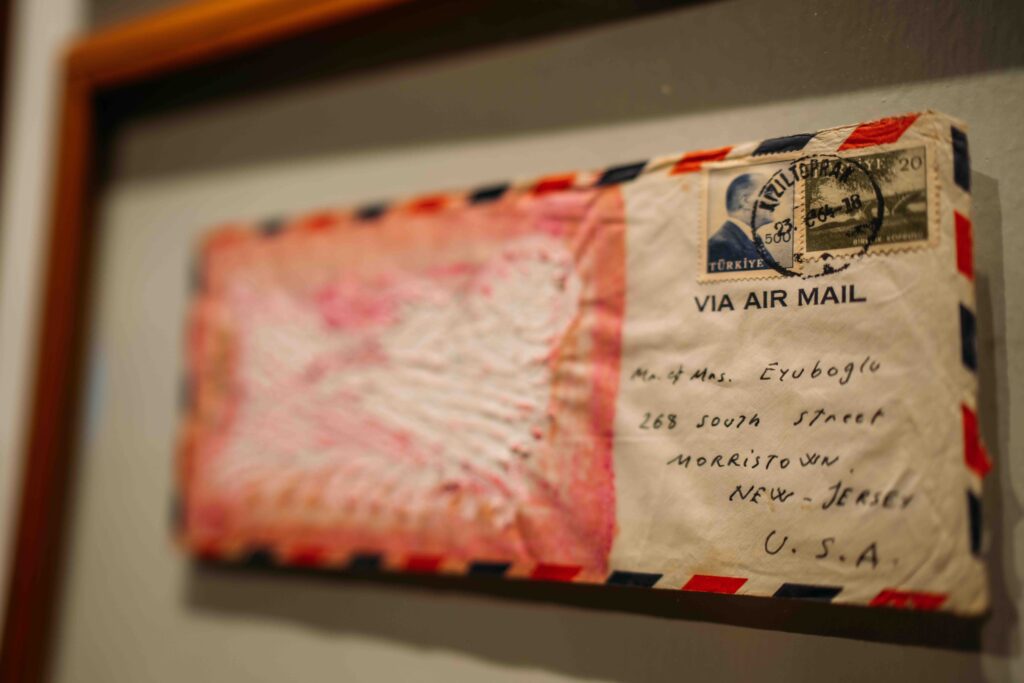
The exhibition presents envelopes dated between 1957 and 1974, bearing addresses not only from Türkiye but also from the United States, Canada, and France. Addressed, undated, or marked with handwritten notes, these envelopes testify to the correspondence between Bedri Rahmi Eyüboğlu and figures such as his wife Eren Eyüboğlu, his brother Sabahattin Eyüboğlu, and his son Mehmet Hamdi Eyüboğlu, as well as prominent names of the period including Fikret Mualla, Mustafa Pilevneli, Turan Erol, Mehmet Ali Cimcoz, Tosun Bayraktaroğlu, and Ertuğrul Özakdemir.
The abstract and near-abstract compositions featured in the exhibition—repeating forms, self-portrait silhouettes, fish imagery, and surfaces created with sand and various materials used during Eyüboğlu’s years in America—merge with traditional motifs to reveal the artist’s distinctive visual language.
Open every day except Monday between 10:00 and 21:00, and free of charge, the exhibition highlights the rich network of social and intellectual connections maintained by the Eyüboğlu family. The envelopes preserved by the family carry traces of friendships and exchanges that seem almost to take flight like birds, conveying an emotional intensity rooted in heartfelt communication.
As the exhibition text emphasizes:
“…each envelope becomes a unique narrative through the drawings, notes, and marks it carries. Bedri Rahmi’s call—‘Let us open the door of our hearts, wide open’—spreads throughout the space through these envelopes.”
The Meeting of Color, Motif, and Image
In his art, Bedri Rahmi Eyüboğlu blended the rational memory of the West and the pioneering possibilities of his era with the rich, multicultural identity of Anatolia. With monumental works ranging from canvas to mosaics and murals, he wears—so to speak—the crown of a singular creative abundance that might even position him as a kind of “Picasso of Türkiye.”
The exhibition presents a sequence of envelopes bearing the artist’s original drawings—letters exchanged with his beloved wife Eren Eyüboğlu as well as Par Avion or Mit Luftpost envelopes addressed to friends and loved ones around the world. Dating primarily from the 1950s and 1960s and extending into the 1970s, this body of work largely features acrylic compositions. On these envelopes, Eyüboğlu repeatedly leaves his own likeness, sharing the freshness of each new self-portrait with his closest companions. Accompanied by handcrafted motifs, these portraits form a remarkable collection that is further animated by the Casa Botter exhibition team’s display of framed envelopes seemingly scattered in midair, creating an atmosphere of lively encounter with the viewer.
The exhibition carries an intimacy that may prompt visitors to ask themselves: “When was the last time I truly reached someone with my own hands, my own words, my own traces?” For instance, one may encounter an elegant winged motif rendered in black marks on a straw-colored envelope sent by Eyüboğlu to Eren Hanım’s boarding house in Belgium. Elsewhere, in a gesture reminiscent of Art Brut, a boldly painted red-and-blue long-distance ship fills the surface of another envelope with generous simplicity.
In one of the letters, dated 1 April 1932, Eren Hanım writes to her beloved Bedri Rahmi:
“Despite everything, I reply to you again with a sweet excitement in my heart. Perhaps I cannot fully explain to you how I have been since the day you left, but I can say that on the night of that day I was very cheerful. I was so joyful that everyone thought I had lost my mind!”
In his works—especially through vibrant reds, blues, and greens—Eyüboğlu evokes the scent and texture of the Aegean and the Mediterranean. In the envelopes shown in the exhibition, he also reveals the iconographic motifs that became synonymous with his signature style. On a white envelope sent to Eren Hanım in Istanbul, for example, he presents a lively “Karagöz’s Ship” motif from 1959, rendered with a graphic, almost cubist flavor that playfully greets the viewer.