
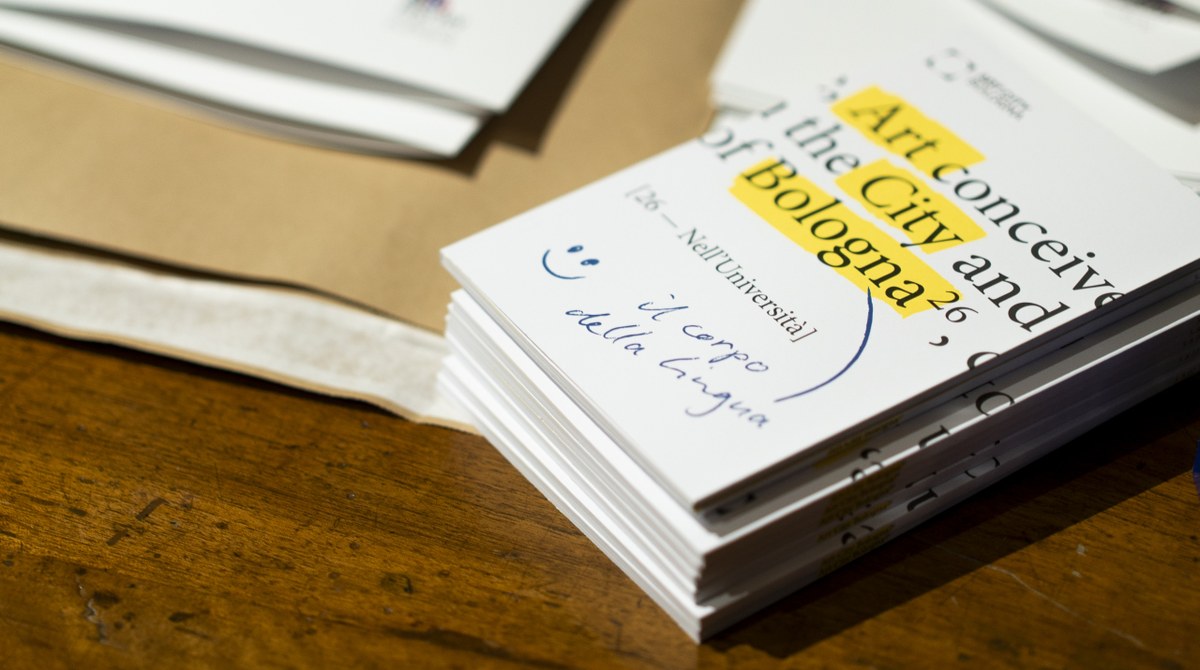
The title The Body of Language is inspired by Giorgio Agamben’s work of the same name, in which the philosopher outlined a detailed anatomy of language: for Agamben, language—like knowledge—develops through the voice, gestures, and relationships with others. Rethinking the body also involves reevaluating knowledge and how it is shared.
The Special Program of ART CITY Bologna 2026 pays tribute to this cultural heritage with a contemporary art itinerary that winds through the spaces of this prestigious institution, some of which will be open to the public for the occasion: the Alessandro Ghigi Hall of the former Institute of Zoology, the Atrium of the former Faculty of Engineering, the Sala della Boschereccia in Palazzo Hercolani, the Anatomical Theater of the Archiginnasio Municipal Library, the Federico Zeri Foundation, the Educational Laboratory of the Navile District, and the Aula Magna of the University Library of Bologna. The works -either specially commissioned or rearranged – establish a direct dialogue with these spaces, generating new interpretations of the academic, architectural, and political history of the University.
This year’s Special Program, entitled Il corpo della lingua (The Body of Language), continued in the spirit of experimentation under the curatorship of Caterina Molteni. The program invited Italian and international artists—Giulia Deval, Mike Kelley, Ana Mendieta, Alexandra Pirici, Augustas Serapinas, Jenna Sutela, and Nora Turato—to take part in spaces not traditionally used for exhibitions, places little known to the general public, exploring training and teaching as physiological and sensory experiences.
In this perspective, the 2026 edition presented a special collaboration with Alma Mater Studiorum – University of Bologna, the city’s institution par excellence dedicated to knowledge, dialogue, and change, further strengthening the link between the event and the cultural and civic fabric of the city.
The best part of Art City was from February 6 to 8 in Bologna, when Saturday was White Night. During White Night, you could see all the exhibitions until late at night, and on Sunday morning you could have breakfast with the gallery owners and discuss the exhibitions.
Ad example, Alexandra Pirici combines dance, sculpture, music, and words in performances and environments that explore the ways in which bodies produce and transmit knowledge. Considered one of the most influent voices in contemporary performance, she has investigated the potential inherent in the processes of embodied knowledge. For Pirici, corporeality is both an archive and a dynamic device for re-signification: a field of action in which the body reactivates traces of past experiences, but above all asserts itself as a primary instrument of knowledge, capable of generating new interpretations and promoting forms of connection and participation. As the artist argues: “Moving differently is thinking differently.”
In strong resonance with contemporary philosophical and scientific debate, the artist’s formal and theoretical approach reads our presence—observed in its fascinating materiality—as intimately intertwined with the organic and technological systems we live in. This perspective highlights the irrelevance of the binary distinctions characteristic of modern humanist philosophy and proposes a porous and inextricable continuity between human beings and so-called (more-than-human) otherness.
The performance was very powerful and tragicomic. I think the purpose of the performance was to show how we are transforming and being transformed, almost like robots. The human body is no longer truly a body, but something like a computer. We are continuously shaped and manipulated by external forces, yet we remain unaware of it. yet we don’t think about it and we don’t care. This year, I saw many performances or videos of performances that we don’t usually see. The director of the fair has changed, and you can clearly notice that.
This year’s art week felt markedly different—more powerful and more coherently curated. It seems that each year features an increasing number of performances, video works, and technologically driven projects.
Next year, art will continue to challenge, transform, and awaken new ways of seeing and feeling or not?