

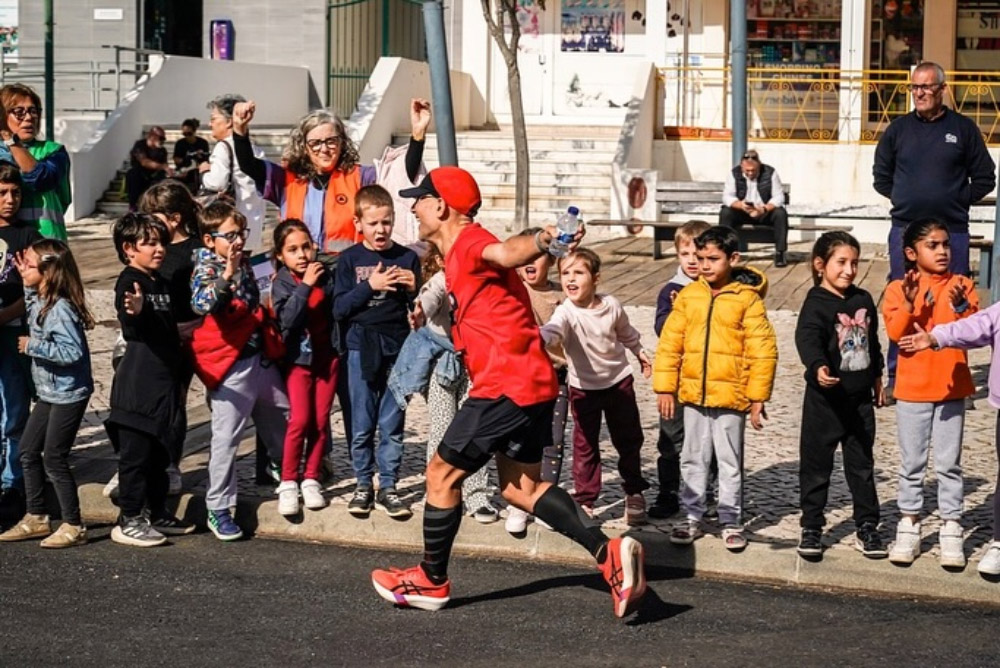
Running, technology, and contemporary art converged on the streets of Istanbul.
Halil Altındere and Ahmet H. Uysal have created an extraordinary project in honor of TEGV’s 30th anniversary—a project that leaves a mark on the city and brings a movement of goodwill onto the same line as art. Internationally renowned contemporary artist Halil Altındere, together with Ahmet H. Uysal, realized the project “Istanbul: The Art of Running” for the 30th anniversary of the Educational Volunteers Foundation of Turkey (TEGV). Having collaborated on previous projects, Altındere and Uysal now rebuild their joint production through a trace left on the streets of Istanbul. Conceptually designed by Altındere as a GPS route and completed by Uysal through a six-day performance, “Istanbul: The Art of Running” transformed into a collective movement of goodness, where art, sports, and social benefit intertwine.
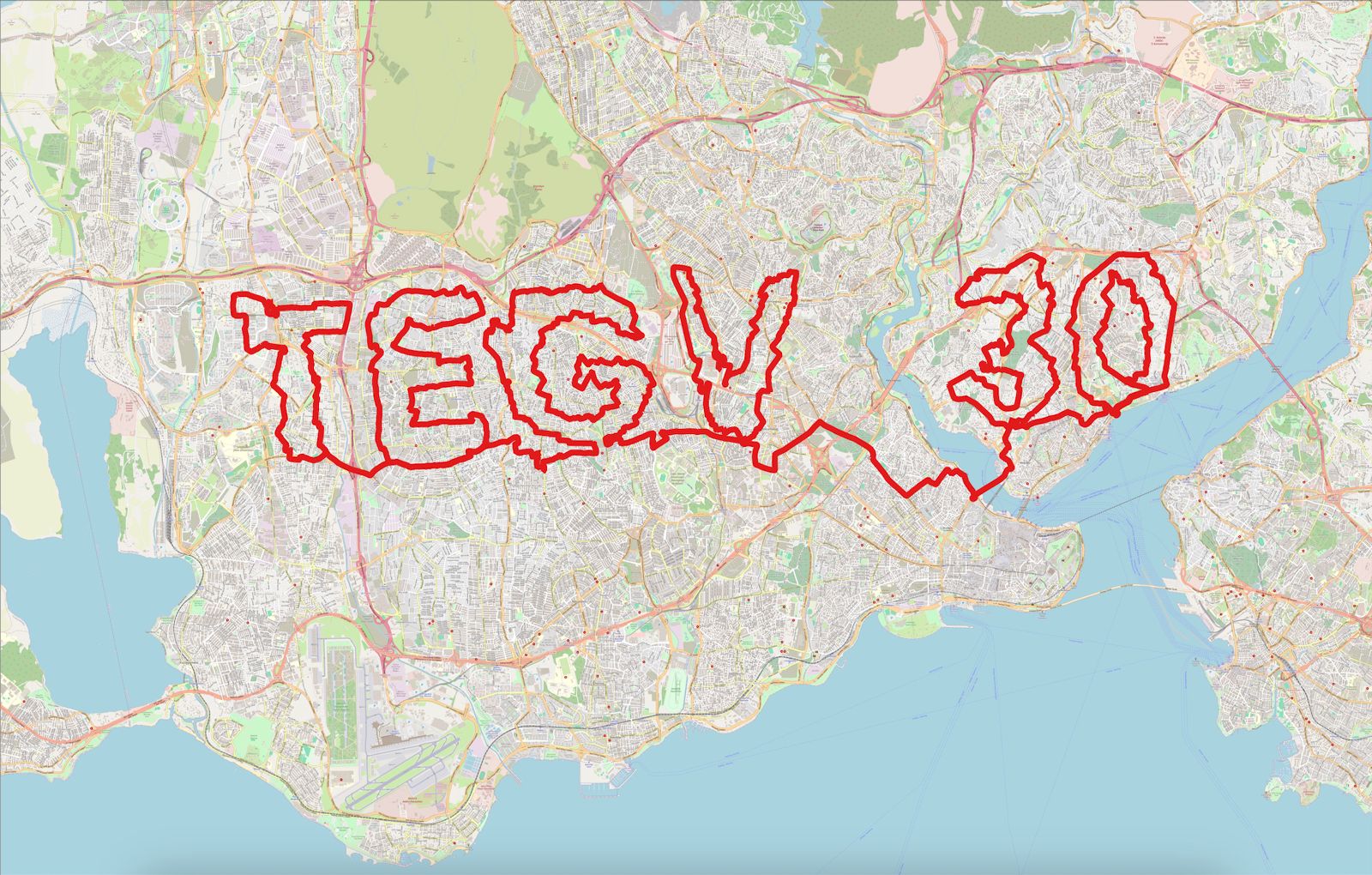
The duo had previously worked together on the project “The Man Running for the World,” realized for the benefit of TEGV. Defined by Altındere as “an athlete who pushes the limits of his body for the sake of goodness,” Uysal has long dedicated his extreme runs to raising awareness for children’s education. This shared motivation brought them together once again, resulting in a new project that turns the streets of Istanbul into an artistic surface. The route designed by Altındere to write “TEGV 30” across the Istanbul map was completed by Uysal over six days, running from Küçükçekmece to Beşiktaş. We spoke to Halil Altındere and Ahmet H. Uysal about “Istanbul: The Art of Running.”
How did the “Istanbul Map: Art of Running” project you carried out with Ahmet H. Uysal emerge?
Halil Altındere: We had previously collaborated with Ahmet Uysal for TEGV. Inspired by Ahmet’s achievement of running seven marathons on seven continents in seven days, we created a 3D animated NFT video titled “World Marathon Challenge in the Metaverse” and a children’s book titled “The Man Running for the World,” in which the pages came to life through augmented reality (AR) technology. The text was written by Süreyyya Evren, and the 3D drawings were made by Utku Turan. Ahmet and I first met while taking our children to the park; first our children, then we became friends. Ahmet had already run at the North Pole for TEGV, and had crossed Turkey from one end to the other to raise awareness for education—he is a philanthropist athlete. His pushing the boundaries of his body in extreme marathons for education, goodness, and a better world for children intrigued me, and we decided to collaborate.
This year marks TEGV’s 30th anniversary, celebrated through various events throughout the year. Ahmet and I wanted to create another performative project as a gift for this milestone.
In our first collaboration for TEGV, we used augmented reality (AR) technology; in this new collaboration, we used GPS art technology. Since Ahmet had already completed extreme runs at the poles and ran seven marathons around the world in seven days, this time I pushed the idea further: I designed a running route that would write “TEGV 30” across the Istanbul map. Using the GPS system on his wrist, Ahmet followed a 133-kilometer route over six days, completing the phrase across the streets and avenues of the city. The project writes TEGV’s 30-year journey onto the streets of Istanbul.
How did Istanbul’s chaotic, multilayered structure play a role in this work?
Ahmet H. Uysal: Istanbul is an extraordinary city for running thanks to its topography; with its strait, streams, hills of varying altitudes, valleys, and forests, you can run fresh-air routes with breathtaking views. But once the task becomes “writing by running,” everything changes. The city has grown so unplanned over the years that residential areas have merged with industrial zones, and highways we call ring roads have ended up in the city center. You see that distorted urban development and the prohibitions that have become part of daily life infiltrate the streets. Suddenly, you encounter locked-off roads with fences and walls. In some places, there are no sidewalks; in others, motorcycles come at you from every direction.
We studied maps for days to determine how to write “TEGV 30” across the city on foot, adhering to pedestrian rules. Among many alternatives, we chose the route that was both aesthetically pleasing and feasible. The route was ready, but running it was another challenge. Although the distance did not tire me compared to ultramarathons, overcoming obstacles, fences, slums, and highways was truly difficult. I must confess—I didn’t struggle this much even when running seven marathons on seven continents in seven days.
“Four Times Harder Than a Marathon”
GPS data transforming into an artistic composition creates a new conceptual field between body movement and technological recording. How do you interpret this interplay?
H.A.: GPS art is a drawing method in which an artist uses a Global Positioning System (GPS) device to follow a pre-planned route and create a large-scale image or pattern. During the drawing process, a GPX data file is recorded, later visualized, and usually rendered as a line layered onto a map of the region. Some artists run routes they’ve drawn beforehand, using navigation support; for larger works, boats or aircraft can also be used.
To ensure the “TEGV 30” inscription was clearly legible from satellite imagery, the most suitable areas of Istanbul were selected, and the route from Küçükçekmece to Beşiktaş was determined as the ideal region. Ahmet completed this demanding route by running a letter a day, covering 133 kilometers over six days. Running through Istanbul’s back streets as a cosmopolitan city made it four times harder than a normal marathon. Experiencing the city across different district borders for six days was, for Ahmet, also a unique way of observing socio-economic and cultural contrasts.
Your artistic practice frequently highlights marginalized groups and invisible stories. Is there a particular story you wanted to make visible in this project?
H.A.: Istanbul is a multilayered metropolis. From Küçükçekmece and Bağcılar to Maçka and Beşiktaş, vastly different socio-cultural and socio-economic groups coexist. Yet these lives often unfold within their own district borders. In this project, one person runs 133 kilometers over six days, confronting and overcoming challenges in districts with entirely different social identities—experiencing and internalizing them firsthand.
“For Goodness, For Children, For a Better World”
How do you define the space where social benefit intersects with contemporary art?
H.A.: While conceiving this project, as with our previous work, I focused on the intersection of social benefit and useful art. I am more excited by projects that engage with everyday life rather than distance themselves from society. Ahmet always prioritized social benefit as the primary condition in his extreme marathons. Running for goodness, for children, for a better world empowers him each time. Through the act of running, “Istanbul Map: Art of Running”challenges both artistic boundaries and physical limits.
What meaning did this movement of goodwill gain for you throughout the project? Will there be more projects like this?
A.H.U.: TEGV has provided qualified educational support to more than three million children across Turkey through its learning units over the past 30 years. It accomplished this entirely through donors and a gigantic volunteer family that has grown beyond one hundred thousand over the years. TEGV’s impactful model has even been incorporated into Harvard University’s curriculum as a case study.
While tracing Istanbul step by step, I thought of the volunteers who wrote this 30-year legacy across every corner of Anatolia. I drew my inspiration from them—from our children, our volunteers, our educators. What made this project meaningful for me was precisely this: an individual effort transforming into a much larger movement of goodwill.
Therefore, yes—there will certainly be more. Halil Altındere and I believe deeply in the creative power of projects that contribute both artistically and socially. Art and running are stories that gain meaning as they move forward; we will continue writing these stories to touch the futures of even more children.