

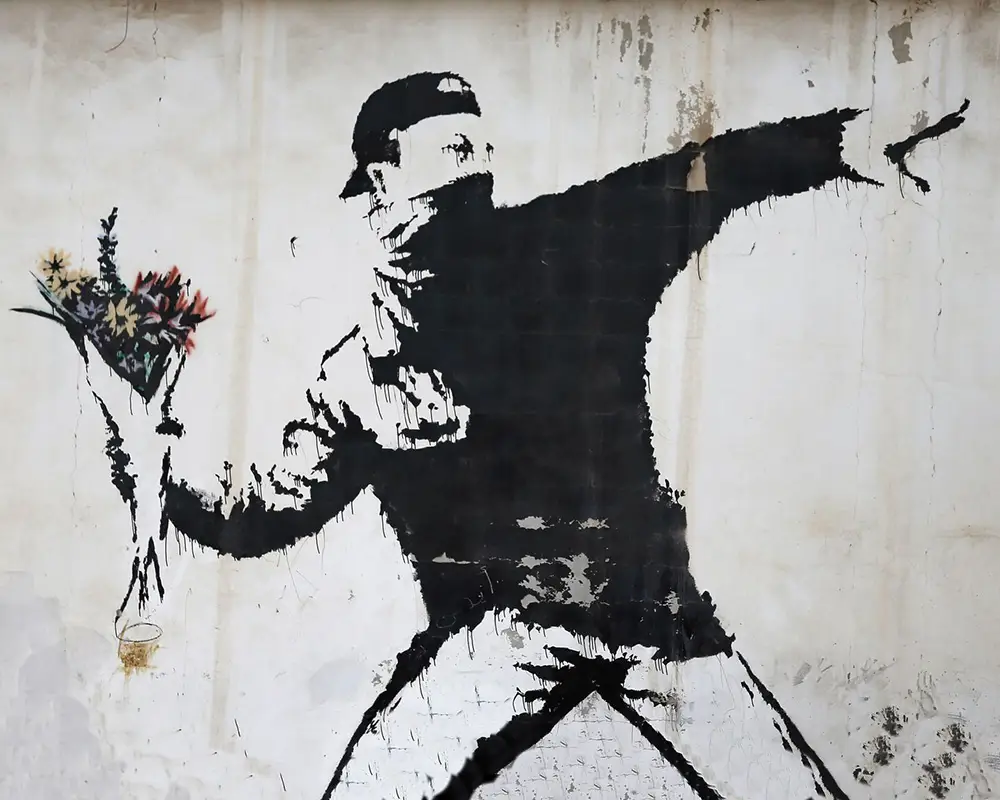
One of the most comprehensive investigations to date into Banksy—the artist who has become a global phenomenon through politically charged imagery left on walls while skillfully concealing their identity for years—has been published. Following a year-long inquiry, Reuters claims to have identified the artist’s real identity based on court documents, police records, immigration data, and witness statements.
The identity of Banksy, the world’s most famous and most enigmatic street artist, has long been considered one of the art world’s greatest mysteries. Alongside the political references, anti-war imagery, and critiques of systems that appear on walls, the artist’s anonymity has become an inseparable part of the work itself.
Reuters now claims to have solved this mystery after an extensive year-long investigation.
The news agency alleges that the individual behind Banksy is a British citizen who officially changed their name in 2008. However, the artist’s legal team has strongly objected to the disclosure, warning that revealing the identity could pose serious security risks. Taking these warnings into account, we are not publishing the names mentioned in the original report here.
How Did Reuters Reach This Conclusion?
Reuters’ investigative team based its findings on a multi-layered dossier. Key sources include U.S. court records, police documents, archival photographs, immigration data, and interviews with numerous individuals said to have insider knowledge.
Murals that appeared in Ukraine in 2022 also formed a significant part of the investigation. Reuters reporters traveled to the towns where the works emerged and spoke with local witnesses.
A handwritten confession, reportedly linked to a public disorder charge, is described by Reuters as the “key piece of evidence.” The agency claims that this document conclusively clarifies the artist’s identity.
The report also notes that an identity claim first put forward by the Daily Mail in 2008 has been reinforced with new evidence. Reuters stands by its reporting, emphasizing that it is based on a far broader network of data and witnesses than previous speculation.
The Ukrainian Mural and a “Familiar” Name
One of the most striking elements of the investigation is a mural that appeared in Ukraine in 2022. In the town of Horenka near Kyiv, the artwork depicted a small child throwing a large man to the ground using a judo move. The piece was widely interpreted as a reference to Russian President Vladimir Putin’s background in judo.
According to Reuters, interviews conducted in the town led to a witness who recalled two men creating the mural. Among the photos shown to the witness was Robert Del Naja, the lead vocalist of the British trip-hop group Massive Attack.
Del Naja has long been rumored to be connected to Banksy. Reuters reports that Ukrainian immigration records confirm that Del Naja entered the country around the same time. Additionally, another source claimed to have seen him at a hotel in Kyiv during that period. However, Reuters stops short of definitively stating that Del Naja is Banksy, instead pointing to the possibility of a connection.
Rare Photographs and an Old Dispute
Photographs allegedly showing Banksy’s face are extremely rare. The report highlights one image in particular, said to have been taken around 20 years ago. In the photograph—reportedly taken in Jamaica in 2004—a man wearing a white T-shirt under a blue short-sleeved shirt, sunglasses, and carrying spray paint is seen. The image is said to have surfaced following a dispute between the artist and a photographer.
Legal Response and Security Concerns
Banksy’s legal team has challenged Reuters’ findings. Lawyers argue that many of the details presented in the investigation are inaccurate and that publishing the identity would violate the artist’s privacy and undermine their freedom to work.
More importantly, they emphasize that the loss of anonymity could pose a physical security risk. Much of Banksy’s work engages directly with political themes—war, state authority, migration, and inequality. As such, revealing the artist’s identity could have consequences that go far beyond mere public curiosity.