
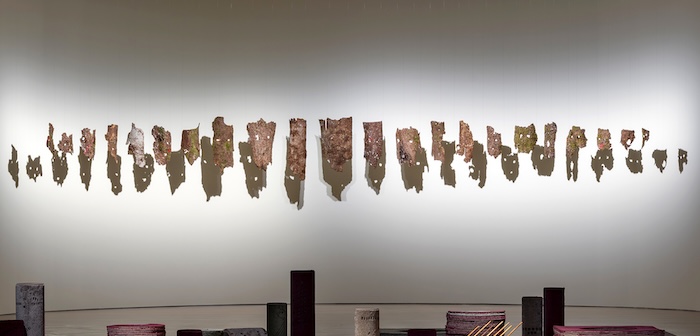
Hera Büyüktaşcıyan’s solo exhibition titled Phantom Quartet opening at Arter provides a comprehensive look into her artistic practice focused on identity, memory, and nature. The works displayed highlight disruptions in urban history through the artist’s personal past connected to the two neighborhoods surrounding Arter, namely Kurtuluş and Tarlabaşı. Combining the pieces created for this exhibition with selected earlier works, some from the Arter Collection, the exhibition examines dualities such as presence and absence, life and death, body and spirit, erasure and reconstruction across four distinct sections. Curated by Nilüfer Şaşmazer, Phantom Quartet will be on view at Arter’s third-floor gallery starting November 27.
Phantom Quartet combines Hera Büyüktaşcıyan’s newly created works for this exhibition with a selection of earlier pieces, some from the Arter Collection. The exhibition explores the artist’s main focus on invisibility, cyclicality, memory, architecture, the city, and nature through her personal history rooted in the two neighborhoods surrounding Arter—namely Kurtuluş and Tarlabaşı—and through the ruptures etched into urban history. Büyüktaşcıyan connects these ruptures with imaginary landscapes formed by fragments, echoes, and voids drawn from her memory. The exhibition thus links different times and places to create new stories.
Drawing on the term ‘phantom limb’, which evokes a lingering presence following loss and was originally used in the medical field, Phantom Quartet unfolds in four chapters – Necropolis, Courtyard, Avenue, and Gaze – that bring the outside into the gallery space. This four-part structure resonates through the elements of fire, air, water, and earth, each influencing the works in different ways. Interweaving four distinct temporalities – past, present, future, and purgatory – the exhibition creates a sensory landscape that summons the ghosts hidden within objects, forms, surfaces, sounds, and colors.
Through the materials and the deconstructive form language she employs, Büyüktaşcıyan points to a surface tension and examines both the collision and coexistence of different elements transformed by time. Tracing the imprints of individual and collective memory through textures, sounds and urban landscapes, her works attest to a world woven with dualities such as presence and absence, life and death, body and spirit, erasure and reconstruction. By overturning dominant narratives and modes of seeing, they propose a reverse perspective that enables historical memory, the non-human, and what lies beyond the perceived world to be understood in new dimensions.