
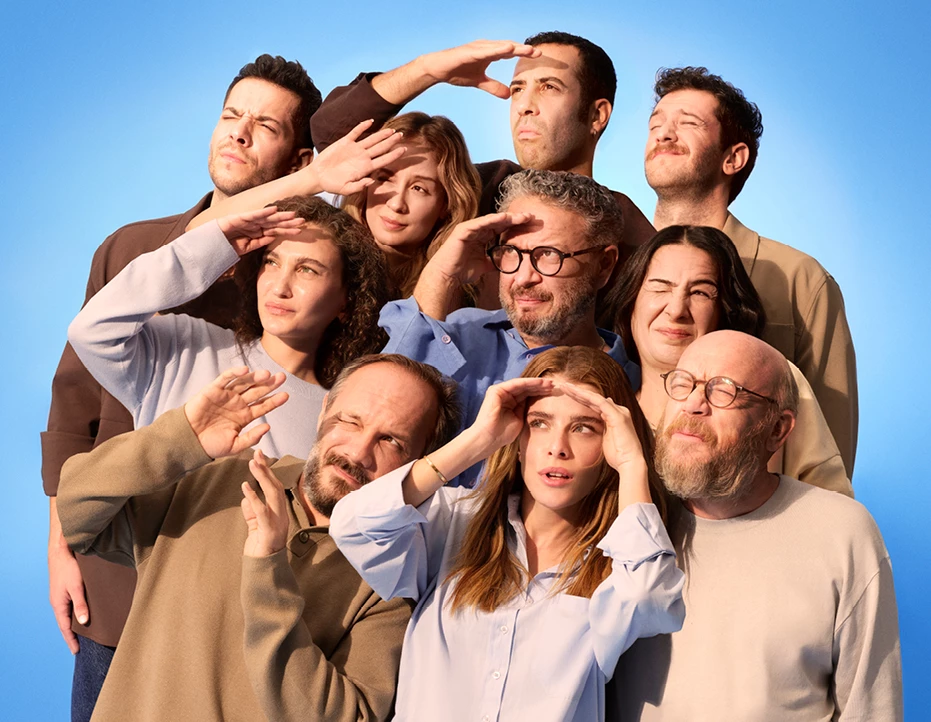
Drawing from the surreal atmosphere of İkinci Yeni, and in what Onur Ünlü calls a “fantastical yarn,” the film A Son of the Sun is now moving from cinema to the theatre stage. We discussed with Onur Ünlü the theatrical journey of A Son of the Sun, its connection to the absurd, and his understanding of art.
Saluting the surreal world of İkinci Yeni and described by some critics as a “miraculous,” “original” work, the film A Son of the Sunis, in Onur Ünlü’s words, a “fantastical yarn” now adapted for the theatre stage.
The play, set to premiere on December 5, will be directed by Onur Ünlü, with Nagihan Gürkan, whom we know from the plays Gebe, Loop and Sen Ne Güzeldin Aşkımızın Şehri, by his side. Centered around the story of retired literature teacher Fikri Şemsigil, the script weaves a powerful narrative out of human stories, brought to the stage by a large cast combining veteran and younger actors: İbrahim Selim, Deniz Celiloğlu, İlayda Alişan, Beyti Engin, Ali Yoğurtçuoğlu, Zeynep Kankonde, Efekan Can, Sergen Özdemir, Ilgaz Kaya and Selin Beliz Şahan. Director Onur Ünlü answered our questions.
How was your 2025 “Z report,” so to speak, and what is your outlook on the future of art?
Truth is not something objective; it is something constructed. What we call art is a small contribution toward constructing truth, nothing more. Just as we shouldn’t exaggerate a lot of things, we should also not magnify art in our eyes. I cannot possibly know where this will lead; because I cannot estimate how much more everything will fragment.
How did the idea of adapting A Son of the Sun for the stage come about?
The idea of turning the film into a play came from an actor friend. After some thought it struck me as interesting. And besides, I already wanted to do a play. I thought I should start from what I know.
When converting the script into a theatre text, what were your priorities?
The biggest technical issue was related to the locations. There were many more locations than would normally be possible in a theatre play. So we had the actors recreate the locations themselves. That was essentially the problem we solved. We hardly interfered with the text itself. The character relationships are very tight in the text. A small intervention could have harmed many other things — so we remained as faithful as possible to the original.
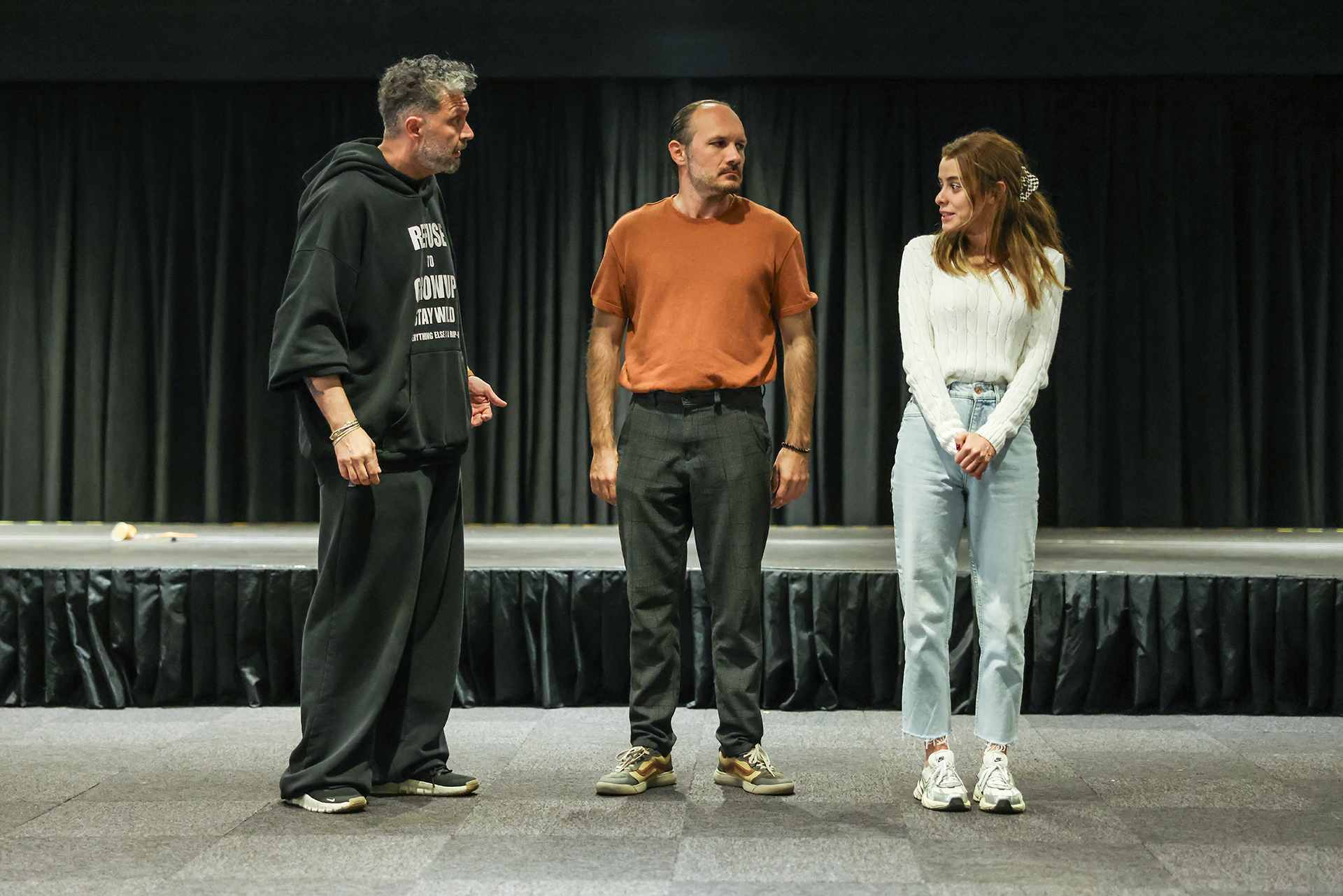
“The play has no critique of the system. Because the system has become too wretched to be criticized. It has lost all seriousness.”
How did assembling the team go?
After the idea surfaced, we got together with our producer Yağmur Dolkun. Yağmur suggested I work with Nagihan Gürkan, whom I had collaborated with before. They really formed a really good team. All I did was sit back and watch the stage. They did all the work.
Does the play carry criticism directed at the system?
The play has no criticism of the system. Because the system has become too wretched to be criticized. It has lost all seriousness. It is no longer something meaningful to talk about; instead, we tried to focus on the problems of existing in the world itself. Even if the system were a different system, the play would be the same.
“‘The biggest lie I’ve ever heard is the lie that truth is relative.’”
From this line in the play — in your view, why is the boundary between “reality” and “absurdity” still so permeable on stage?
Our fundamental problem is that we have no fixed point to let us take a stance toward the world; and the postmodern nonsense floating around makes that fixed point even more uncertain. The moment where the place we call “absurd” emerges is when we knowingly behave as if a fixed point doesn’t exist — because that is easier, more comfortable, I guess more profitable. As the play also says, the absurdity of a work is directly proportional to the number of its audience.
During rehearsals and staging, what was on your mind or occupying your background?
Throughout rehearsals I kept wondering why we were rehearsing so much. When the rehearsals ended, I thought — why didn’t we rehearse more? In the end, I thought that just as one can never be ready for death, one can never be ready for a play.

“Are we glossing over the absurdity of existing in the world, wrestling with it, or are we just unaware of it?”
As a director who chooses to sever the story’s ties to logic — in your opinion, is there still an audience for the absurd today?
Here’s the thing: are we glossing over the absurdity of existing in the world, wrestling with it, or are we simply unaware of it? Depending on which of these three categories you’re in, your view of the world is determined accordingly. I am not delivering a message, I have no mission. When I see something that interests me I just say, “Look what’s here.” That’s all I do.
“One day you are invited to a feast. Then when you get there, you see your name written on the menu.” Using this meaningful line, do you think a person’s self-destruction is the tragedy of our age, or merely a mortal anxiety?
First of all, that line belongs to Murat Menteş — let’s send him a salute. The difficulty of existing in the world has nothing to do with the era or place. The only thing independent of the fixed point we mentioned above is the “absurd.” Maybe we ought to make the “absurd” the fixed point. Maybe, I say!
If you had to sum up your work in cinema (2008) and theatre (2025) in one sentence — for example, what have you experienced?
In cinema I understood that editing existed. And theatre, no matter what, is done within a frame — there is no 181st degree. Whatever you do there, that is it.
For those who haven’t seen the film but will attend the play — how would you describe the story in one sentence?
Look into the mirror, you will see yourself.
What have you found lately inspiring or uplifting in the cultural-artistic trajectory?
Lately I’ve been interested in Paul Cézanne. I would recommend him to every adult.
What projects are on the horizon for us?
In mid-December I will shoot a dark youth film. Then the New Year will come.
A Son of the Sun
75 minutes / One act
Set Design: Barış Dinçel
Costume Design: Gül Sağer
Lighting Design: Cem Yılmazer
Assistant Director: Şevval Öztay
Photography: Beste Zeybel
Executive Producers: Yağmur Dolkun (Dolkun Production), Zorlu PSM
Performance dates: December 7, 17, 18 — 20:30, Zorlu PSM