



Award-winning documentary photographer Martin Parr has died at the age of 73. Parr was internationally renowned for his distinctive approach to British everyday life, particularly through his photographs of the British working class in the 1980s.
One of Parr’s most recognised—and most controversial—bodies of work is The Last Resort, a series focusing on holidaymakers in New Brighton, Merseyside. At the time, many of the era’s self-important art critics looked down on Parr’s use of saturated colour and his instinct for capturing fleeting moments on the street. They were unsettled by the bluntness with which he recorded the leisure time of working-class people: women in yellow bikinis feeding their babies, children smearing ice cream down their clothes, suited grandfathers handing out crisps and cola on the beach.
In more recent years, these images have faced criticism for different reasons. Some commentators argued that Parr’s voyeuristic framing of working-class families eating chips amid the litter and packaging of a decaying seaside town amounted to a form of open humiliation.
Parr consistently described himself as a documentarian of real life, insisting that there was no intention behind his images beyond the desire to capture the moment. Yet as an admirer of his work, it is difficult to fully accept this claim. Many of Parr’s most famous photographs reveal a striking degree of selectivity, a strong sense of construction, and considerable technical mastery.
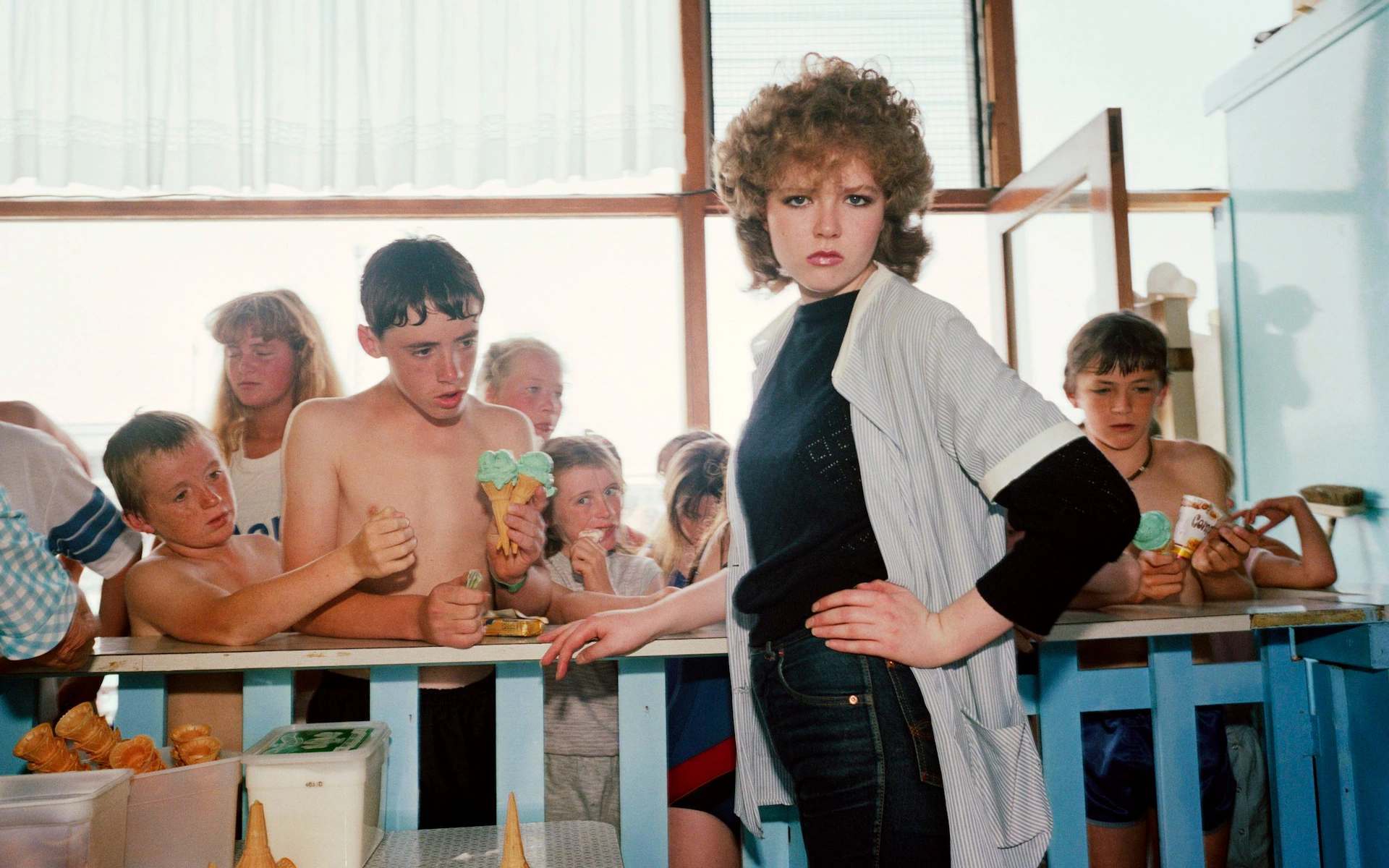
One of my favourite photographs was taken from behind the counter of an ice cream stand in New Brighton and functions almost as a lesson in composition. A young woman behind the counter stares sternly at Parr, her hand planted firmly on her hip; beside her, a spotty teenager struggles to balance three cones at once, fixing his gaze on her. Through the slats of wooden shutters, the sunburnt legs of children can be glimpsed. The image is so alive that you can almost smell the melting mint chocolate ice cream.
Parr’s photographs are bright and densely populated because the people he photographed were exactly that. The working class knows how to enjoy itself. This is not the bleak landscape of poverty depicted in Angela’s Ashes. On the contrary, every child heading to the seaside is dressed in their best clothes; women wear make-up, and men appear in their carefully chosen Sunday outfits. Parr’s output was not limited to beaches and sun cream. In a cover photograph he shot for The Telegraph Magazine on 27 February 1993, an article about an English village is accompanied by a large, eye-catching jar of lemon curd—an image that offers a powerful representation of England itself.
Parr’s work stands as a coherent whole in its own right. Yet in hindsight, an important question emerges: why were Britain’s cultural elites so captivated by these exaggerated, hyper-saturated images of everyday life? Especially when the people depicted in these photographs belong to social classes that are often treated with distance in real life. Parr’s subjects are embraced only as long as they remain two-dimensional figures eating fish and chips. When working-class culture begins to speak for itself, that acceptance quickly evaporates.
Although Parr attempted to keep his political views in the background, he revealed something of his perspective in a lunch interview with The Guardian in 2017. Responding to a question about Brexit, he described the referendum result as “a clear ‘fuck off’ message from those who are likely to be hurt most by this vote to the southern elites.” Perhaps it is precisely this tone of pity—the idea of “poor, naive Brexit voters”—that fuels accusations that Parr’s images look down on the working class rather than truly representing them.
But if figures like Grayson Perry, Tracey Emin, and art school elites speaking in fake Cockney accents enjoy fetishising Parr’s “ordinary” Britons, so be it. The people within Parr’s frames already speak for themselves—through their resilience, their everyday pleasures, and their genuine joy in the ordinary.
This article is from Ella Whelan’s piece originally published in The Telegraph on 08.12.2025.