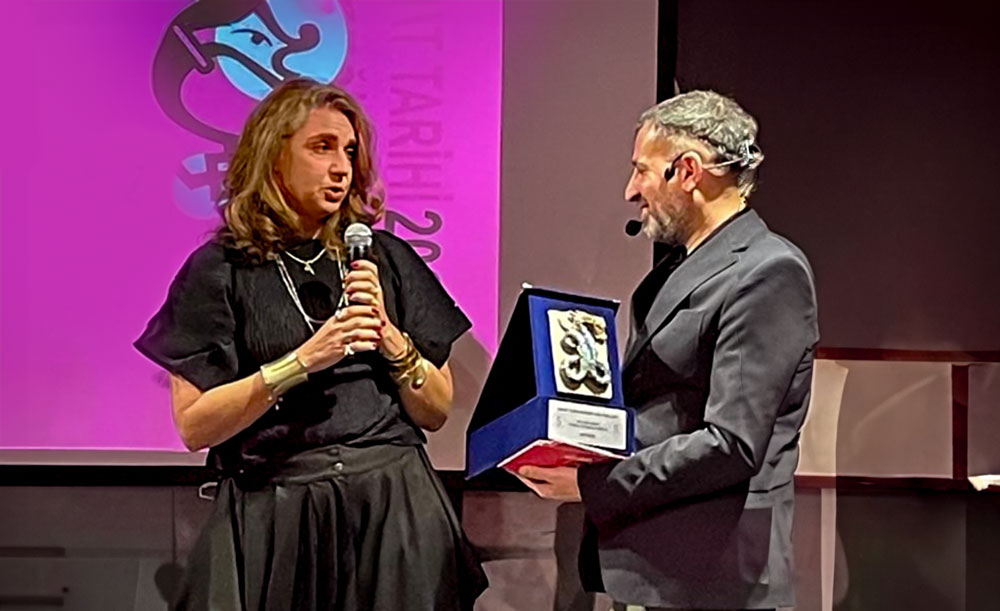

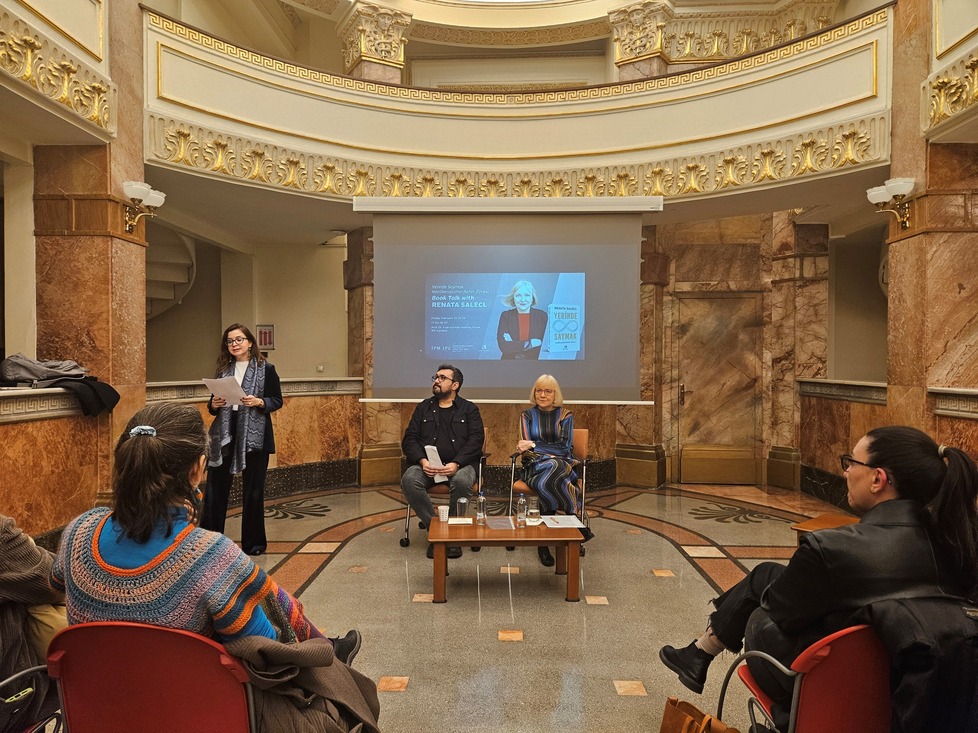
The Istanbul Policy Center (IPC) hosted renowned Slovenian philosopher and critical theorist Renata Salecl for a book talk marking the Turkish edition of her latest work, Stagnation: The Hostage Subject of Neoliberalism (Turkish title: Yerinde Saymak: Neoliberalizmin Rehin Öznesi).
Held at IPC’s Karaköy headquarters, the event focused on how neoliberal systems shape both individual and collective experiences through the concepts of freedom, choice and responsibility. Drawing attention to the ways in which neoliberalism structures everyday life, Salecl discussed its impact on personal decision-making processes, social relations and subjective experience.
The conversation also addressed the intellectual and political roots of the growing sense of insecurity that characterises contemporary societies. Salecl examined the pervasive feeling of “stagnation” defining the current global climate, offering a critical perspective on the psychological, political and cultural consequences of neoliberal systems. The event provided attendees with the opportunity to engage directly with one of today’s leading voices in critical theory, and evolved into a dynamic exchange enriched by active audience participation.
Philosopher, Social Theorist and “Archaeologist” of Everyday Life
Often described as a philosopher, social scientist and archaeologist of everyday life, Renata Salecl is known for transforming the seemingly ordinary aspects of daily existence into striking theoretical insights. In Stagnation: The Hostage Subject of Neoliberalism, she brings together philosophy, politics, psychoanalysis, forensic science, genetics and sociology in a compelling interdisciplinary synthesis.
Emerging from a critical reflection on the past four decades, the book explores how ordinary individuals, despite continuous effort and labour, find themselves unable to move forward, gradually losing economic security and facing the risk of leaving little behind for future generations.
About the Istanbul Policy Center
Founded in 2001, the Istanbul Policy Center conducts policy research on major political and social issues ranging from democratisation and climate change to transatlantic relations and conflict resolution. The centre operates globally and structures its research under six main programmes:
- IPC–Sabancı University–Stiftung Mercator Initiative
- Climate Change
- Democracy, Conflict Resolution and Global Politics
- SHURA Energy Transition Center
- Sustainability
- Digital Society
Since its establishment, IPC has provided impartial analysis and innovative policy recommendations to decision-makers, opinion leaders and stakeholders in its areas of expertise.