



The cat, although it may appear merely as an animal, often becomes one of the most powerful narrative elements in the history of art.
In Ancient Egypt, it appears as a hunter against the enemies of order (and of the sun god); in 17th-century Holland, as a symbol delivering a moral lesson; in the French still lifes of the 18th century, as a harmony between lifeless objects and living presence; in 19th-century Paris, as a shadow of modernity and debates surrounding sexuality; and in 20th-century modernism, as the silent companion of psychological tensions.
Within the narrative of art history, no element is used randomly, and the cat is not merely a “decoration.” It is often the visual counterpart of the meanings that societies attribute to it like sacredness, domestication, sensuality, independence, threat, compassion, play, or death. In an Ancient Egyptian tomb painting, a cat included in a hunting scene is positioned within both the intimacy of domestic life and the idea of cosmic order. As the visibility of the cat increases in early modern European painting, its meaning sharpens along the axis of “domestic order and disorder.” In Dutch genre painting, the cat can become a moral mechanism that suggests how play can suddenly turn into punishment; in English portraiture, the idea of death infiltrating a family scene may also be represented through cats.
In 19th century Paris, the cat transforms into a symbol suited to the tensions of modern urban life: questions of sexuality, class, the gaze, and display which is often pushed beneath the surface of politeness condense in the form of a “black” presence within the painting.
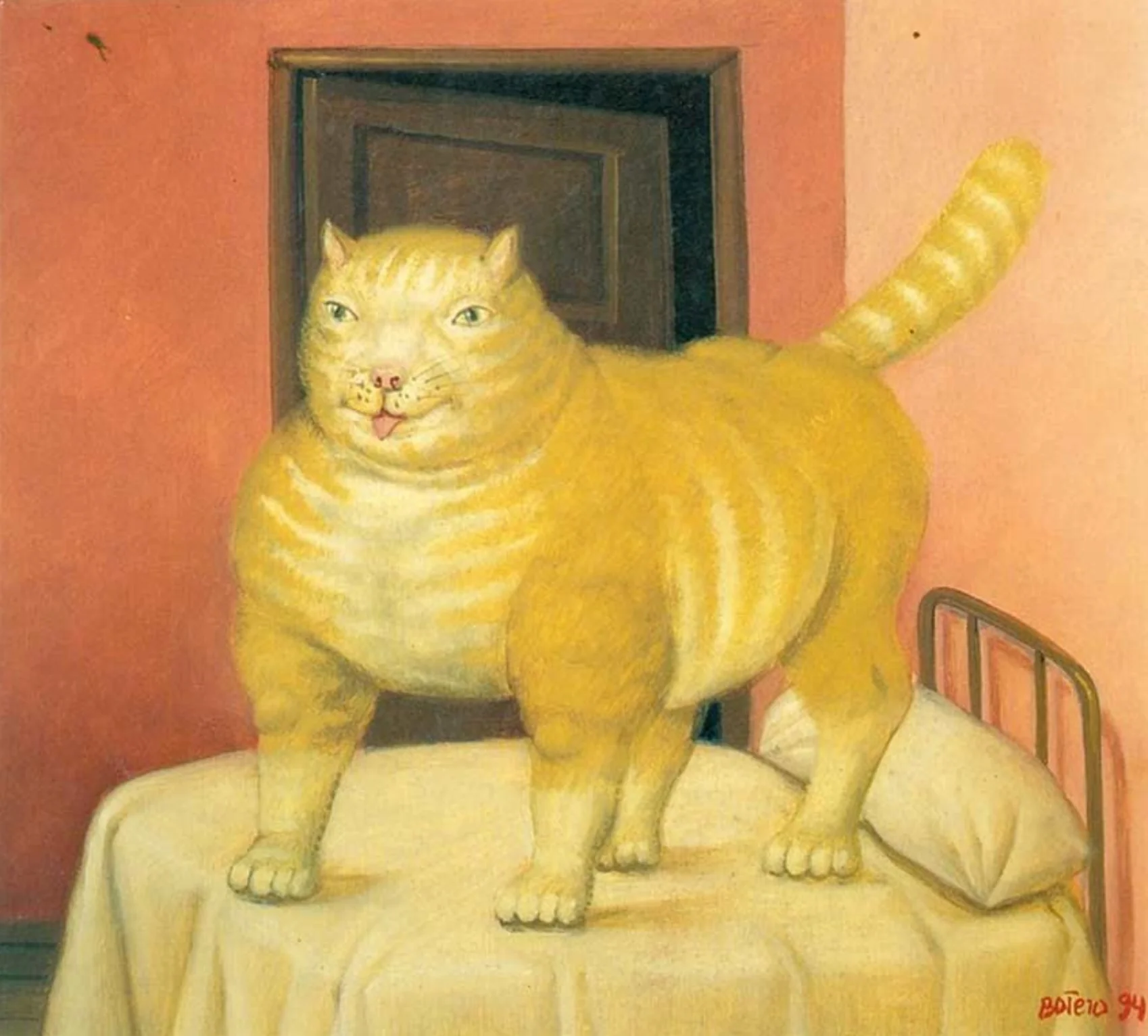
In the 20th century, the cat gains strength along two distinct lines. On the one hand, it becomes the “perfect model” for explorations of formal distortion, decorative surfaces, and investigations of pattern and line. On the other, it turns into a silent yet sharp companion to psychological narratives such as desire, dreams, tension, and timelessness.
Cat-Loving Painters, Studios, and House Cats
One of the institutional texts that most clearly articulates this relationship appears in the record of Le Chat blanc. For Pierre Bonnard, the cat is not a singular motif but rather a habit of seeing that unfolds through “countless” repetitions and variations. The museum text emphasizes that the artist repeatedly addressed cats sometimes as a small detail within a composition, sometimes as the main subject itself.
The role of the cat as a “studio companion” becomes even more visible in modern painting. Andy Warhol’s cat-themed artist’s book from the 1950s “25 Cats Name[d] Sam and One Blue Pussy” is today included in the collection inventory of Museum Brandhorst, demonstrating at the level of institutional record that the cat occupied a “personal” place within Warhol’s early visual repertoire.
Similarly, Pablo Picasso’s engagement with the cat as a subject of study can be directly traced through the work Study of Cats, preserved in the collection of the Museu Picasso Barcelona.

Fowling and Fishing in the Marshes (ca. 1350 BCE)
This polychrome tomb-painting fragment that consists of pigment applied to a plaster surface is located in the collection of the British Museum. Within the tradition of tomb-chapel wall paintings from the Theban necropolis of the late 18th Dynasty, such scenes construct an ideal scenario of life for the afterlife. In this context, the hunting scene represents not merely recreation but a motif associated with the ideas of rebirth and cosmic order.
The painting is considered a high-quality example of the New Kingdom tomb-painting tradition, with the central figure identified as Nebamun. The detail of the cat catching three birds at once introduces both movement and a strong focal point within the composition.
Here the cat operates on two symbolic levels. On the one hand, it conveys the intimacy of a domestic companion; on the other, it may allude to the sun god who hunts the enemies of light and order. Institutional and educational interpretations often support this reading, particularly by pointing to the cat’s gilded eye as a clue to its possible religious significance.
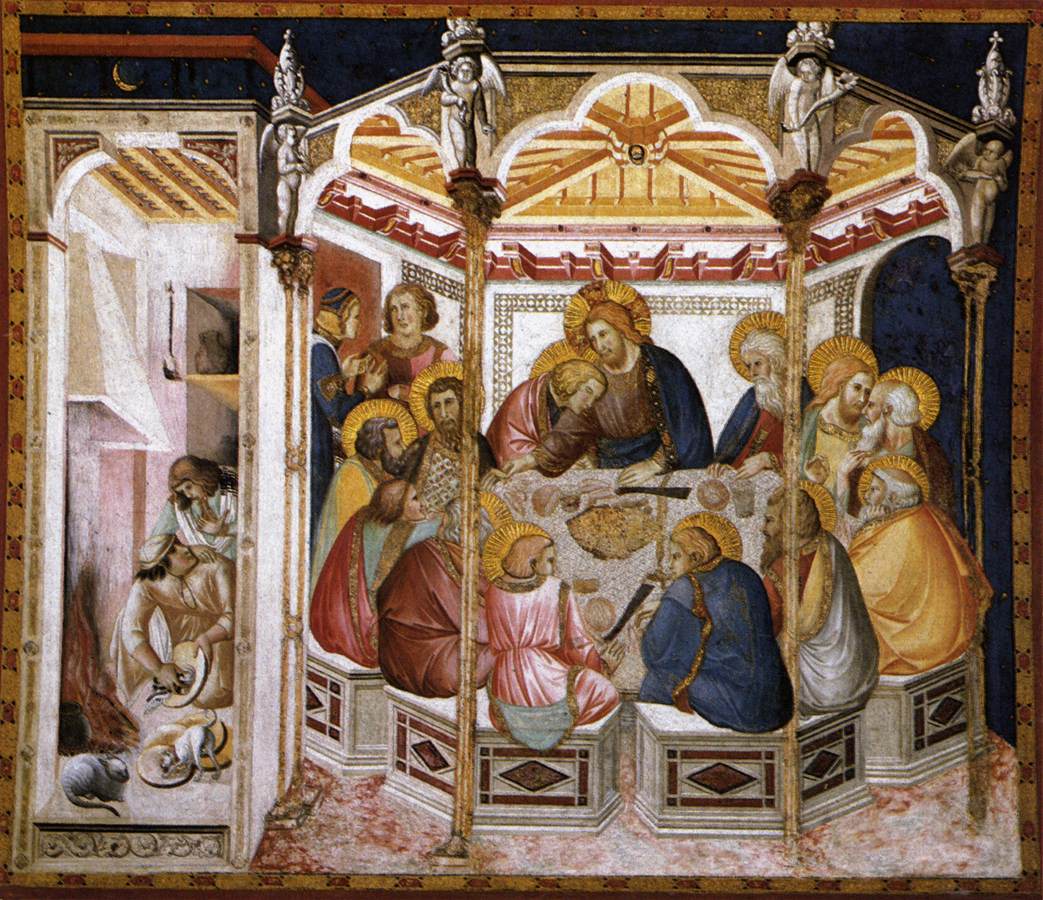
In the composition of The Last Supper while Christ and the apostles are seated at the table, a cat can be seen beneath it. Although this animal occupies a separate plane from the sacred center of the scene, it functions as an element that strengthens the symbolic meaning of the painting. In medieval iconography, the cat was often associated with betrayal, secrecy, and uncontrollable instincts. In Lorenzetti’s composition, the cat’s position under the table suggests a contrast between the sacred order at the center of the scene and the worldly instincts that exist beneath it. In this context, the cat has been interpreted as a visual metaphor for Judas’s impending betrayal.
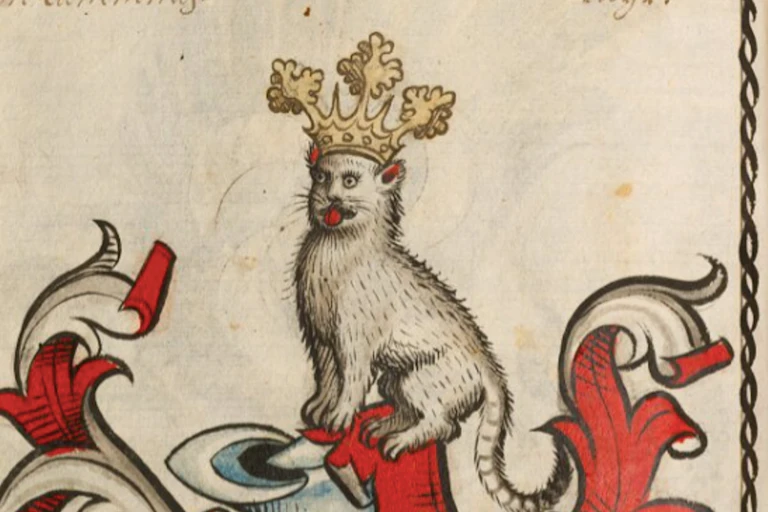
At the same time, such details reflect a common practice in medieval painting: the incorporation of everyday life elements into sacred narratives. The cat appears on the one hand as an ordinary part of domestic life, yet on the other it functions as a symbol that intensifies the moral tension of the scene. For this reason, the cat in medieval art is not merely a decorative detail; rather, it acts as a carrier of the theological and moral meanings operating beneath the surface of the composition.cat king, germany, 15th century
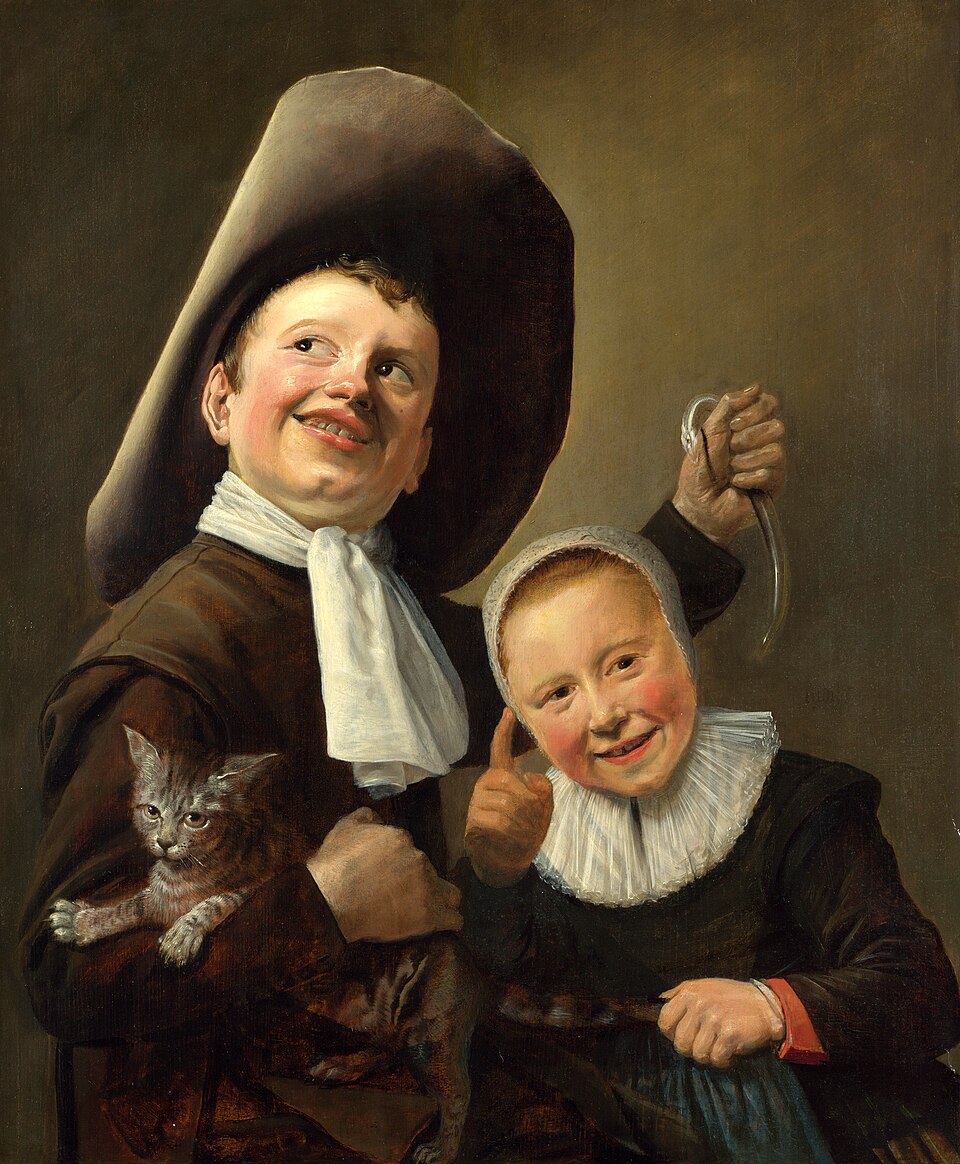
A Boy and a Girl with a Cat and an Eel (c. 1635)
In 17th-century Dutch painting, scenes of children’s games often function as indirect critiques of adult morality. The museum’s interpretive text suggests that the painting may allude to a Dutch proverb “those who play with cats get scratched” indicating that the scene carries both an entertaining and a cautionary meaning.
Judith Leyster is regarded as a prominent figure of Dutch Golden Age genre painting, noted for her strong narrative construction and careful control of the pictorial surface. In this work, she creates a brief but intense moment of drama, capturing a humorous yet tense instant within the scene.
Here, the cat represents “nature’s swift punishment”: the playful interaction may quickly end with a scratch. Beneath the painting’s lively and humorous surface, this possibility produces a subtle moral tension. Scholarly interpretations have therefore argued that the relationship between the children and the animal operates not merely as a joke but as a warning about social behavior.
Museum interpretations likewise emphasize that the painting has long been read simultaneously as entertainment and admonition, an ambiguity that constitutes one of the central strengths of the genre painting. The viewer’s anticipation of the cat’s next movement creates a sense of suspense, functioning almost like an early cinematic moment within the painted scene.
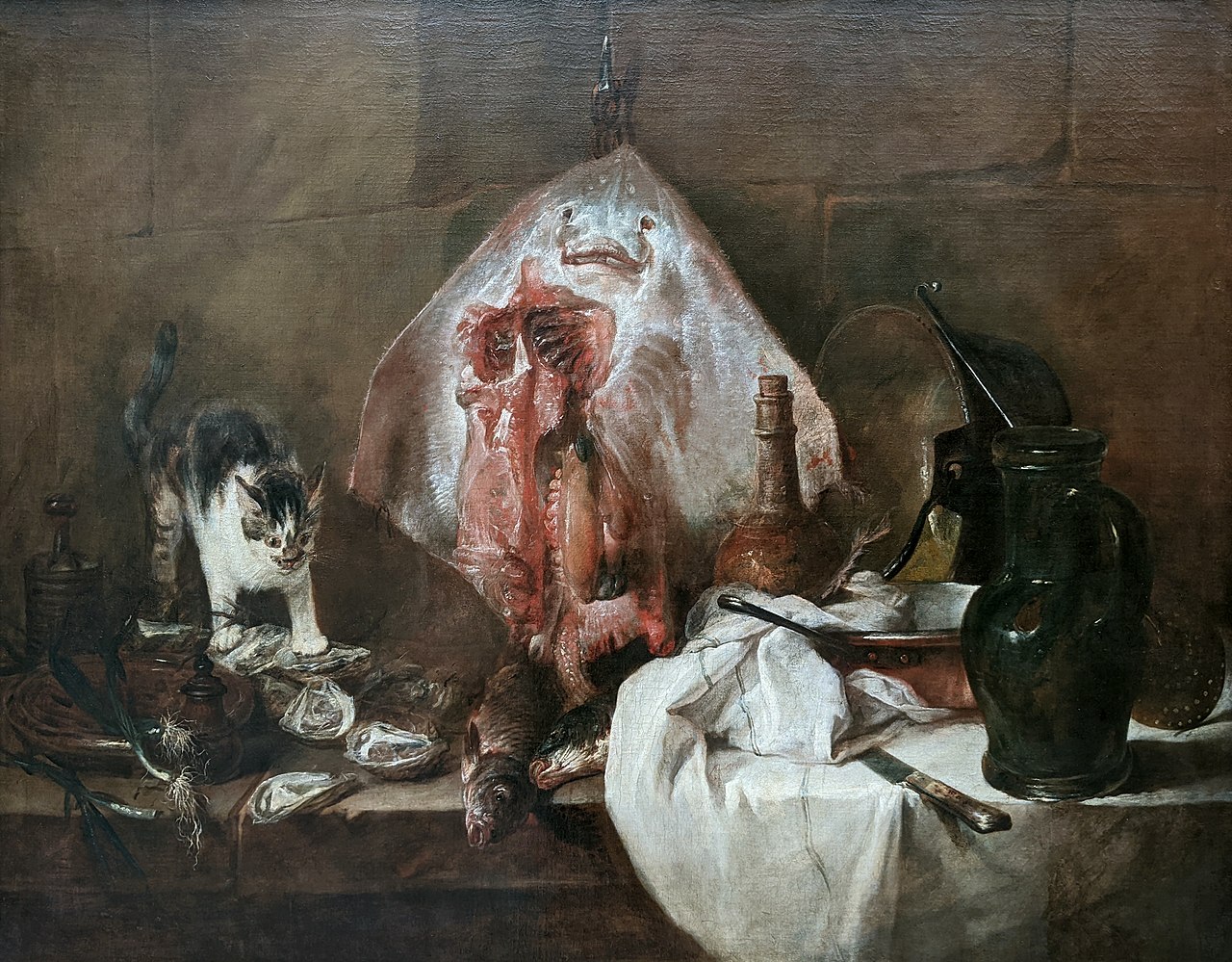
La Raie (1728)
Jean-Siméon Chardin’s La Raie is considered one of the turning points in the early eighteenth century for an approach that treated everyday objects with the seriousness of grand painting. Art historical literature emphasizes that the work played a decisive role in the artist’s admission to the French Royal Academy in 1728. Chardin is often associated with a compositional strategy in which objects are arranged like protagonists whose roles shift within the pictorial space. When he introduces a living animal—a cat—into a still-life arrangement, the expected stillness of the genre is deliberately disrupted.
The hanging skate establishes the central axis of the composition; to the right are kitchen utensils, while to the left appear shellfish and a tense, stretched cat. This opposition between life and death is conveyed not only through subject matter but also through the behavior of paint itself. A point discussed through Denis Diderot’s writings in 1763 describes how Chardin layered paint to create an effect in which the surface seems to dissolve when viewed up close yet reassemble into coherence from a distance.
Although Diderot famously commented on the skate while making no explicit mention of the cat, the animal’s presence carries much of the compositional tension. For this reason, the painting transcends the boundaries of a simple “kitchen scene.”
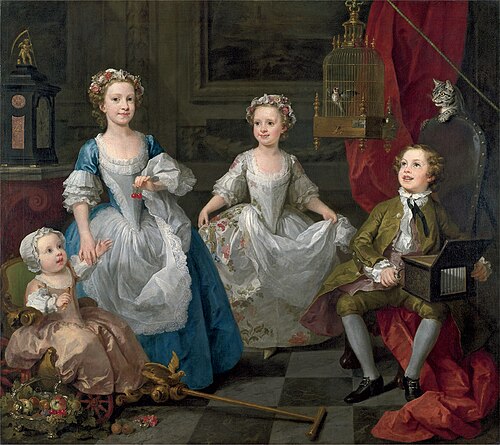
The Graham Children (1742)
Eighteenth-century English family portraiture often combines the idea of innocence with an underlying sense of fragility. The museum’s interpretive text notes that the symbols within the scene such as the goldfinch and the cherries construct a narrative about childhood and the transience of life.
William Hogarth, known for embedding moral and dramatic layers within everyday scenes, here creates a symbolic arrangement that elevates the family portrait toward the gravity of a history painting. The composition presents an atmosphere of elegance and order. Yet the scene suddenly shifts toward a sense of threat with the cat climbing onto the chair. This movement directs the viewer’s gaze toward the caged goldfinch and, indirectly, toward the idea of death.
According to the museum interpretation, the cat frightening the goldfinch evokes the suddenness with which death may strike. In this way, the smallest living creature within the painting carries the largest allegorical weight. In readings of The Graham Children, the cat produces a counter-rhythm that prevents the viewer from fully settling into the comfort of a “happy family scene.” The symbolic analysis offered in the museum text suggests that this tension was deliberately constructed.
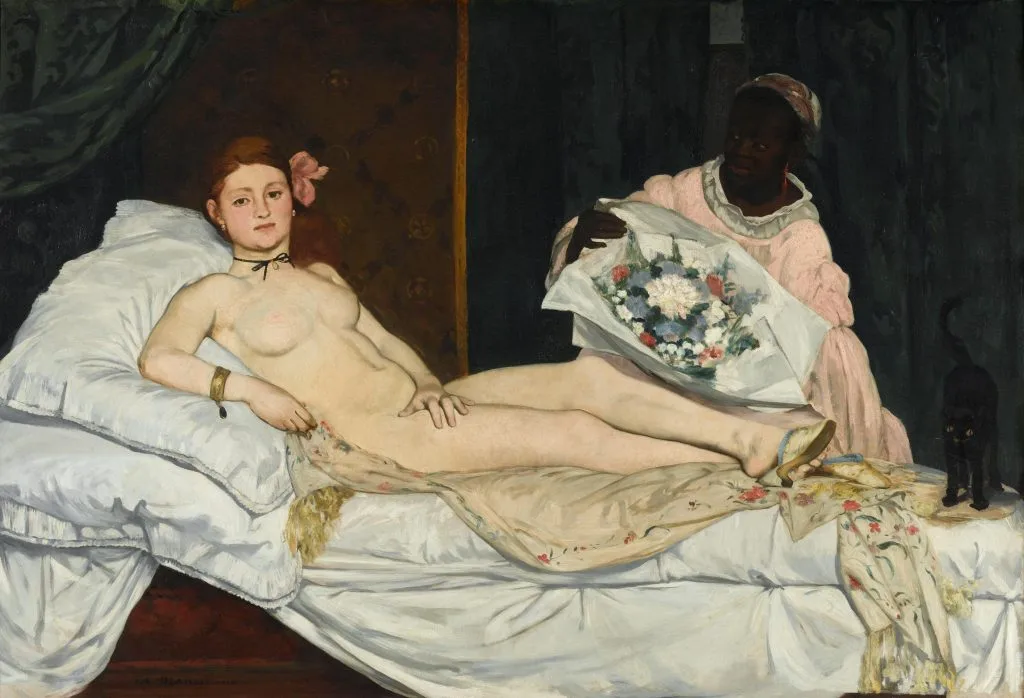
Olympia (1863)
The museum’s interpretive text explains the scandal the painting provoked at the Salon of 1865, emphasizing both its subject ,a contemporary nude, and its uncompromising pictorial language. It also notes that Édouard Manetmade deliberate references to earlier visual sources, including Titian’s Venus of Urbino, Goya’s La Maja Desnuda, and the odalisque themes associated with Ingres.
Manet is often regarded as a key figure in transforming the “regime of the gaze” in modern painting. In Olympia, the nude appears without the protective veil of mythological or historical narrative; instead, it is placed directly within the stark reality of modern urban life.
The figure’s direct gaze toward the viewer turns the composition into a gesture of confrontation. The sharp contrast between dark and light areas reinforces the painting’s strong planar structure. At the lower edge of this pictorial field, the black cat plays a crucial role both in balancing tonal contrasts and intensifying the narrative tension.
Scholarly interpretations note that the black cat could evoke associations present in nineteenth-century visual culture, including references to prostitution, moral transgression, and sexual availability. Some art historians have also suggested that the cat functions almost as an indirect signature through which Manet inserts his own presence into the painting. These readings move the cat beyond the role of a domestic animal and place it at the ideological center of the composition.
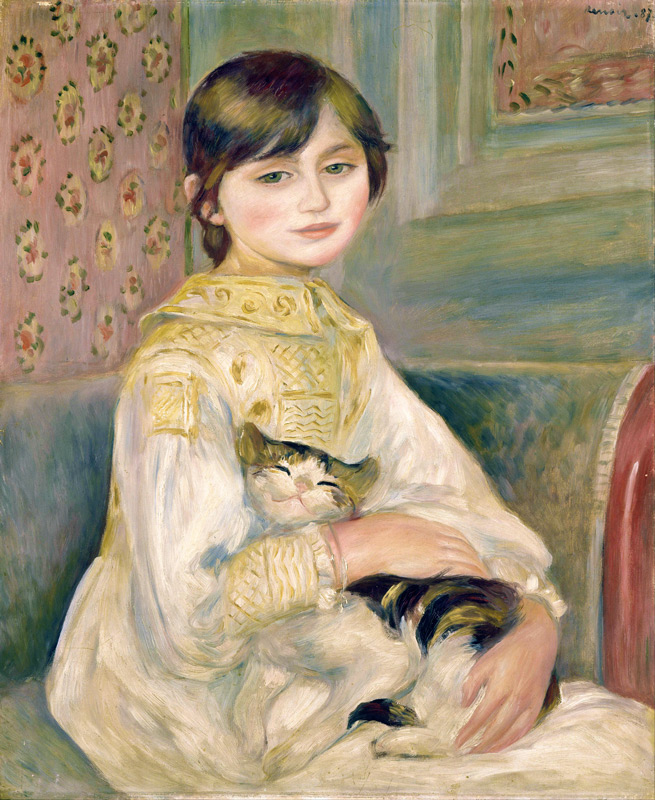
Julie Manet (also known as L’enfant au chat) (1887)
The museum’s text clearly recounts the commission behind the portrait: in 1887, Berthe Morisot and her husband Eugène Manet asked Pierre-Auguste Renoir to paint a portrait of their daughter Julie Manet. Their relationship had grown closer during the second half of the 1880s. During this period Renoir underwent a stylistic shift, increasingly emphasizing line and drawing. Museum interpretations describe this phase as “Ingresque,” reflecting the influence of Jean-Auguste-Dominique Ingres and his emphasis on precise linear structure, a development that sparked debate among the artist’s contemporaries.
The portrait is often described through terms such as a “refined finish” and an “enamel-like surface,” indicating Renoir’s controlled brushwork and a smoother, more polished pictorial surface. Julie later recalled that Renoir decided on the composition quickly without significantly altering her pose and painted the portrait in smaller sections than he usually did.
The alternative title, L’enfant au chat (“The Child with a Cat”), foregrounds the presence of the animal and prevents it from functioning merely as a conventional accessory. Here the cat becomes an intimate companion to the child’s inner world—a “proximity object” that reinforces the atmosphere of tenderness. This reflects a softer semantic field for the cat within the bourgeois portraiture of the late nineteenth century.
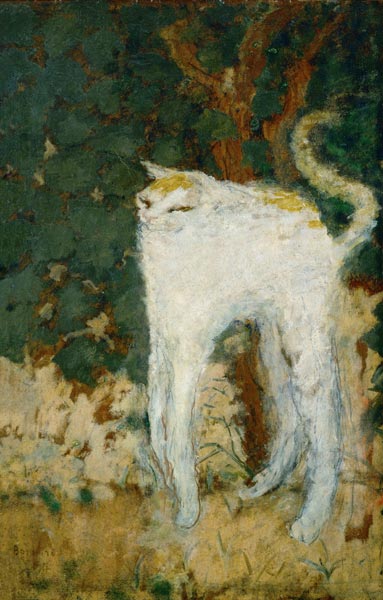
Le Chat blanc (1894)
The work is often associated with the Nabis tradition and with the growing interest in Japanese prints, while also emphasizing Pierre Bonnard’s use of cats as a recurring motif within his visual repertoire. Within discussions of Japanese influence, artists such as Hokusai and Utagawa Kuniyoshi are frequently cited.
Bonnard is regarded as one of the painters who radicalized the decorative surface, cropped framing, and the relationship between pattern and line in modern painting. The flexible body of a cat becomes an ideal subject through which to explore this pictorial experimentation.
The museum’s interpretation explicitly highlights the painting’s distortion: the cat arches its back in an exaggerated curve that borders on caricature. The eyes appear as narrow slits, the spine is extremely arched, and the head sinks into the shoulders. This deliberate deformation renders the cat simultaneously domestic and wild.
The institution also notes that Bonnard worked extensively on the form and placement of the paws; X-ray examinations reveal numerous revisions. In this work, the cat’s symbolism ultimately lies in the very nature of “catness” itself, its ambiguity between the domesticated and the feral. Rather than transforming the animal into a fixed allegory, Bonnard turns it into a form of visual intelligence. Within an artistic approach often described as “not nature,” the cat does not imitate nature; instead, Bonnard reinvents it.

Cat and Bird (1928)
According to the Museum of Modern Art (MoMA) artist biography, Paul Klee taught at the Bauhaus between 1921 and 1931. Created in 1928, this work can therefore be read as part of a visual thinking practice developed alongside his pedagogical and theoretical production. Klee is frequently described as both a painter and a theorist deeply engaged with the principles of line and color.
The painting presents a cat’s face occupying almost the entire frame, with a small bird motif appearing on the animal’s forehead. The forms are simplified and the surface is divided into segments. This reduction brings the cat close to the simplicity of a child’s drawing while simultaneously increasing its capacity to function as a symbol. The materials such as ink and oil paint on a gesso ground enhance the graphic quality of the image.
In Klee’s work, the cat becomes a pictorial schema of the predatory instinct. The placement of the bird on the forehead allows it to be read less as a physical presence and more as a mental fixation or imagined pursuit. In this way, the painting suggests that the cat in modern art is no longer merely something that is seen but also something that thinks or dreams.
Klee’s cat condenses one of modernism’s central claims of “the effort to make thought visible rather than simply reproducing appearances” into the image of an animal face. Here, the cat itself becomes the language of the painting.
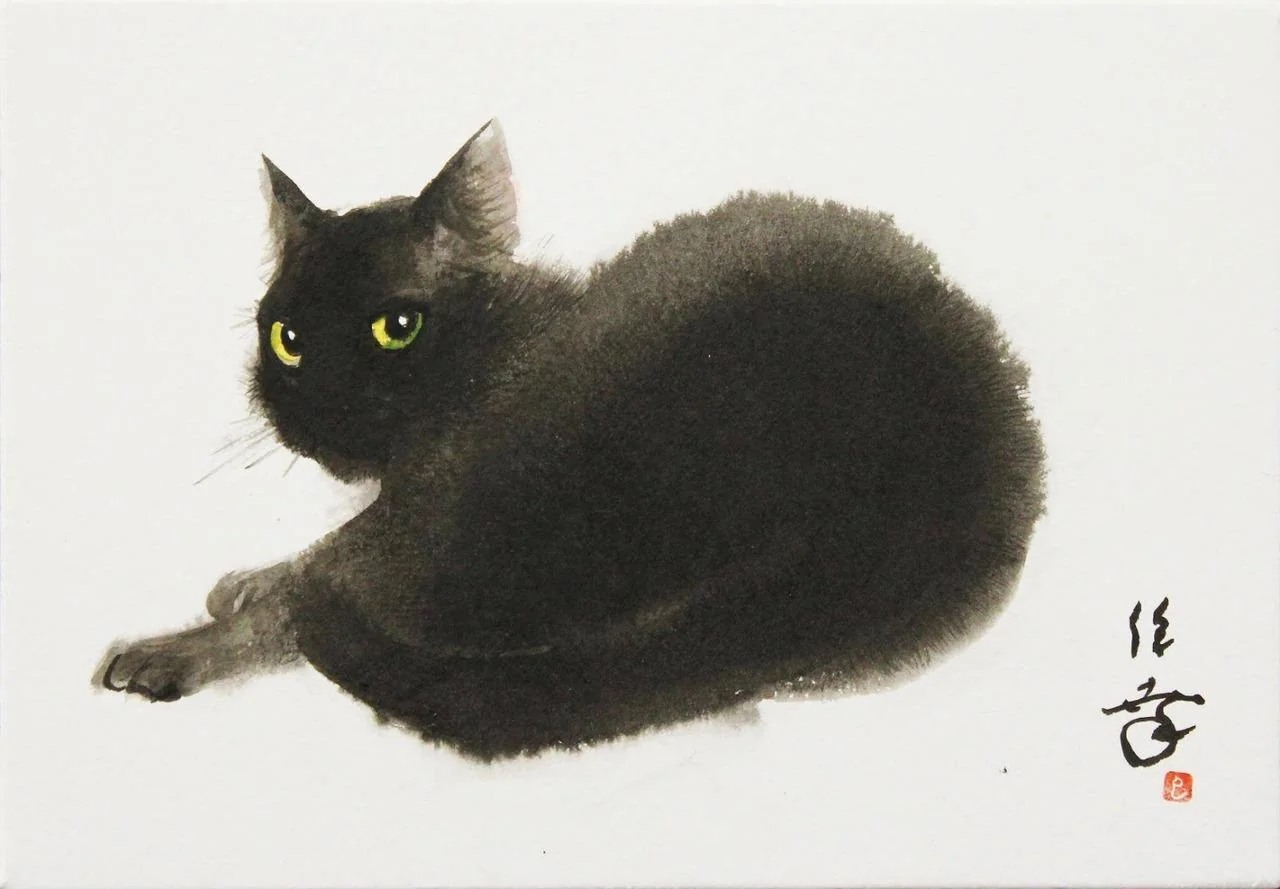
Black Cat (1961)
Enoki Toshiyuki (b. 1961, Tokyo) is a contemporary Japanese artist known for figurative works that bring together folkloric imagery and dreamlike visual atmospheres. Animals, especially cats, appear frequently in his paintings. Rather than depicting them simply as natural subjects, Enoki approaches these motifs through the symbolic meanings circulating within Japanese cultural memory.
Enoki Toshiyuki’s Black Cat reflects on the layered meanings associated with black cats in Japanese visual culture. In Japan, unlike in medieval Western traditions where black cats were often linked with misfortune, they have frequently been associated with good luck and protective powers. Sources from the Edo period (1603–1868) record beliefs that black cats could bring fortune and ward off malevolent spirits. Some Edo-period folk beliefs also suggested that black cats could protect against illnesses such as tuberculosis. In this context, the presence of black cats was sometimes connected to ritual practices related to okyū (お灸), a traditional moxibustion-based treatment, where the animal’s presence was thought to bring healing and good fortune.
In Enoki Toshiyuki’s painting, the black cat can be read as a concentrated image of this cultural background. Positioned centrally within the composition, the cat often faces the viewer directly, becoming not only the depicted subject but also the figure that establishes the painting’s gaze. The density of the black tones almost reduces the body to a silhouette, while the eyes emerge as the brightest and most vivid elements of the composition. In this way, the painting visually intensifies the black cat’s traditional association with night and the unseen world in Japanese culture.
As we can see, in the history of art, the cat often appears as a small yet powerful figure within the composition throughout history . At times it carries the tension of a scene; at others, it becomes a subject in its own right. With its independence, its association with mystery, its sudden movements, and its distant intimacy with humans, the cat has served artists not merely as an animal to be depicted but also as a conceptual and symbolic device. For centuries, and likely for centuries to come, cats continue to be among the most vivid and intriguing representatives of the relationship between art and everyday life.