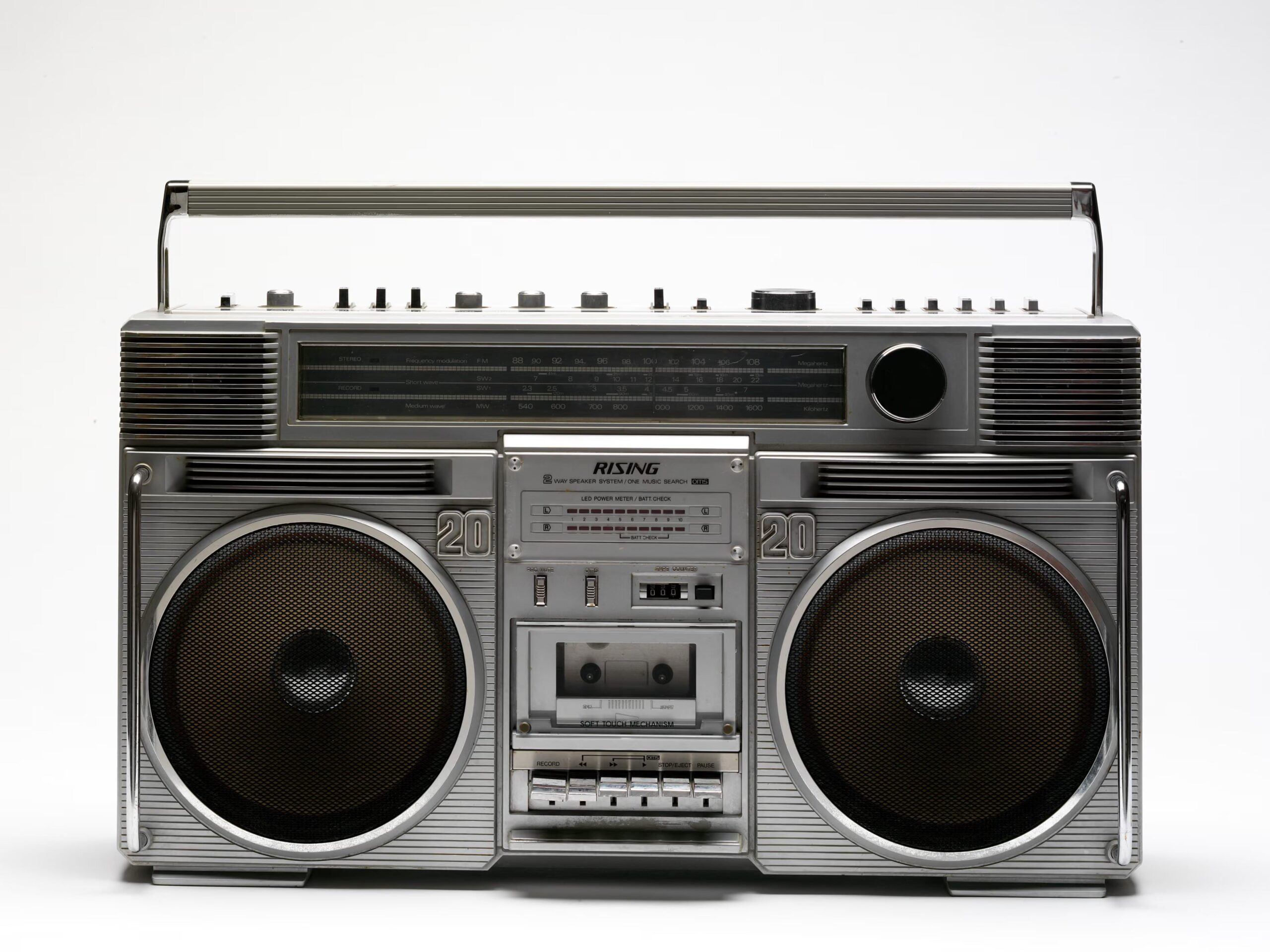
1980’lerden kalma bir boombox. Fotoğraf: Jaron James/Victoria and Albert Museum, Londra.
A Contemporary Look at 21st-Century Design at Victoria and Albert Museum
The Victoria and Albert Museum brings together the traces of 21st-century design — spanning from everyday life to political memory — with a comprehensive selection of 250 objects, following the renewal of its Design 1990–Now galleries.
The Victoria and Albert Museum has reopened its Design 1990–Now galleries, recently refurbished to foreground 21st-century design. Bringing together a total of 250 objects, the new display makes visible the multi-layered impact of design in shaping modern life — from everyday practices to politics, from technology to identity.
The wide-ranging selection spans early baby monitors to Nigeria’s 2018 World Cup jerseys, from 1980s boomboxes to computer components once owned by Edward Snowden, as well as the Labubu figure — revealing how design circulates across times and geographies. Rather than following a chronological narrative, the galleries are organised around six thematic sections, including living spaces, crisis and conflict, consumption, and identity.
V&A’da sergilenen Labubu. Fotoğraf: Victoria and Albert Museum.
Contemporary Reflections of Design
The 60 new objects on display present striking examples that particularly focus on women’s relationship with working life. A padded-shoulder women’s suit from 1986 — an emblem of 1980s office culture — is exhibited alongside a plastic-lined bra used by women working on production lines in China to avoid invasive body searches when leaving factories, and jeans produced at the Rana Plaza complex in Bangladesh. This section offers a powerful framework that reminds us design is not merely an aesthetic field of production, but one deeply entangled with labour, the body and power relations across different periods.
Eleven contemporary objects selected in line with public suggestions have been added to the collection as part of the Rapid Response programme. This section includes the Snake Island stamps that became symbols of resistance during the Ukraine–Russia war, the “life medal” awarded to those imprisoned for environmental activism, and the Labubu figure. Summing up the core aim of the galleries, V&A Senior Curator of Design and Digital, Corinna Gardner, states:
“We imagine everyone who visits as waking up in the 21st century. We try to understand our present through the past and to develop a perspective on the future. Design becomes our guide in this process.”
Burkini tasarımı, Aheda Zanetti’nin yeğeninin spor yaparken yaşadığı deneyimlerden ilham aldı. Fotoğraf: Robert Auton/V&A Museum.
Design objects that accompany everyday life form one of the exhibition’s most striking sections. An IKEA lamp makes visible the balance between portability and aesthetics, pointing to the relationship industrial design establishes with the scale of mass production. A 1977 Apple computer, shown alongside contemporary advertising material, offers a revealing testimony to a period when working from home was still a new and experimental idea.
The first baby monitor, designed in 1937 by Isamu Noguchi, was shaped by rising security anxieties following the kidnapping of the Lindbergh baby; meanwhile, the plywood leg splint developed by Charles Eames and Ray Eames during the Second World War to stabilise wounded soldiers’ legs recalls how a material now widely used began its journey under wartime conditions. Together, this selection highlights the strong ties design forges not only with everyday life, but also with moments of historical rupture.
Apple II Computer 1977.
The burkini, designed in 2004, stands out as a solution developed by Aheda Zanetti in response to the physical and social barriers her niece encountered while engaging in sports. The carbon-fibre rope that powers the elevators of the Jeddah Tower in Saudi Arabia — planned to reach a height of one kilometre — demonstrates how engineering design connects advanced technology with everyday life.
In the section focusing on the past 25 years of data and communication, a laptop belonging to Edward Snowden, on loan from The Guardian archive, is on display — a powerful symbol of how design intersects with information, surveillance and public debate in the digital age.