
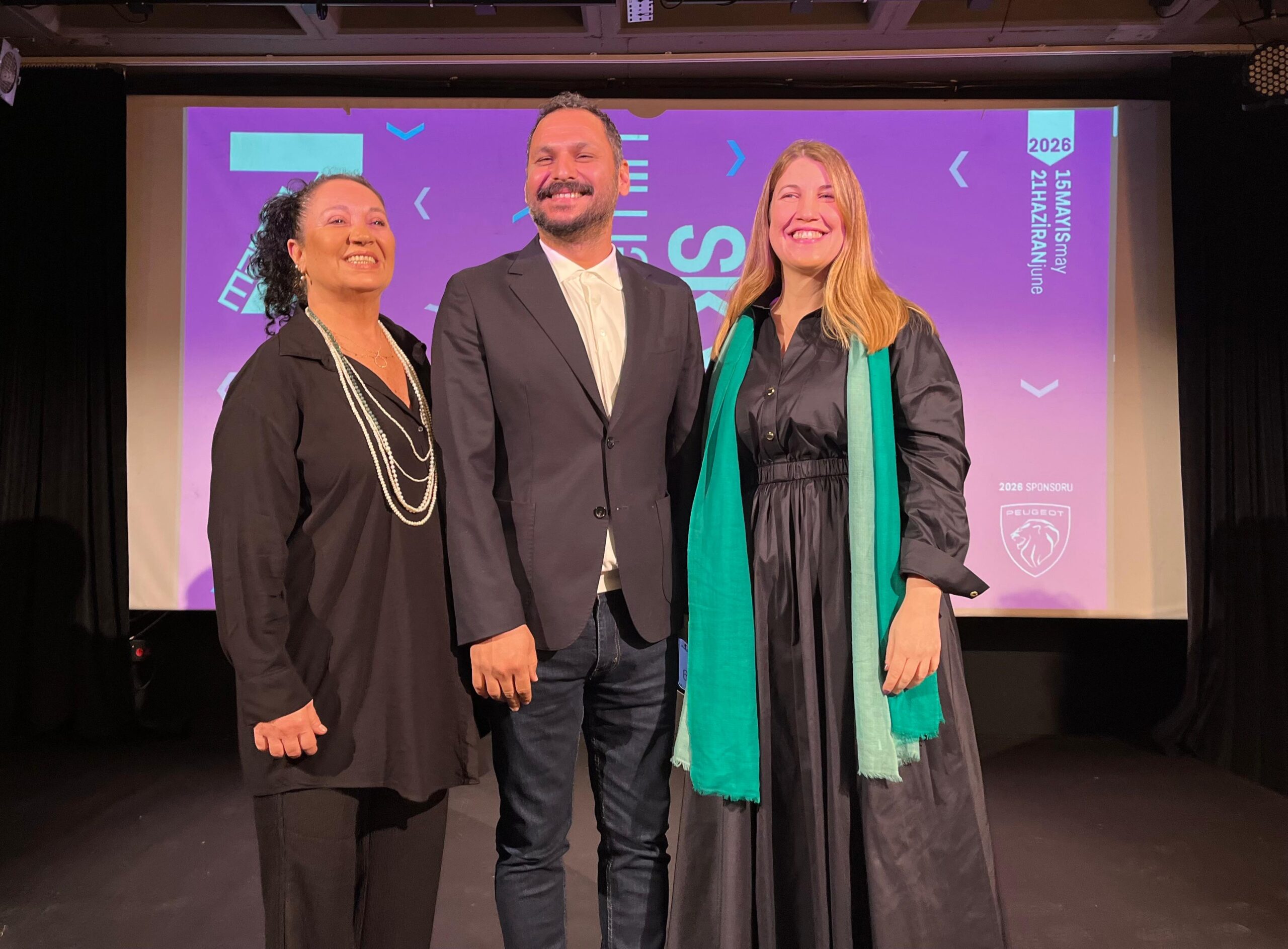
Opening her remarks with the words, “21 December is the darkest moment of the night, when light is at its most timid. But as of 22 December, we are also at the first day when daylight begins to lengthen again. In other words, we are on a threshold where days start to grow longer once more. We are at a time when, from within seemingly endless nights, an almost imperceptible light begins to return. It is a time—an interval, a month of intervals—when the sky is born precisely on such thresholds; when below and above, darkness and light, reality and dream touch one another,” Bafra stated that this condition of in-betweenness—where sky meets ground, darkness meets light, and reality meets imagination—constitutes the point of departure for the concept of GÖKzemin.
Between Sky and Ground
Bafra recounted that she first came to Diyarbakır and Mardin in 2005 together with artists and the team of the Istanbul Biennial, and noted that since then she has sought to maintain her connection with the region:
“We tried to sustain this relationship through local artists, particularly via independent art initiatives and civil society organizations. Some of them are still here today.”
Describing her ongoing effort to understand Mardin, she said: “I tried—and I am still trying—to understand Mardin’s shopkeepers and artists, its mornings and evenings, its eccentrics and its wise ones, its air and water, its fauna and flora.”
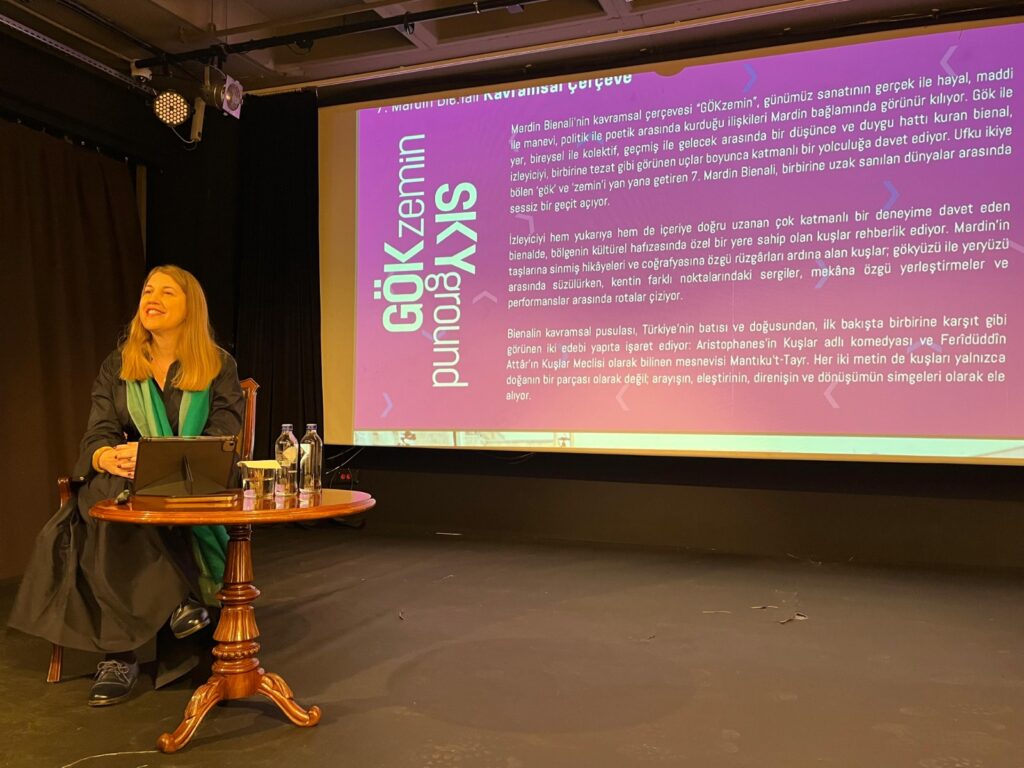
Bafra also noted that she closely follows biennials and museums around the world, and that in international seminars and lectures she takes particular care to reference the Mardin Biennial and other biennials across different parts of Türkiye. After receiving the curatorial invitation, she explained, she began to seek answers to the following questions: “In today’s world, within today’s biennial landscape, amid all these contradictions, polarizations, ruptures, and injustices, is it still possible to dream? And if so, how can such a dream be constructed without detaching from the ground of reality?”
The Biennial Extends Beyond the City for the First Time
Organized since 2010, the Mardin Biennial will, with its 7th edition, for the first time expand beyond the boundaries of the historic old city, extending to Dara Antik Kenti, Deyrulzafaran Manastırı, and Kızıltepe. With this expansion, the biennial invites audiences to consider the region’s diverse geographical, historical, and cultural layers together.
Detailing the biennial’s spatial framework at the press conference, Bafra said:
“For those unfamiliar with the area, Upper Mardin and the Deyrulzafaran Monastery right next to it, with their multi-religious and multilingual structure, ancient architecture, and vast panorama, constitute one of the biennial’s intellectual centers. The feeling of being suspended between sky and ground, this gaze over Mesopotamia together with the birds, becomes one of the biennial’s metaphors.”
Defining Kızıltepe as the biennial’s urban and social ground, Bafra emphasized the district’s vibrant character:
“Kızıltepe is the largest district of Mardin, where many artists were born and raised. Throughout history, it has been a center of trade and everyday life, and today it remains a very lively place where social relations and political tensions intertwine.”
As for Dara Ancient City, Bafra described it as “one of the places where the journey between past and future is felt in the most layered way.” She noted that with its archaeological texture and natural landscape, Dara has been conceived as a resonance field within the biennial.
Bafra added that GÖKzemin is a concept that emerged precisely from these questions—“a somewhat invented term, but one that deliberately places two opposing words side by side.”
Guided by Birds
Inviting audiences into a multilayered experience that extends both upward and inward, the biennial is guided by birds—figures that hold a special place in the region’s cultural memory. Carrying the stories embedded in Mardin’s stone architecture and the winds unique to its geography, birds glide between sky and earth, tracing routes among site-specific installations and performances spread across different points of the city.
The biennial’s conceptual compass points to two literary works from Türkiye’s west and east that may at first appear opposed: The Birds, the comedy by Aristophanes, and Mantıku’t-Tayr (The Conference of the Birds) by Feridüddin Attar. In both texts, birds are treated not merely as elements of nature but as symbols of quest, critique, resistance, and transformation.
Artists from Diverse Geographies
Touching on the selection of artists invited to the biennial, Çelenk Bafra emphasized that particular space was given to artists from Türkiye as well as from geographies capable of forming cultural connections with Mardin. She added that the biennial will feature artists from Eastern Europe, the Balkans, Asia, North Africa, and South America.
Noting that the opening of Deyrulzafaran Manastırı as a biennial venue for the first time carries special significance for them, Bafra described the site as “a space for slowing down, pausing, and reflection.” In Kızıltepe, she stated that art will, for the first time at this scale, inhabit spaces tied to everyday life such as an old hammam and a former vegetable market.
The biennial will open on 15 May in Yukarı Mardin with a traditional celebration. Throughout the biennial period, exhibitions, performances, and public programs will unfold across multiple venues, culminating in the closing on the summer solstice, 21 June, at Dara Antik Kenti.
Summarizing the biennial’s core approach, Bafra stated: “The Mardin Biennial does not propose choosing between sky and ground; it proposes pausing within the passage between the two—placing imagination in the sky and responsibility on the ground.”
Hosted by the Mardin Sinema Derneği, the 7th Mardin Biennial will be realized with PEUGEOT as its main sponsor.