
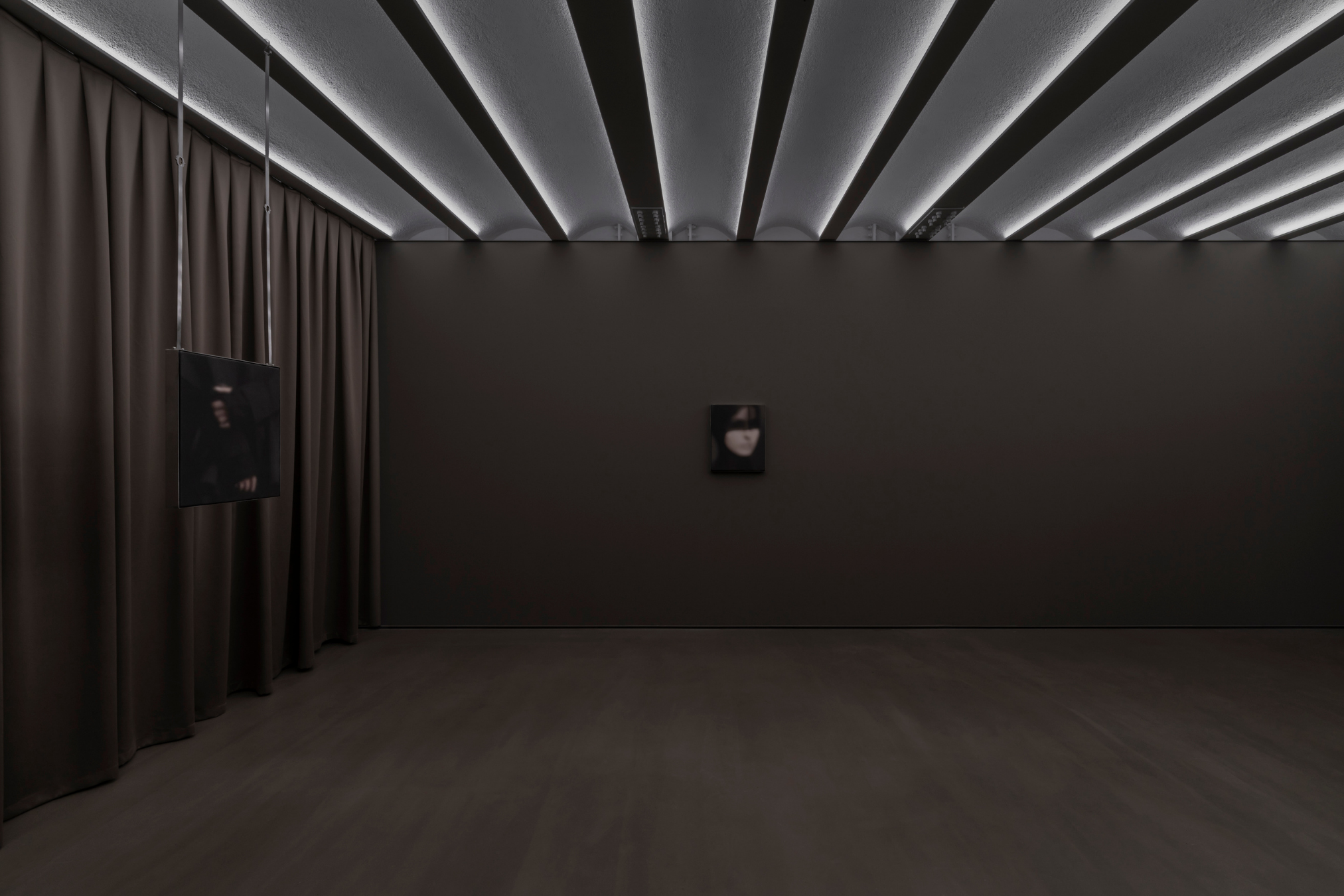
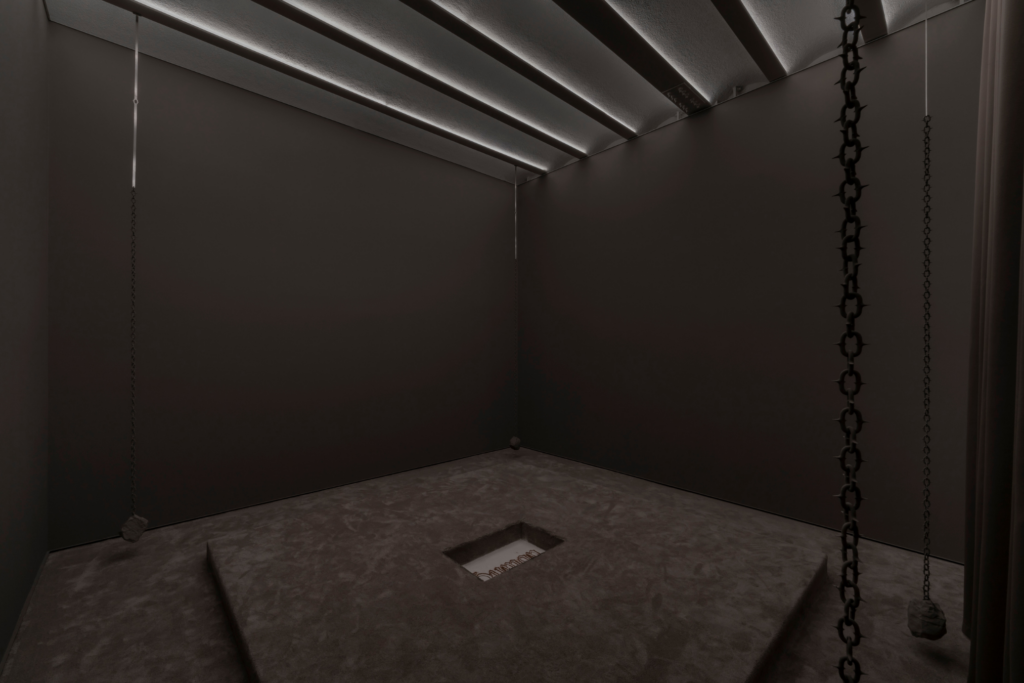
SANATORIUM hosts Christiane Peschek’s solo exhibition titled PHOENIX CASTLE between September 17 and October 31, 2026. Upon entering the PHOENIX CASTLE exhibition at Sanatorium, what awaits you is not the conventional sterile white cube, but the scent of incense, a quiet invitation to take off your shoes, and the fading word “human”. This initial tactile contact established with the floor creates an intimate, sheltered space reminiscent of home, rather than imposing a detached exhibition experience. In the two-floor spatial narrative of the exhibition, while the lower floor invites the viewer into a meditative sanctuary with stones suspended from the ceiling, Ernst Lima’s sound installation, and fragrances; moving to the upper floor transitions into a dynamic world that shifts weekly, where we try to make sense of what fades and disappears.
Rather than imposing conceptual certainties, the exhibition leaves meaning to visitors’ own associations; touching upon themes of digital fatigue, identity, and vulnerability. We spoke with Christiane Peschek about the conceptual layers of PHOENIX CASTLE, its spatial design, and their artistic practice that resists the pressures of visibility.
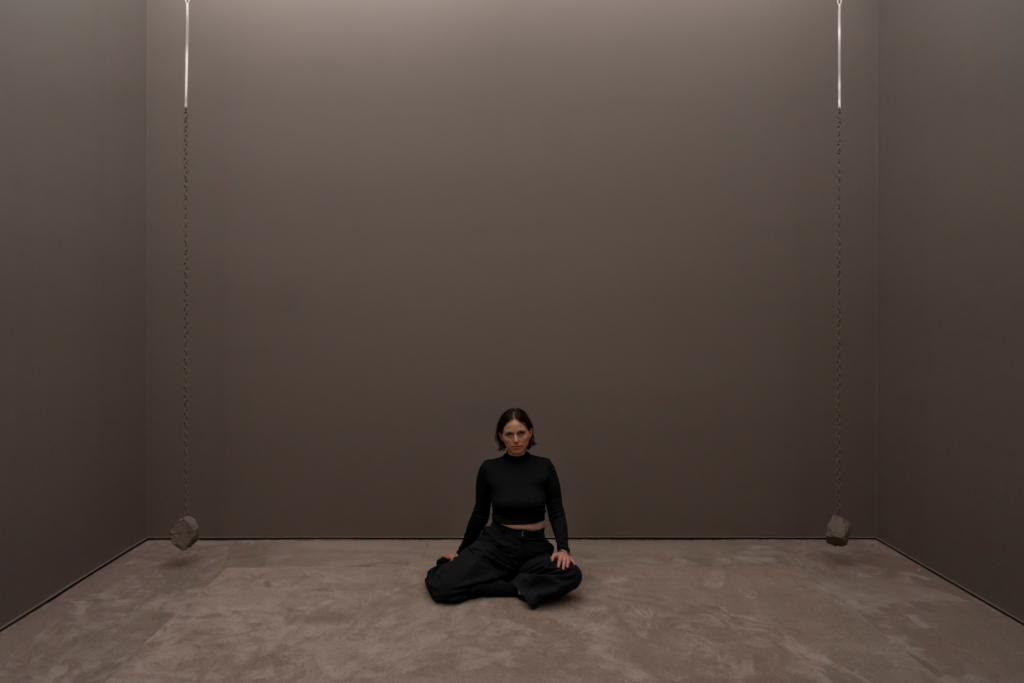
The stones hanging few centimeters above the ground remind us the gravity that grounds us. But the phoenix flies. Did you engineer the exhibition around that tension?
The installation emerged from the practice of grounding meditation in which you imagine becoming completely still and solid like a stone, allowing thoughts, emotions, and sensations to pass without following or resisting them. The practice cultivates non-attachment as you remain present and receptive without feeling compelled to react to everything that arises. In the exhibition we find ourselves in a post-apocalyptic scenario where grounding got interfered by promises of the virtual realm. As the digital is not bound to gravity it has the potential to disconnect us emotionally, physically and environmentally from being embedded on earth.
The phoenix, in the classical versions, is a bird that lives for an extraordinarily long period and eventually dies only to be renewed or born again.
For PHOENIX CASTLE I used the metaphor of the phoenix to represent the cyclical ontology of “being earth”. Death does not interrupt the cycle of earthness, death is the mechanism through which the next state becomes possible.
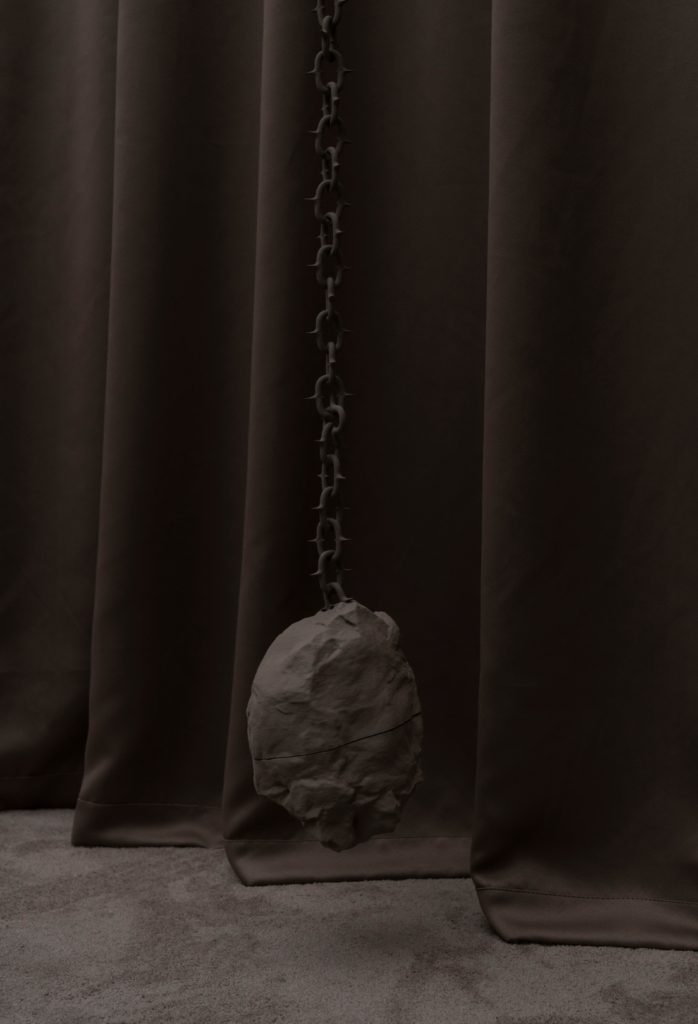
You’ve said that “I claim my right to be blurry” in this high resolution age. Why? Is this urge a form of resistance or a return to one’s essence?
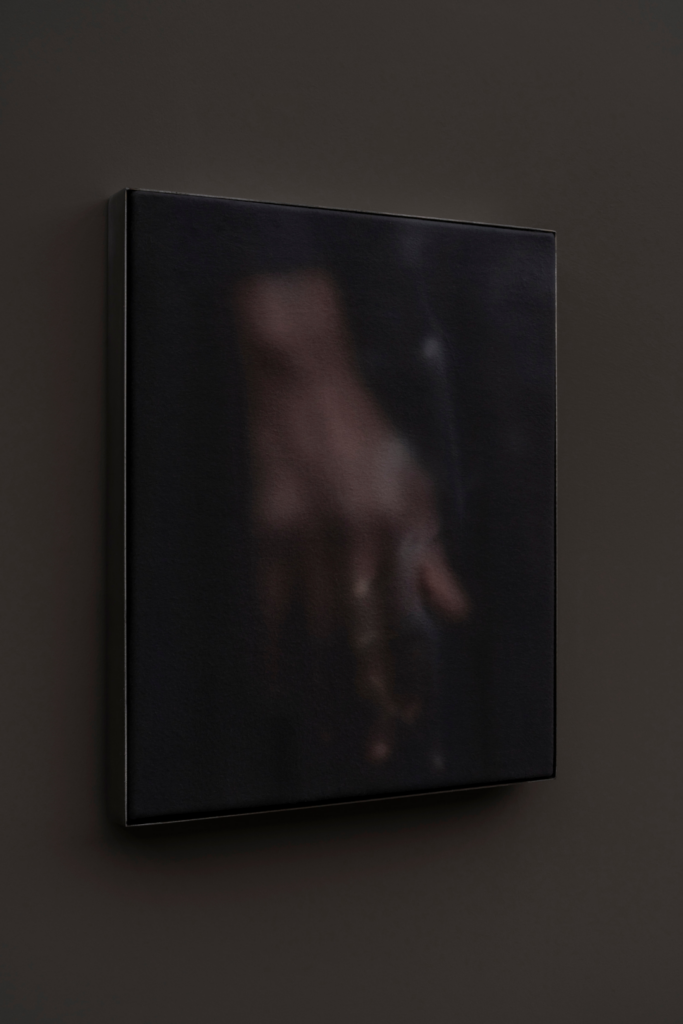
We live in an increasingly high-resolution culture where everything is expected to be visible, identifiable and legible.Our faces, bodies, preferences, locations and identities are constantly captured, categorized and processed. There is an implicit demand to make ourselves readable. To claim the right to be blurry is to interrupt that demand. Blurriness allows for ambiguity, contradiction and transformation. It creates a space in which I don’t have to fully define what I am, or make myself completely available to be interpreted. So for me, being blurry is the freedom to be undefined, to stay soft, to stay open for fluidity, to stay curious and algorithmically unreadably. Being blurry in a high-res culture is a radical form of agency.
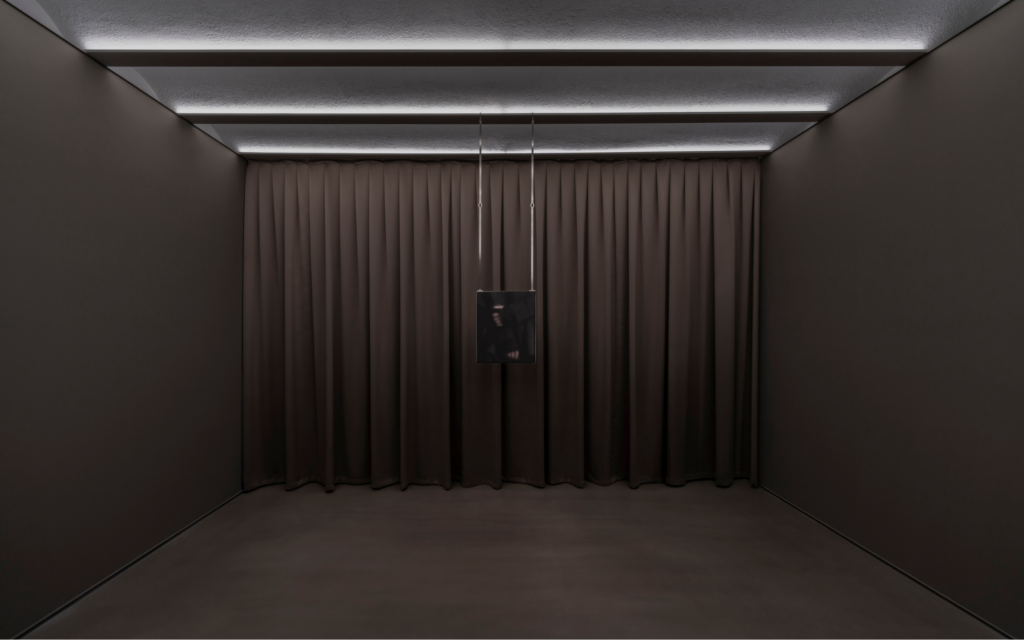
You encourage people to take off their shoes and engage with the room and other people. A gallery is usually a solitary experience, why did you make people share this one?
In my installations I aim to create a more embodied and relational experience. Taking off your shoes already changes your awareness of your own body and of the ground, but it also makes you more aware that other bodies are sharing the same space.
The presence of others becomes part of the work. You might sit beside a stranger, listen together, smell the same incense, or simply become conscious of someone else breathing in the room.
For me, this is important because the exhibition deals with interconnected systems. It would be contradictory to create an experience about our entanglement with the non-human world while maintaining the gallery’s usual logic of isolated individuals entering an interior environment with an exterior behaviour.
You’ve said that if someone cannot see the exhibition for a few weeks they won’t miss anything even though the works will be different. Did you design the “unseen weeks” as a necessity of the exhibition, or was this outcome something you discovered along the way?
What I meant is that each visit is intended to be a holistic experience in itself. Whatever you encounter, and whatever understanding or insight you take from it, may be exactly what you need to receive at that particular moment. See it as a response to FOMO culture and to the pressure to experience everything, document everything and not miss anything. I wanted to create an exhibition that allows for a different relationship to time in which missing something is not necessarily a loss.
Of course, returning to PHOENIX CASTLE each week will reveal another part of the cycle and allow the different stages and their connections to unfold more completely, each week tells a different story in the images and the scent.
Throughout the exhibition, a state of ‘alchemy’ is preserved. Do you believe in that kind of balance in the relationship between human and nature, or is this “lossless transformation” only an ideal?
I think for transformation, loss is actually fundamental to the cycle. Also I believe nature never aims to exist in a state of perfect balance. What interests me is that loss does not necessarily mean the end of matter, but a change of state. In the installation the ash of HUMAN is not the scent, and the sediment is not the thing that came before it. Something has been lost. At the same time, something else became possible in that case it’s the word itself that is burned into the ash.
Through the work of Ernst Lima, the body becomes an antenna that gathers Earth’s vibration. What did that collaboration change for you?
I’ve been working with Ernst Lima for around eight years across several sonic installations, and over that time we’ve developed a deep understanding that often works almost non-verbally. There is a shared sensitivity to emotional layers, to atmosphere, and to what it means to sense oneself within the world.
Working with Ernst Lima on PHOENIX CASTLE allowed the sound to become a way of sensing the environment, that could register vibration, instability and the relationship between the body and the earth in constant movement.
There is also a very personal dimension to this collaboration as we are both familiar with the unpredictability of life, with having to constantly recalibrate and respond to sudden shifts and quakes. That shared understanding became part of the work without needing to be explicitly translated. After so many years of collaborating, Ernst Lima understands the emotional and physical layers I want the sound to inhabit, and that trust allowed the sonic work to develop intuitively rather than being dictated by a fixed concept.
The portraits in THE TIRED series are hiding their faces. Why are they hiding the face specifically?
THE TIRED is a series of extended self-portraits depicting different states of exhaustion, rest and physical or mental depletion. What connects the paintings is a refusal to perform for the camera or for an algorithmic gaze. The face is normally the primary site through which we make ourselves visible, recognizable and legible. By avoiding that direct exposure, I am interrupting that process of recognition, resisting the expectation to present a readable, performative or emotionally available self.
I see this as a small act of agency towards the body and towards identity. Social media has fundamentally changed our relationship to the camera in the way we increasingly learn to anticipate how an image will be read, circulated and evaluated by algorithms and other people. THE TIRED deliberately withdraws from that economy of visibility.
The hidden face also protects something that cannot easily be optimized or performed, which is the fact that we have bodies that become tired, overwhelmed, exhausted and eventually reach their limits. The series asks what happens when we stop treating the body as an endlessly available resource and start thinking about the physical and mental body as something that has an expiry date.
You’ve said that it’s not necessary for you to place yourself in front of the camera for the image to be ‘you’. Are you questioning the authority of the camera or what ‘you’ even are?
I am interested in redefining what we understand as a self portrait. In my understanding we are beyond the point of a self-portrait necessarily showing the creator’s physical likeness, or even their body in front of the camera. Through algorithmic media consumption, we increasingly become multitudes. We absorb images, aesthetics, opinions, gestures, styles and ways of seeing from the content we consume. We repost them, imitate them, internalize them and at some point it becomes difficult to separate what we have encountered from what we consider to be ourselves. THE TIRED is therefore a series of something I recognize as myself. The paintings depict states, gestures and bodies that I can identify with. In that sense, I see the self less as a singular, stable identity and more as a constantly shifting accumulation of influences, images and experiences.
Why does the phoenix have a castle? What does the phoenix defend itself from?
The castle gives the phoenix a home. It is where it reigns, rises, dies and rises again, in that way a place that contains its entire cycle of transformation. I was drawn to the castle because of its particular cultural imagination. It carries something majestic and almost fairytale-like, but it also speaks of history, memory, protection and power. It exists somewhere between the past and the future, like a structure that has survived time while also belonging to an imagined world.
The phoenix is not necessarily defending itself from a specific external threat. The castle is more a protective space for something inherently vulnerable which is the sensitivity of our inner core. I think of it as a kind of sanctuary for transformation, like a place where something can remain fragile, change, disappear and return without having to constantly defend its existence.
So the castle is both a symbol of nobility and protection, but also a container for impermanence. It gives the phoenix a place to belong, even though the phoenix itself can never remain the same.
The scent changes every week without you controlling how visitors will read it. What does it mean to make something you cannot have the full control of, does that worry you?
No, actually there is no need to worry. We are never fully in control of how visitors read, interpret or experience a work. For me, allowing that openness is actually part of the practice. It connects to the idea of the stone meditation I mentioned earlier. Practicing non-attachment and allowing things to exist without needing to determine their outcome. I see my role less as controlling an experience and more as creating the conditions for something to arise and then to allow the work to become something different for each person.
The changing scents work in a similar way. I can choose the material, the timing and the conditions, but I cannot determine what someone will associate with a particular scent or what it will make them feel.
What do you think people will feel when they first enter the exhibition?
I see my installations more as spaces that facilitate rest, attention and reflection than as environments designed to produce a specific emotional response. The invitation at PHOENIX CASTLE is to slow down and spend some time with the work, and perhaps to contemplate a world that is currently in a state of ecological, technological, political and emotional tremor. I’m interested in what happens when those external conditions encounter our own emotional architecture and observe where they interfere, resonate, or perhaps unexpectedly align with it. So rather than asking the visitor to feel something specific, I want to create the conditions in which they can notice what they are already feeling.