
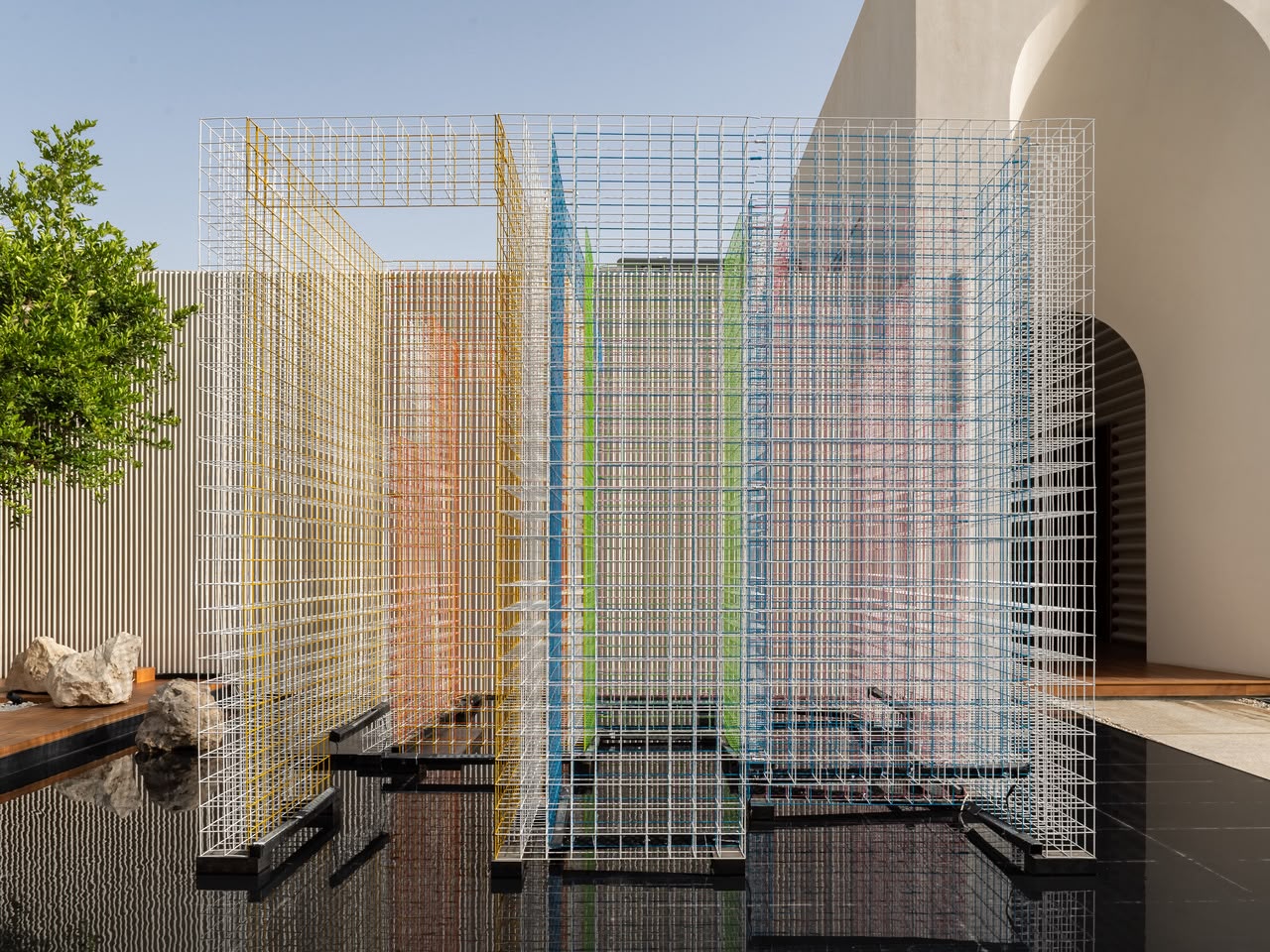

One of the leading figures in Gulf contemporary art, Bahraini artist Rashid Al Khalifa has long investigated the interplay between light, colour, architectural geometry, and human perception. Bridging the visual intelligence of traditional Middle Eastern architecture—such as the permeable logic of the mashrabiya—with modernist abstraction, his practice has progressively evolved from the painted canvas toward expansive, spatial structures. Presented at Tersane Istanbul as part of Contemporary Istanbul, his large-scale installation Inhabited Crate – Multicolored brings this long-standing inquiry into the open air, turning galvanised steel mesh, vibrant chromatic rhythm, and movement into an immersive public encounter that invites viewers to step directly inside the grid.
In the conversation that follows, Şebnem Kırmacı spoke with Rashid Al Khalifa about the conceptual shifts that led him beyond the wall, the dialogue between industrial shipyard heritage and permeable architecture, and the emotional resonance of colour across different geographies. He also reflects on the responsibilities of building a sustainable, artist-centred cultural ecosystem in the Gulf, and how he navigates the delicate ground between a prominent public identity and the quiet autonomy of the studio.
Your practice has evolved from landscape painting and abstraction toward increasingly sculptural and spatial forms. What prompted you to move beyond the traditional boundaries of the painted surface?
The movement was gradual rather than a deliberate rejection of painting. As my work became increasingly abstract, I began to think of colour, line and surface as physical presences rather than simply pictorial elements. The aluminium structures emerged from a desire to allow the painting to occupy space, to project from the wall, respond to architecture and change as the viewer moved around it.


Eventually, the wall itself felt too restrictive. I wanted the work to share the viewer’s space and to be experienced through the body, not only through the eye. In that sense, my installations remain closely connected to painting: colour, rhythm, repetition and light are still fundamental, but the surrounding architecture and the movement of the viewer have become part of the composition.
In Inhabited Crate – Multicolored, the grid becomes a three-dimensional, permeable structure rather than a flat compositional device. What does the grid represent for you, and how has its meaning changed throughout your practice?
The grid has always represented both order and restriction. It can suggest architecture, urban systems and the structures—visible and invisible—through which society organises and regulates our lives. In my earlier work, it operated mainly within the picture plane, establishing rhythm and containing colour.
In Inhabited Crate, the grid leaves the painting and becomes an environment. It is no longer something the viewer observes from outside; it is something one enters and negotiates physically. Yet because it is permeable, it does not behave like a solid enclosure. One can see through it and remain connected to the surrounding space. This creates an ambiguity that interests me: it can feel protective and restrictive, open and confining, rational and unsettling at the same time.
Your work often explores light, shadow, transparency and movement, while also drawing on the geometry of Islamic architecture and the tradition of the mashrabiya. How do you translate these cultural references into a contemporary visual language without reducing them to symbols of identity?
I do not reproduce traditional patterns or use the mashrabiya as a decorative cultural symbol. What interests me is the intelligence behind it: the way a geometric structure filters light, creates privacy without complete isolation, and allows interior and exterior spaces to remain in dialogue.
These principles have become part of the way I think visually. Perforation, repetition, reflection and shadow allow the work to change continuously with its surroundings. The cultural reference is therefore embedded in the structure and behaviour of the work rather than applied to its surface. It arises naturally from my visual memory and my experience of Bahrain, but I want the resulting language to remain contemporary and open enough to speak beyond a single geography or identity.
The Istanbul installation is being presented within Tersane Istanbul, a site with a long history of shipbuilding and industrial production. How did the character and history of the site influence your understanding of the work—or the way you wanted audiences to experience it?
The industrial history of Tersane Istanbul creates a particularly meaningful setting for the work. Its history of shipbuilding, engineering and collective labour establishes a strong dialogue with the installation’s modular construction and its use of galvanised steel mesh. The material belongs naturally within this environment, yet the colour, permeability and movement of the work transform its industrial character.
The site did not determine the original conception of Inhabited Crate, but it revealed new meanings within it. Against such a historically charged architectural setting, the installation can be understood as both a constructed object and a temporary place of passage. I want audiences to experience the contrast between the weight of the site’s history and the visual openness of the structure, to move through it while remaining conscious of the architecture, the light and the presence of others around them.
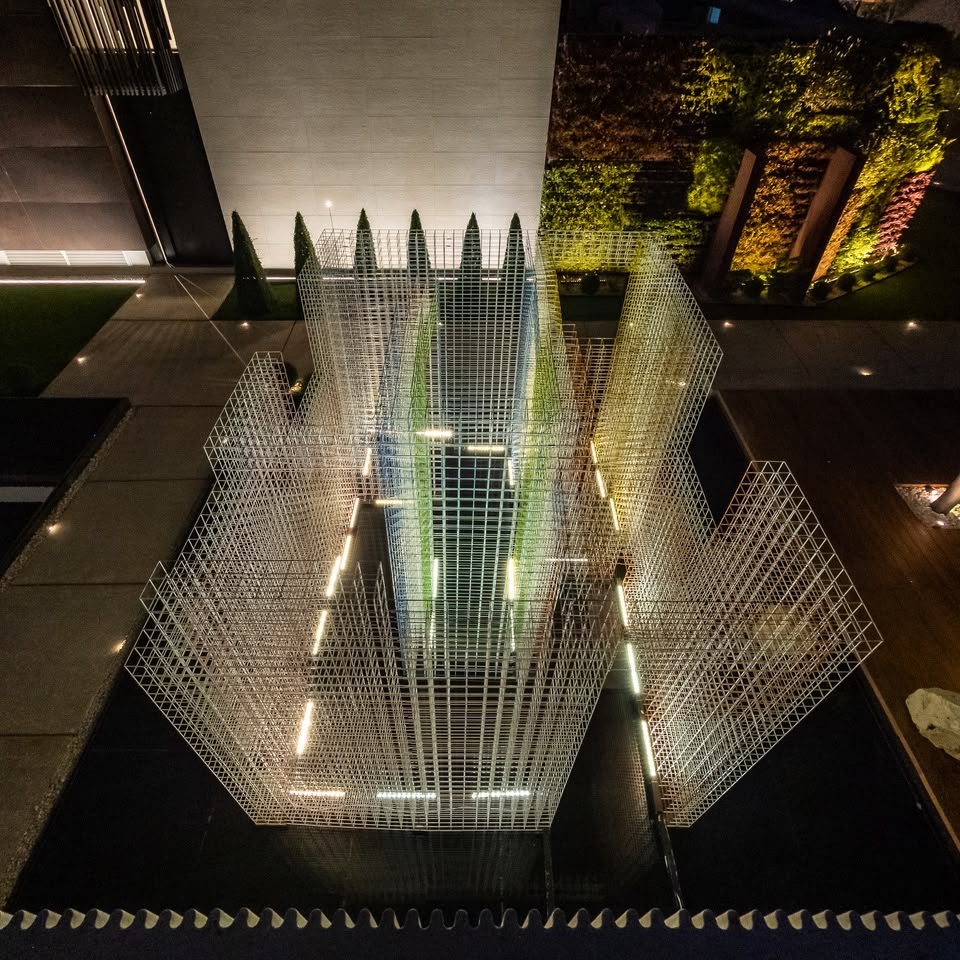
The title Inhabited Crate suggests that the work is not simply something to be looked at, but something to be entered and inhabited. What changes for you when the viewer becomes physically part of the work?
When the viewer enters the installation, the work is no longer a self-contained object. The body becomes part of its scale, rhythm and composition. Each person sees a different configuration depending on where they stand, how they move and who else occupies the structure.
This physical participation is essential. The viewer may feel protected, exposed, enclosed or liberated, sometimes simultaneously. Their movement also animates the work for those observing from outside: bodies appear, disappear and fragment behind the mesh. The installation therefore becomes a changing social space rather than a fixed sculpture. It is completed temporarily by each person who inhabits it.
You presented another version of Inhabited Crate in Venice in 2026. What distinguishes the Multicolored version in Istanbul from the earlier iteration, and how do you think a work changes as it moves from one cultural and architectural context to another?
The Multicolored version introduces a stronger chromatic rhythm. Colour alters the emotional register of the structure: it makes certain planes advance or recede and changes the way light and shadow travel through the installation. The modular form remains recognisable, but its atmosphere becomes more animated and less austere.
An installation of this kind is never experienced in exactly the same way when it moves. In Venice, it entered into dialogue with a city defined by water, reflection, fragile surfaces and layers of history. At Tersane Istanbul, it encounters a former shipyard shaped by industry, construction and transformation. The structure remains constant, but its meaning is reactivated by each location. Architecture, history, climate, light and the behaviour of the audience all become collaborators in the work.
You have played an important role not only as an artist but also in the development of Bahrain’s cultural and artistic institutions. How has your institutional role influenced your understanding of what it means to build an art ecosystem in the Gulf?
Being both an artist and someone involved in building institutions has taught me that an art ecosystem cannot be created through exhibitions alone. It requires education, archives, criticism, collecting, sustained patronage and opportunities for artists to experiment without having to produce immediate commercial results. Above all, it requires continuity.
Through my work with cultural institutions and, later, through the RAK Art Foundation, I have tried to preserve important artistic histories while also creating opportunities for new generations. The Gulf has undergone extraordinary change in a relatively short period, but cultural development cannot depend only on impressive buildings or occasional international events. It must grow through serious local engagement, intellectual exchange and long-term commitment. My experience as an artist keeps me conscious that institutions should ultimately serve artists, ideas and the public.
You occupy a distinctive position as both an artist and a member of Bahrain’s royal family. How do you think this position has shaped the way your work is received, and does it ever create a tension between the public perception of your identity and the independence of your artistic practice?
It inevitably shapes the way some people initially approach my work. A public identity can create visibility and opportunity, but it can also produce assumptions before the work itself has been considered. I have always been aware of that tension.
My artistic practice, however, has developed over more than five decades through sustained work, experimentation, failure and change. The studio is where titles and public roles become irrelevant; the work must succeed or fail on its own terms. I cannot control every perception, nor do I try to deny who I am.