


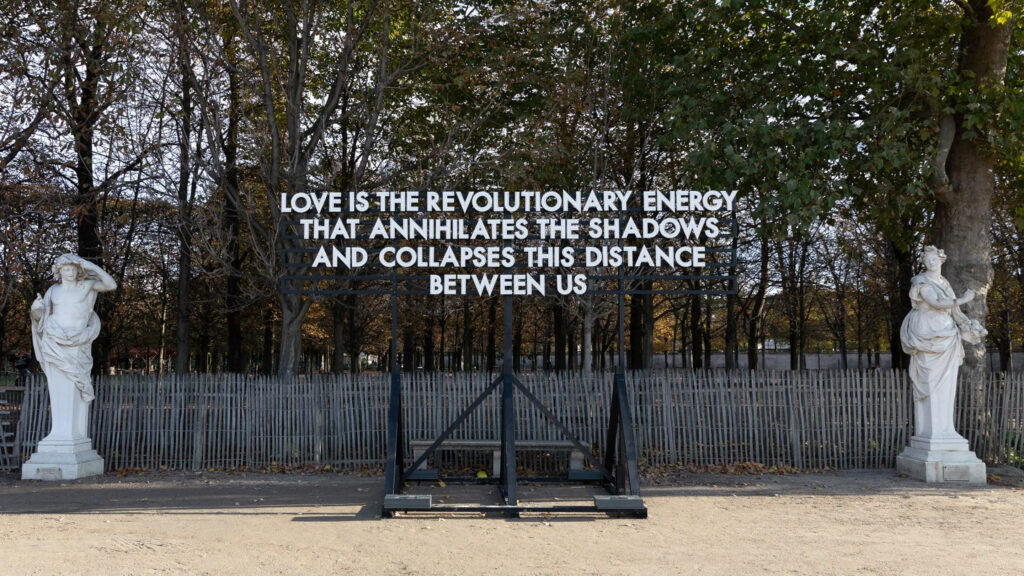
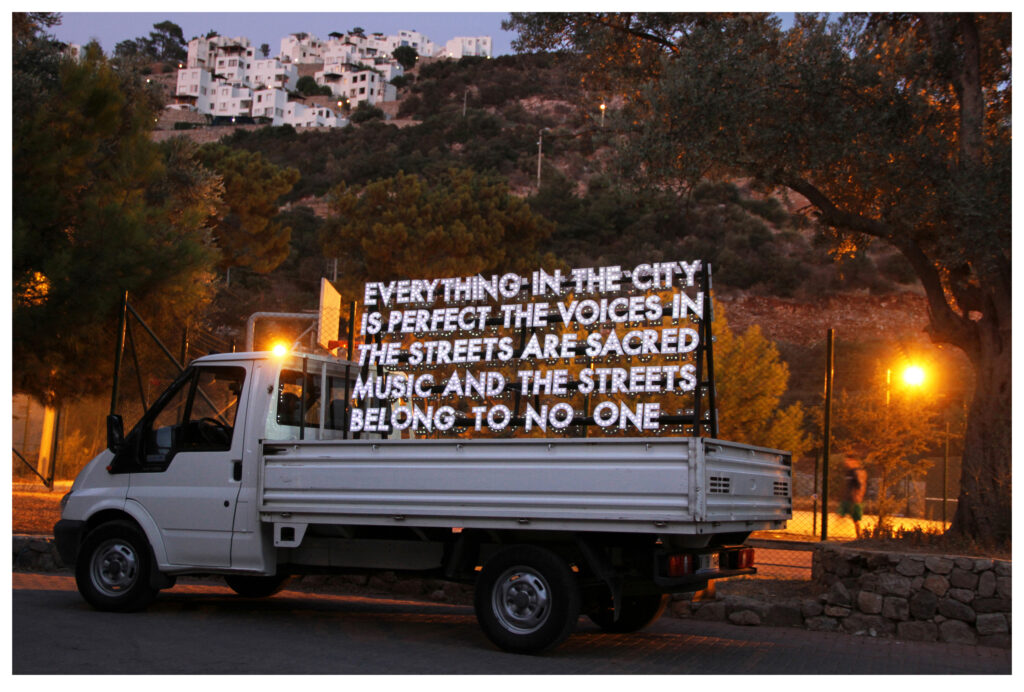
British contemporary artist Robert Montgomery has long engaged the public space through light works, billboard poems, fire poems, paintings and watercolours. His work continually draws text art closer to the language of poetry. In JAMES BALDWIN’S BALCONY IN ISTANBUL and OTHER WORKS, his solo exhibition at ISTANBUL’74, Montgomery expands his ongoing exploration of language, memory, and the city through new light works and paintings, offering a fresh perspective on his long-standing relationship with Istanbul. Shaped by notions of distance, longing, and return, his works establish a new dialogue with the Istanbul’s literary memory and poets.
We spoke with Montgomery about the ideas shaping his new exhibition: imagining an encounter between James Baldwin and Edip Cansever on the Galata Bridge, returning to painting after years, what poetry means to him and how cities and poets haunt each other. Montgomery reflects on Istanbul as an enduring symbol of intercultural dialogue, while discussing his understanding of authorship, the dialogue he shares with his audience, and why hope remains his most steadfast message to the public sphere.
Your earliest billboard poems emerged from a political moment—the anti-Iraq war protests—yet your work has increasingly become associated with intimacy, grief and hope. What has remained unchanged in your relationship with the public space?
Well I think the battle against war is always connected with grief and hope, and that battle is never over. I think what remains unchanged in my relationship with public space is hope. I do want to make messages of hope. And I believe that the kindness of people will overcome war and cruelty.

You once described your position as an “awkward space” between artistic categories. With Poets in the Cities, painting seems to become another such space—between portraiture, literature and memory. What did painting allow you to do that the billboard could not?
Well painting is what I studied, back at Edinburgh College of Art, before I went on my journey of exploring text art and public art and other media, and I always knew I would come back to painting, and I have more and more over the last five years or so. The paintings are quite intimate, they are of poets I love, poets who I carry in my heart. They are like my friends, and I want to put them back in the cities they inhabited and celebrate them. I make the paintings partly for the simple selfish reason that I want to spend time with the poets I love.
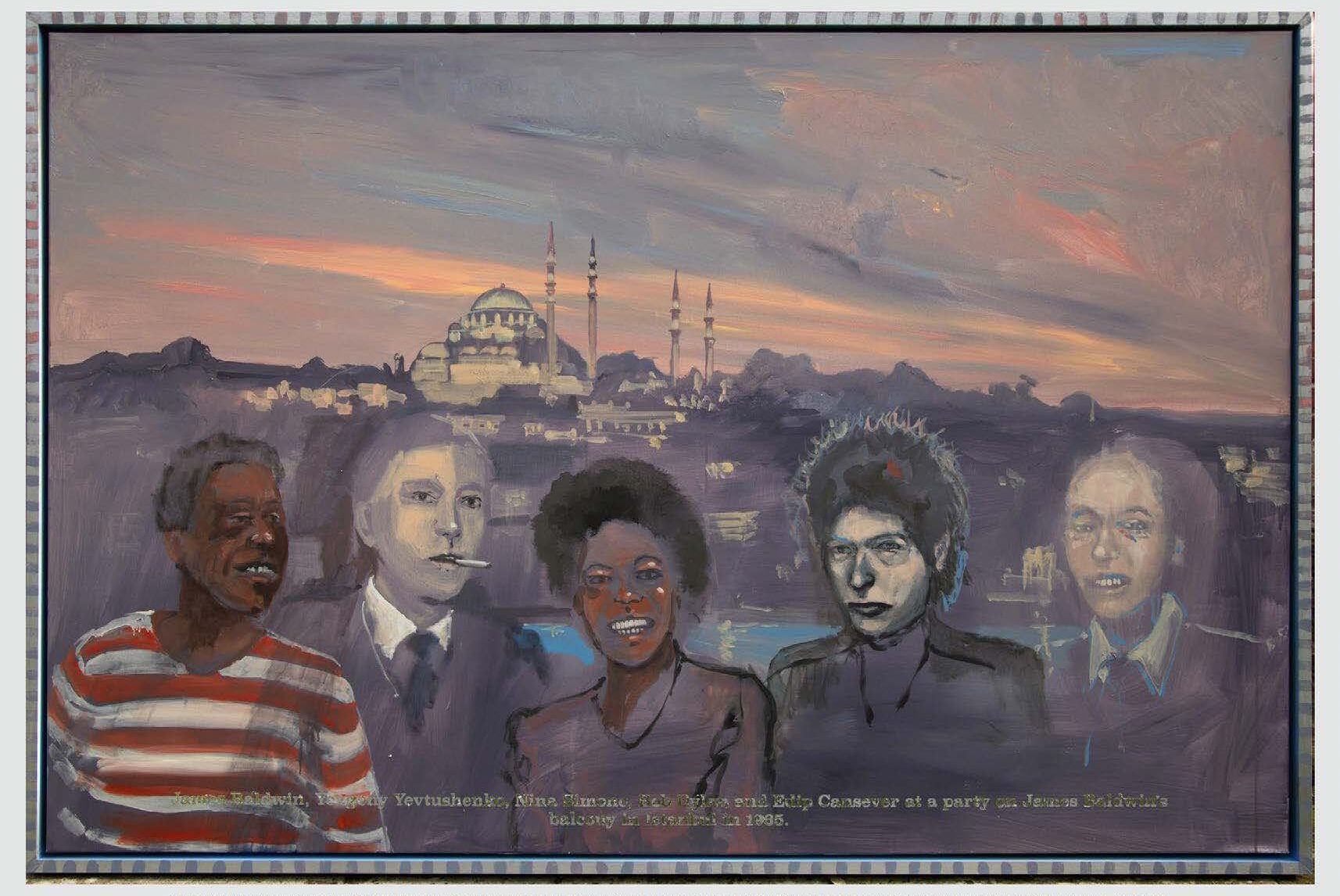
The exhibition is titled James Baldwin’s Balcony in Istanbul. Baldwin’s years in Istanbul
were a period of both distance and extraordinary creative intensity. What drew you to imagine him here, and why did the balcony become the image through which you approached the city?
Well I found a photograph that’s in the collection of the Smithsonian Museum of African American History, it was taken by the photographer Sedat Pakay in 1966, and it’s of Baldwin standing alone on the Galata Bridge, you can see the great romantic silhouette of the Süleymaniye Mosque behind him. But in the photograph Baldwin looks kind of sad and alone, and I wanted to bring him some friends. So, in my painting the Galata bridge becomes his ‘balcony’ and he is hosting a party- to the party I brought his friends Nina Simone and Bob Dylan. But it’s a poets party, so I also brought along the Russian poet Yevgeny Yevtushenko and of course Edip Cansever. There is actually no documentation or proof that James Baldwin and Edip Cansever met, but I love
Cansever’s work, and so in my fantasy I imagine they met and shared a coffee and cigarette at a street café in Galata, and then became friends, and I see them in my dream reciting and discussing poetry together on a balcony full of laughter long into the Bosphorus night. So the painting is a scene I am inventing really, I would love to be at a party in Galata with James Baldwin and Nina Simone and Bob Dylan and Edip Cansever, wouldn’t you?
You have made work about Istanbul before—most notably Poem for the City of Istanbul during the 2011 Biennale. Has the city changed in your imagination over the past fifteen years, or has your own way of seeing it changed more?
Istanbul always lives vividly in my imagination, it is historically so important to our European and Asian civilization, and I think it is a city that is a city of global crucial importance today. For me it is the city where the east and west meet and understand each other— where the east and the west live as friends, where Islam and secular culture exist in mutual respect and harmony. And we need Istanbul’s example of multicultural understanding more than ever today.
Your work has always moved between the public and the intensely personal. This exhibition brings together Baldwin, Edip Cansever and other writers. Are these paintings portraits of particular figures, or portraits of the cities and memories we attach to them?
Well they are paintings of poets and artists who are intensely personal to me, and I’m interested fundamentally in the poetics of cities, I’m interested in how poets can haunt cities, and I’m also interested in how cities can haunt poets.
Your words have travelled far beyond the physical sites for which many of them were originally made—onto phones, social media and even people’s bodies. Does the transformation of a poem into an image that circulates independently of you change your relationship to authorship?
Well I set out with a mission to take the idea of concrete poetry and run with it across as many different media as possible. When Apollinaire invented the idea of concrete poetry in the early 20 th Century it was the idea that the way the poem looked on the page, graphically, was integral to its meaning. I wondered what could happen if you took that idea OFF the page- if you took poems onto billboards, light signs, paintings, and yes phone screens, and almost all of my work has been an exploration of that central idea taking concrete poetry off the page. But I never had the idea myself for my work to become tattoos. That is an idea that came from the audience. It’s an incredible honour when someone chooses to get one of my pieces as a tattoo, that is always an amazing compliment.
You have spoken about art as a way of communicating our innermost feelings to strangers.
After working with text in streets, light, fire and now increasingly in painting, what still surprises you about the distance between writing something and seeing another person make it their own?
For me all poems are memories of love, they are footsteps and lipstick traces. Poems are the innermost thoughts of someone read later by someone else far away. So you never speak in person with the reader, but in a way the poet and the reader have a uniquely intimate conversation, and it’s that combination of solitude and intimacy that is very special about poetry as a language.