




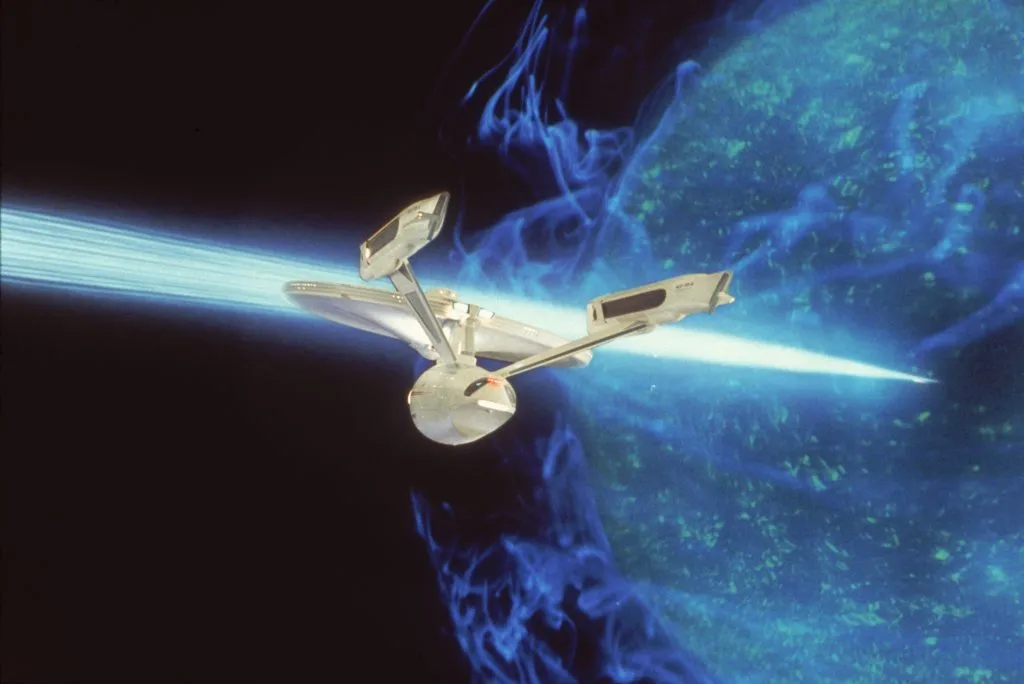
As part of Star Trek’s 60th anniversary celebrations, the Science Museum in London has partnered with the long-running franchise to present a free exhibition of archive objects. Opening on 26 March and running until September, Star Trek Warp Trail goes beyond stage props to explore the connections between science fiction and real-world innovation.
The costume section features the uniform worn by Chief Engineer Montgomery Scott, played by Simon Pegg in the 2009 Star Trek film; the command uniform of U.S.S. Enterprise captain Christopher Pike, portrayed by Anson Mount in Star Trek: Strange New Worlds; and the uniform of Admiral Jean-Luc Picard, worn by Patrick Stewart in Star Trek: Picard. A costume worn by Sonequa Martin-Green as Captain Michael Burnham draws inspiration from real spacesuits designed to keep their wearers alive in the vacuum of space.
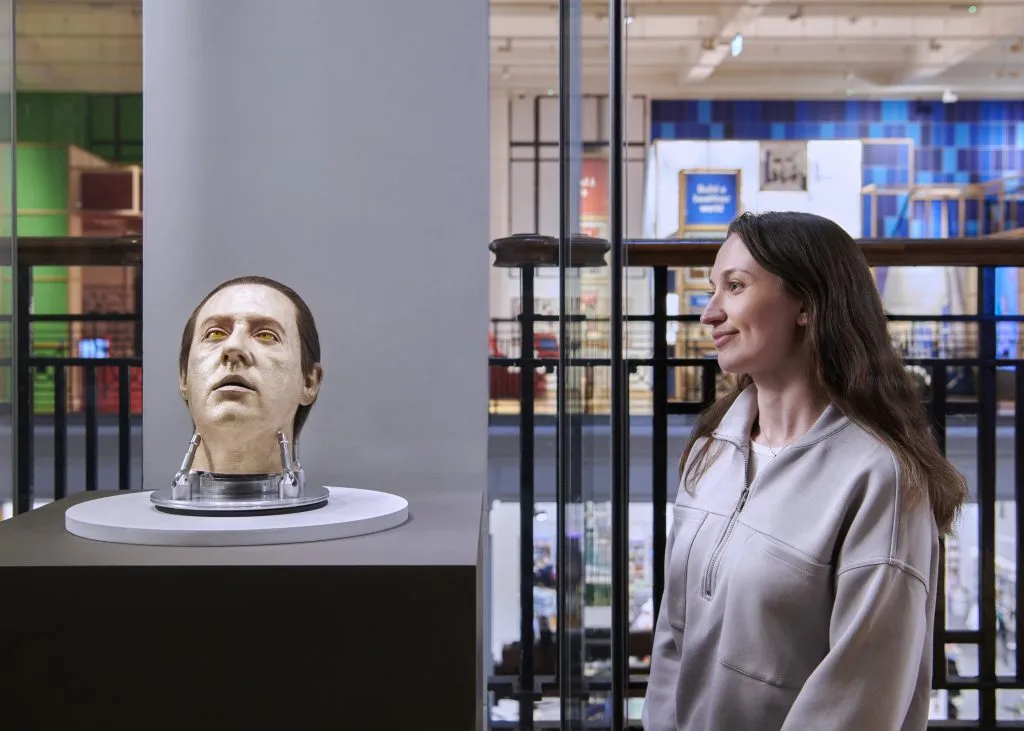
The exhibition opens with a model of the U.S.S. Enterprise from Star Trek: Strange New Worlds and continues with the prop head of prototype android B-4, found by Lieutenant Commander Data — played by Brent Spiner — in Star Trek: Nemesis. At a time when AI assistants have become commonplace, this object raises important questions about the future of such technologies.
These kinds of predictions run throughout the franchise. Trekkies were already familiar with the idea of portable communication devices long before mobile phones began to emerge in the 1970s. As the museum notes, Motorola’s clamshell phone of the late 1990s was clearly influenced by the series — the device was even named the StarTAC.
This connection is traced across the exhibition through objects from the Star Trek universe including personal display devices, communication tools, and badges.

Star Trek and the Exploration of Space
The exhibition also addresses the franchise’s vision of long-distance interstellar travel — a journey humanity has only recently begun, with NASA’s Voyager 1 and Voyager 2 spacecraft entering interstellar space in 2012 and 2018 respectively. What might the future of space exploration look like? A “photon” collection from Star Trek IV: The Voyage Home (1986) and a “spore” capsule from Star Trek: Discovery (2017–2024) bring this question to the fore. Elsewhere in the exhibition, medical equipment used by doctors in the series — including patient-scanning devices and the “hypospray” — is on display, with the museum highlighting that real-world equivalents of these fictional tools now exist.
The initiative also has a cinematic and collecting dimension. In what is described as a world first, visitors can watch all thirteen films at the Science Museum’s IMAX theatre, with screenings running until mid-June. A dedicated pop-up shop offers exclusive merchandise including coins, t-shirts, tote bags, posters, and iron-on patches.
The museum’s head of collections, Glyn Morgan, said: “Star Trek has been a cultural phenomenon that has genuinely changed the STEM world, from inspiring technical innovations to encouraging a new generation of astronauts. I hope this programme at the Science Museum inspires visitors to think that it might just be possible to ‘boldly go where no one has gone before.'”