

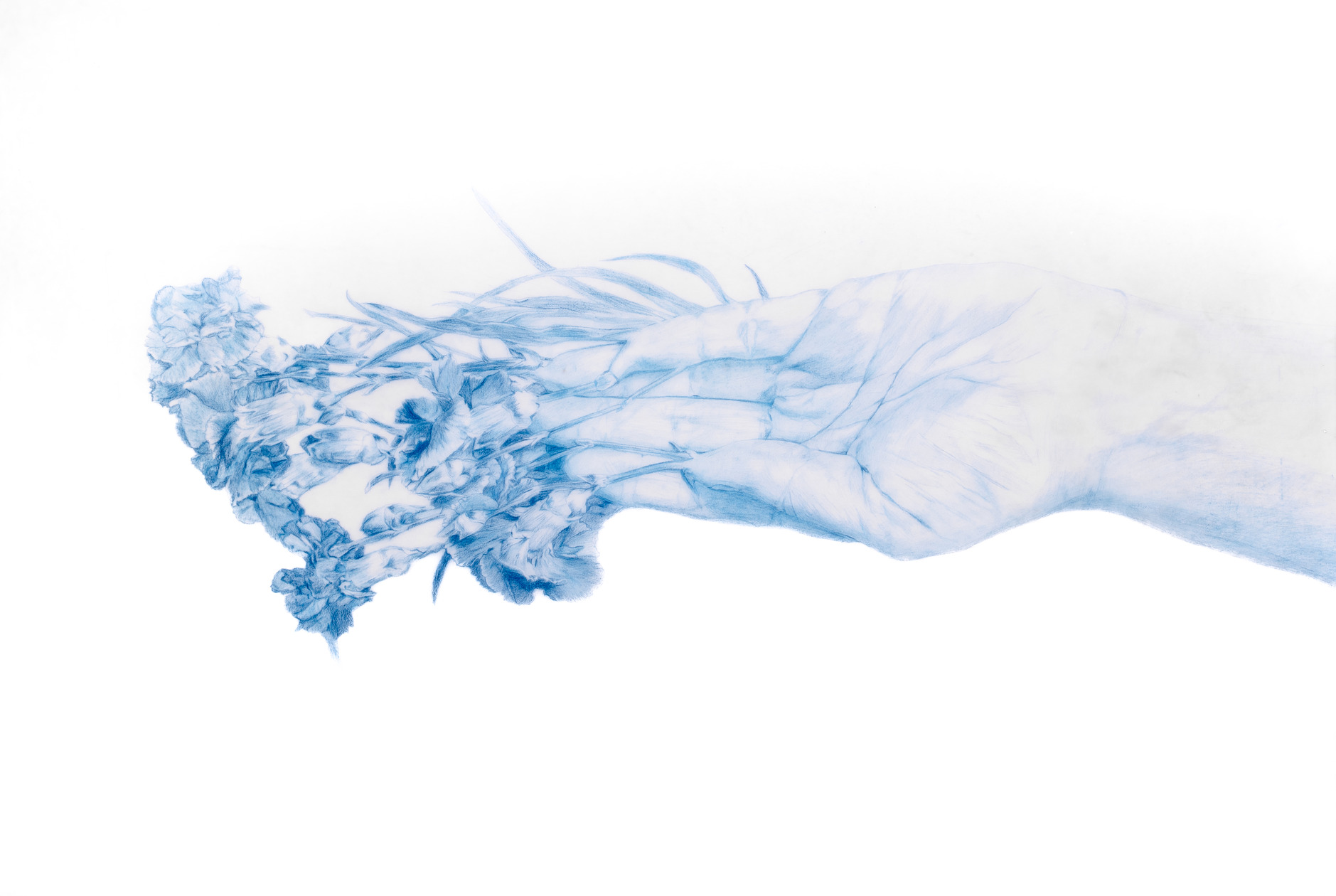

In his novel Heinrich von Ofterdingen, written in 1802 as a coming-of-age story, the German author Novalis places a blue flower in his protagonist’s dream. This mystical flower seen in the dream is in fact more than a plant. The blue flower is a call that expands the soul, opening a path for it. This spiritual opening, under the name Die Blaue Blume (The Blue Flower), in later years becomes far more than a dream and turns into a current followed by the German Romantics.
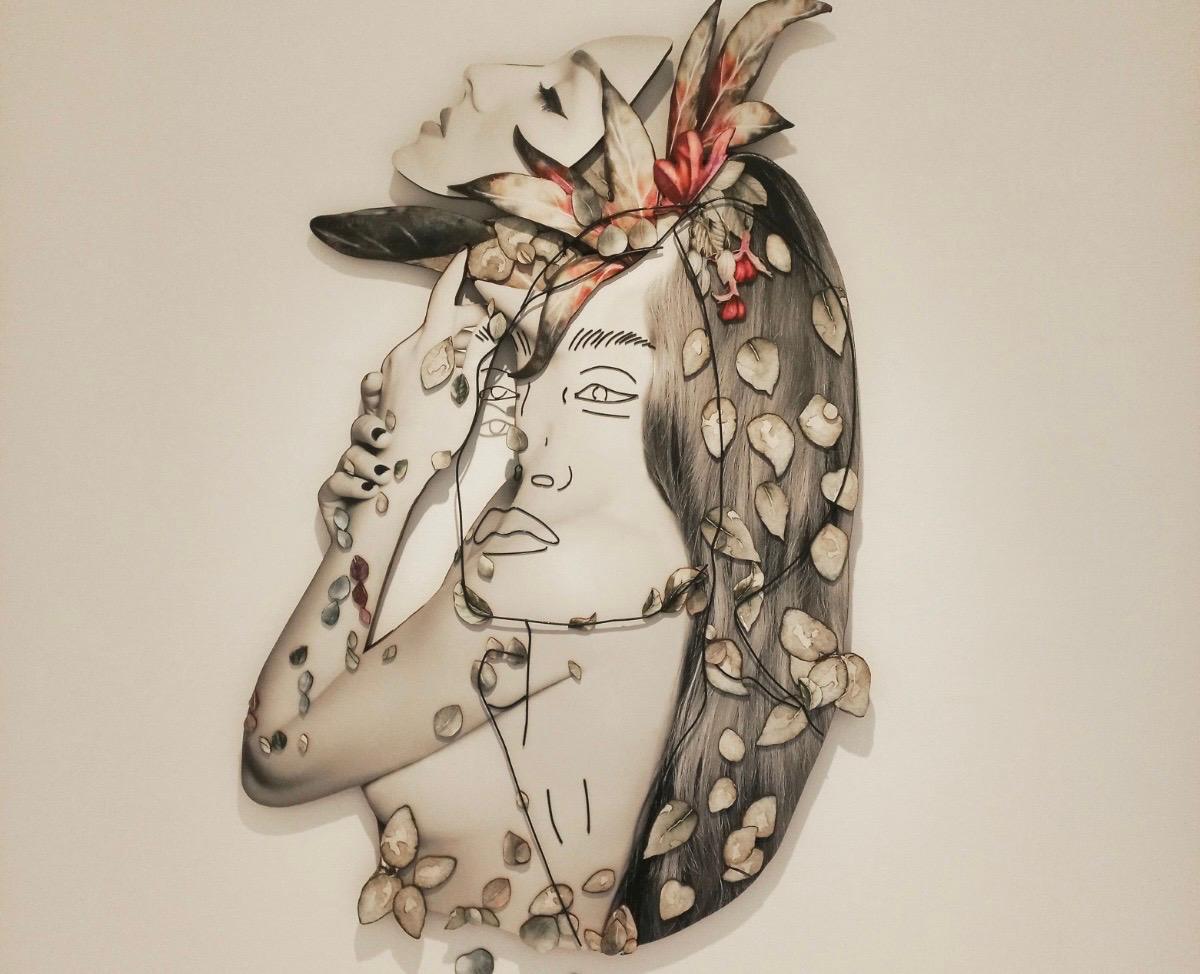
Artist Gülnihal Kalfa brings together her own Die Blaue Blume concept with the viewer in her first solo exhibition, Çiçeklenen Yokluk (A Flowering Absence), assembling fragments from her life and unfoldings from her inner world.
Kalfa’s works not only draw the viewer in through technique; the detail and mastery in her technique turn into a kind of relationship she establishes with the viewer in a field she knows very well.
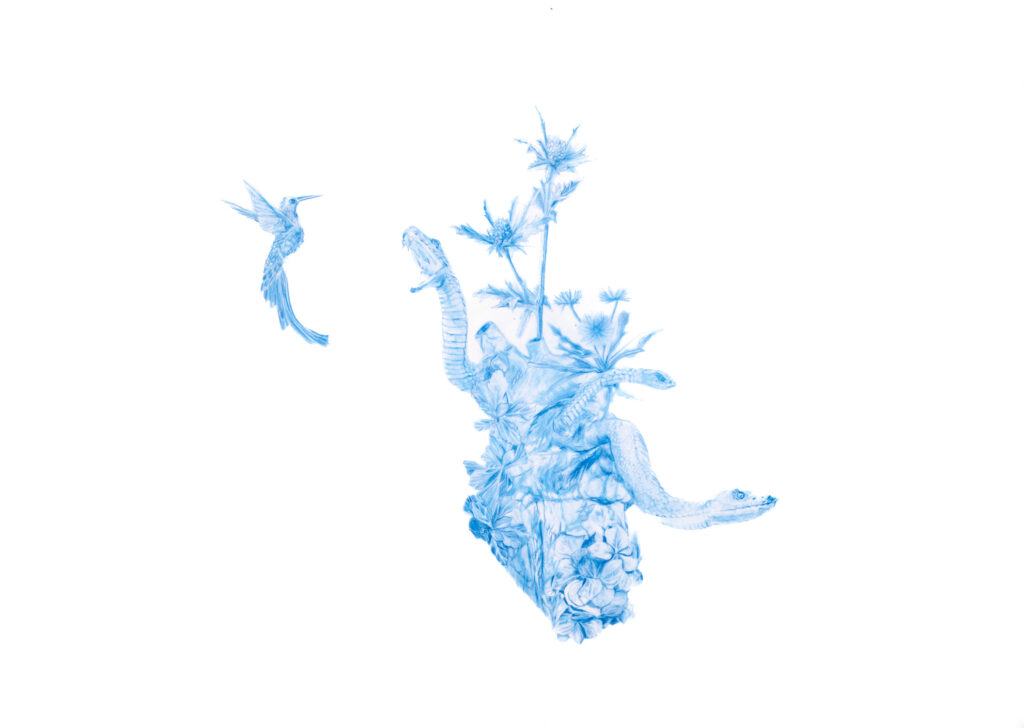
In her paintings, the viewer on the one hand encounters Die Blaue Blume, one of the most important symbols of Romanticism, and on the other hand discovers a profound psychological concept added to this current: the uncanny (unheimlich).


As Kalfa blends Die Blaue Blume with the word unheimlich—the uncanny—she brings together many different elements in her paintings. She shows that blue stands far beyond the calmness we normally associate with it, and positions blue in an uncanny place in light of psychology and inherited karma.
Kalfa relates the concept of the uncanny that she employs and draws attention to with the term unheimlich as used by the German psychiatrist Ernst Jentsch in his 1906 essay “On the Psychology of the Uncanny.” Jentsch defines the uncanny (in German, unheimlich—literally “homeless/without a home,” unfamiliar) as a new and unknown situation that can initially often be perceived negatively. The word is derived from heim, meaning “home.” On the other hand, with the negative prefix un- placed before heimlich (meaning “plain, simple, etc.”), it becomes unheimlich—the Turkish tekinsiz. This uncanny field is Gülnihal Kalfa’s playground, her field of exploration, the very deepening into which she draws the viewer.
According to Jentsch, unheimlich was coined to express the uncanny state that befalls a person who cannot exist in a home-like, peaceful place. Freud, meanwhile, defines unheimlich as placelessness and homelessness, a tense field between the familiar and the foreign.
With the suffix the word takes on, thanks to Gülnihal Kalfa we move toward a new discovery in a linguistic field, and find ourselves in an ambivalent zone in the derived form of the word tekin(siz). Kalfa explains this field as follows: “In fact, in a place where the sense of belonging is very strong (like a home), a state of not fully belonging…”
Having grown up in an environment with grandmothers and grandfathers, Gülnihal Kalfa lived her daily life within their rituals and beliefs. In folk belief, Fatma Ana’nın Eli (Fatma Ana’s Hand)—passed down through lineage and signifying both a healer and a dark mode of being—exists in both her maternal grandmother and her paternal grandmother. Yet while one devotes herself to healing, the other deals with black magic. These two women, in these forms, are at the very center of Gülnihal Kalfa’s childhood memories. Rags tied to one another, symbols drawn on papers, anagrams, strange shapes—the everyday materials of spells—became both her playground and her field of discovery. In the end, these grandmothers unite in their love for their grandchildren and, in Kalfa’s inner world, turn into a duality born of opposition—into the harmony of light and darkness within a larger wholeness.
Nourished by this duality, Gülnihal Kalfa transforms the “Gülnihal” within her inner world in her paintings. As Freud discusses the term unheimlich, she creates—out of the familiar—an unfamiliar stranger, an imaginary twin. Thus, persona grata and persona non grata (that is, her imaginary twin) enter into a struggle for existence against one another. In the exhibition, works produced through the romantic effect of the blue flower and the darkness of the uncanny are in communication with each other; on the other hand, they are both in a state of uniting and of clashing. Especially in her self-portraits, she draws on the tragedy of death arising from childbirth and from the fact that the being one gives birth to will one day die. She addresses this tragedy together with living beings (such as snakes, flowers, plants). She handles the ambivalence of death and life in an interwoven way. In this manner, the figures in Kalfa’s paintings, the blue color, and the subjects she addresses present a kind of ambivalent condition. The artist questions the state of being a twin that is both familiar (known) and familiar (not the same), born out of duality.
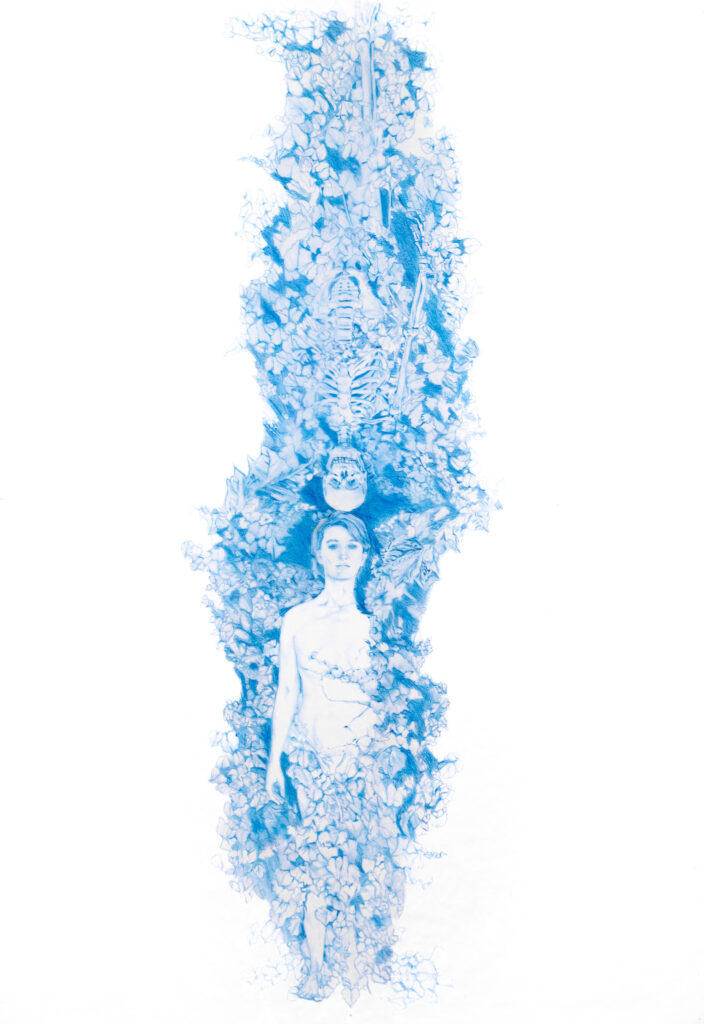
As Kalfa’s paintings wander through this uncanny field in the depth of blue, it is also necessary to touch upon blue’s place in color theory and its meaning in the spiritual realm. In alchemy, blue is associated with spiritual exaltation and purification, and represents the stage of “dissolution”; this is a fundamental step of the Great Work (Magnum Opus) and refers to the phase in which raw matter is dissolved in order to initiate its transformation into a purer substance.
This color has a strange and almost indescribable effect on the eye. It is strong in tone; yet it lies on the negative side, and in its highest purity is almost like a stimulating negation. For this reason, its appearance emerges as a kind of contradiction between enthusiasm and calmness. In this context, it is also possible to see an ambivalent condition.
In the deepening meaning of blue, Gülnihal Kalfa reminds us of things that are, in fact, not entirely safe—of a field, of a life…