



From Frans Hals to Egon Schiele, from Frida Kahlo to Kerry James Marshall, this selection examines the many forms love has taken throughout art history. In this visual journey shaped through intimacy, touch, and gaze, we reflect on how emotional bonds find expression on the painted surface through works from different periods and geographies.
In our previous selection series from art history, we traced the presence of our animal companions in paintings. With Valentine’s Day approaching on February 14, this time we turn our attention to how love has been represented in art, through a selection ranging from legendary couples of mythology to iconic lovers of art history.
In A Lover’s Discourse: Fragments (Bir Aşk Söyleminden Parçalar), Roland Barthes approaches love not as something that can be reduced to a single definition, but as a “set of states” continuously reconstructed in the lover’s mind and shaped by waiting. Art often follows the traces of these states. Here, love appears not merely as an idealized emotion, but as a lived moment, a threshold, and an uncertainty. In paintings, this may become visible in the positioning of bodies, the direction of gazes, or the distance between two figures.
In this selection, we sometimes witness a passionate embrace, sometimes a mysterious look. Tracing a broad line from Frans Hals to Egon Schiele, from Frida Kahlo to René Magritte, we take a close look at the forms love has assumed in art history through works from different eras and regions, and reflect together on how intimacy, desire, and emotional connection are translated onto the pictorial surface.
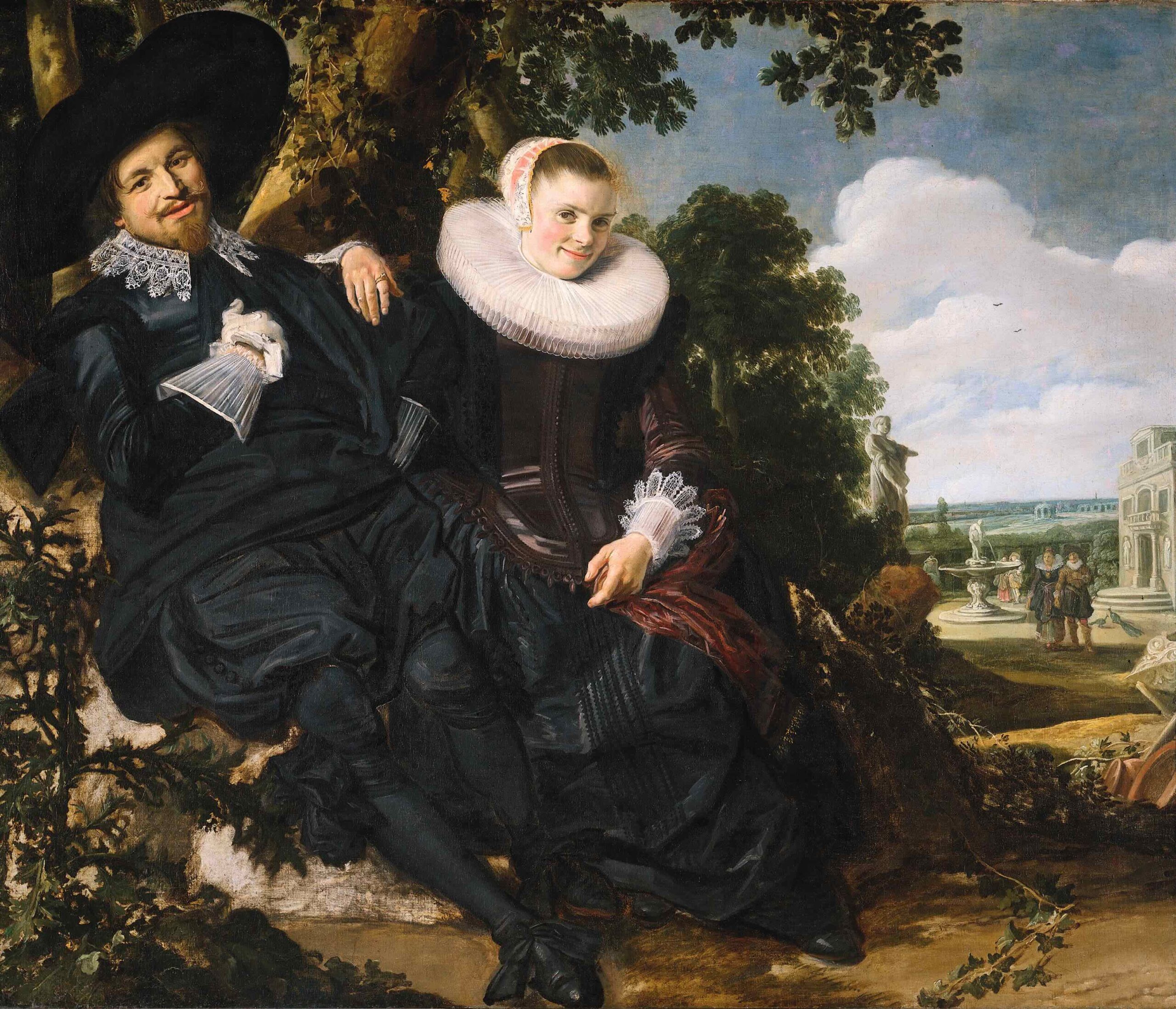
1. Frans Hals, Marriage Portrait of Isaac Massa and Beatrix van der Laen
For the first work in our selection, we travel to the Netherlands in 1622. Painted around this date by Frans Hals, Marriage Portrait of Isaac Massa and Beatrix van der Laen stands out for its unusual sense of naturalness within the Dutch portrait tradition of the seventeenth century. Unlike the formal poses common in marriage portraits of the period, the couple is depicted not indoors but in nature, standing casually in front of a tree. The slight blush on Beatrix’s cheeks and her warm smile, combined with her wedding ring, invite us to share in the joy of this new beginning. Isaac’s sincere gesture of placing his hand on his heart symbolizes deep devotion to their union. Hals’s personal friendship with Isaac Massa can be sensed in the intimacy of the portrait. Today, the work is part of the Rijksmuseum collection in Amsterdam.
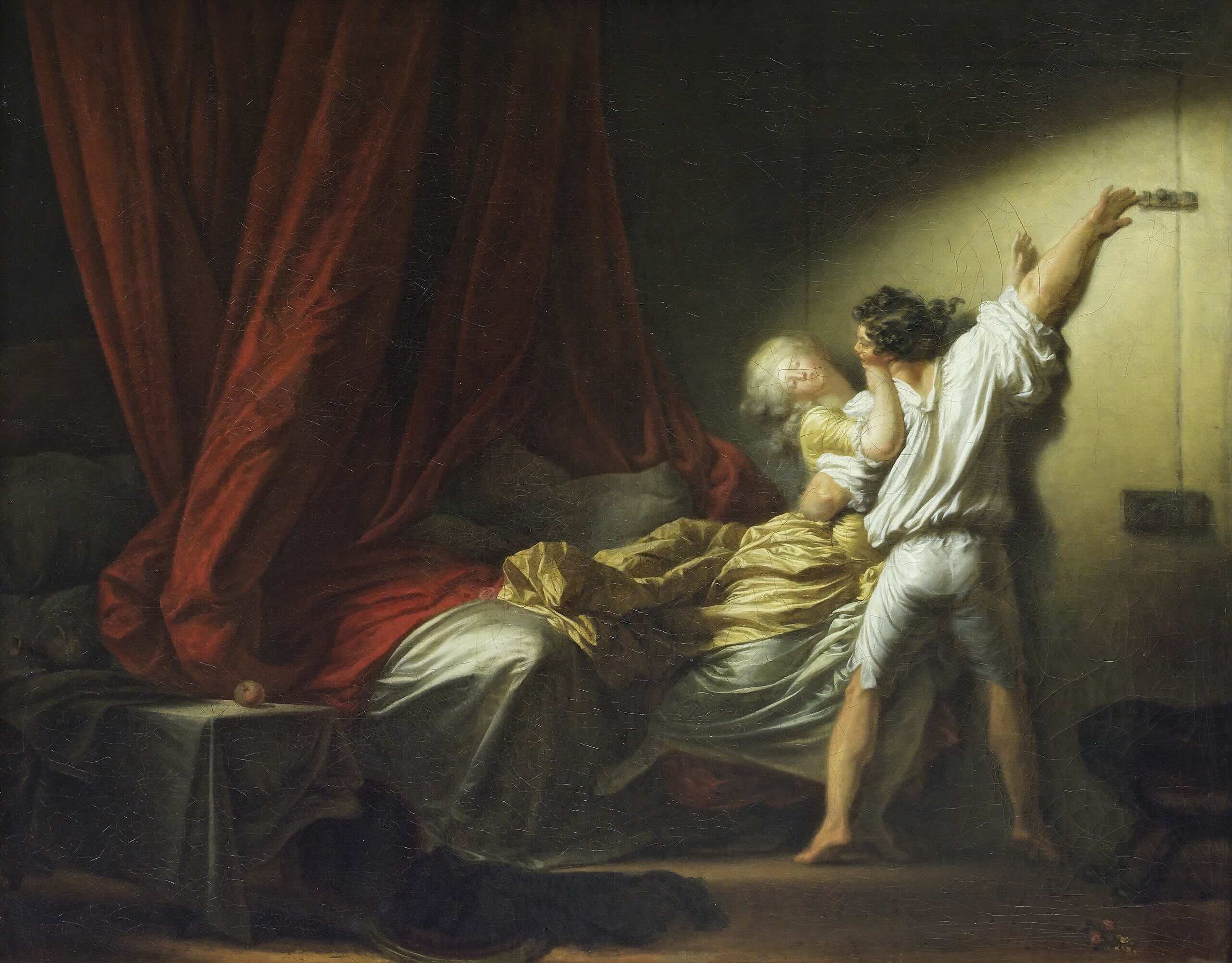
“Le Verrou”, 1770-1777, 73.5 cm x 93.5 cm.
2. Jean-Honoré Fragonard, The Bolt (Le Verrou)
Our second stop takes us to Paris and to Jean-Honoré Fragonard’s The Bolt (Le Verrou), now displayed at the Louvre Museum. Painted between 1777 and 1778, the work is a striking example of how love and desire were represented during the Rococo period. The scene shows a couple caught in a closed room. Without taking his eyes off his lover, the male figure slides the bolt on the door, shutting out the outside world. The disheveled bed, heavy red curtains, and dim atmosphere clearly point to physical and intimate closeness. The bed, positioned at the center of the composition, becomes the main element defining the narrative of the scene.
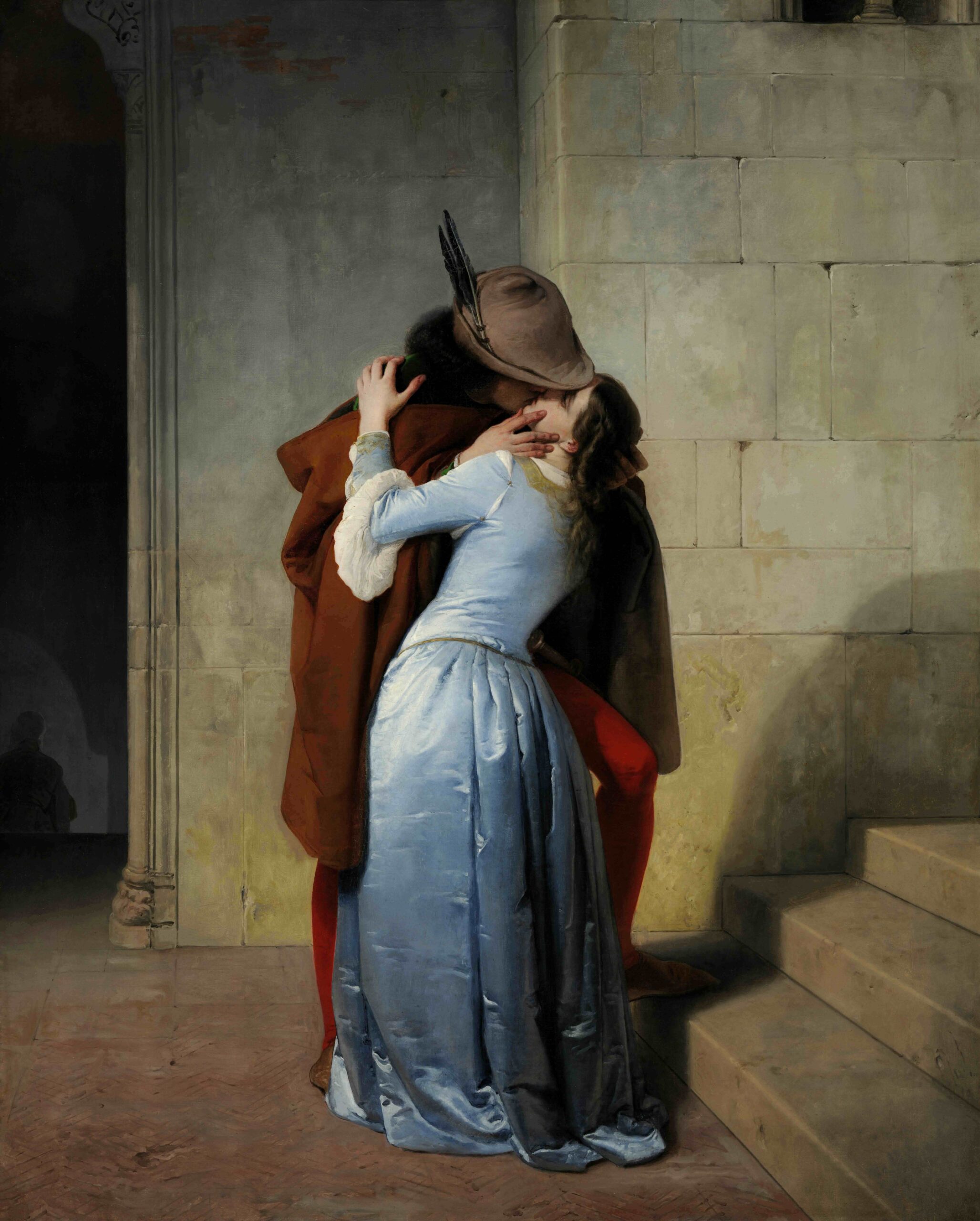
3. Francesco Hayez, The Kiss
By 1859, Italy was undergoing intense political and cultural transformation. Francesco Hayez’s The Kiss can be read not only as a depiction of a passionate kiss between a young couple, but also as a symbolic image alluding to the ideals of national unity and independence during the Risorgimento through its colors and historical context. Depicting a man and woman in medieval dress, The Kiss builds its narrative more through bodies than faces. The shadowed faces render the scene timeless, while the leaning bodies form the true center of the painting. The man’s step on the stone stair, his flowing cloak, and the briefly visible dagger add movement and fragile tension. Today, the work can be seen at the Pinacoteca di Brera in Milan.
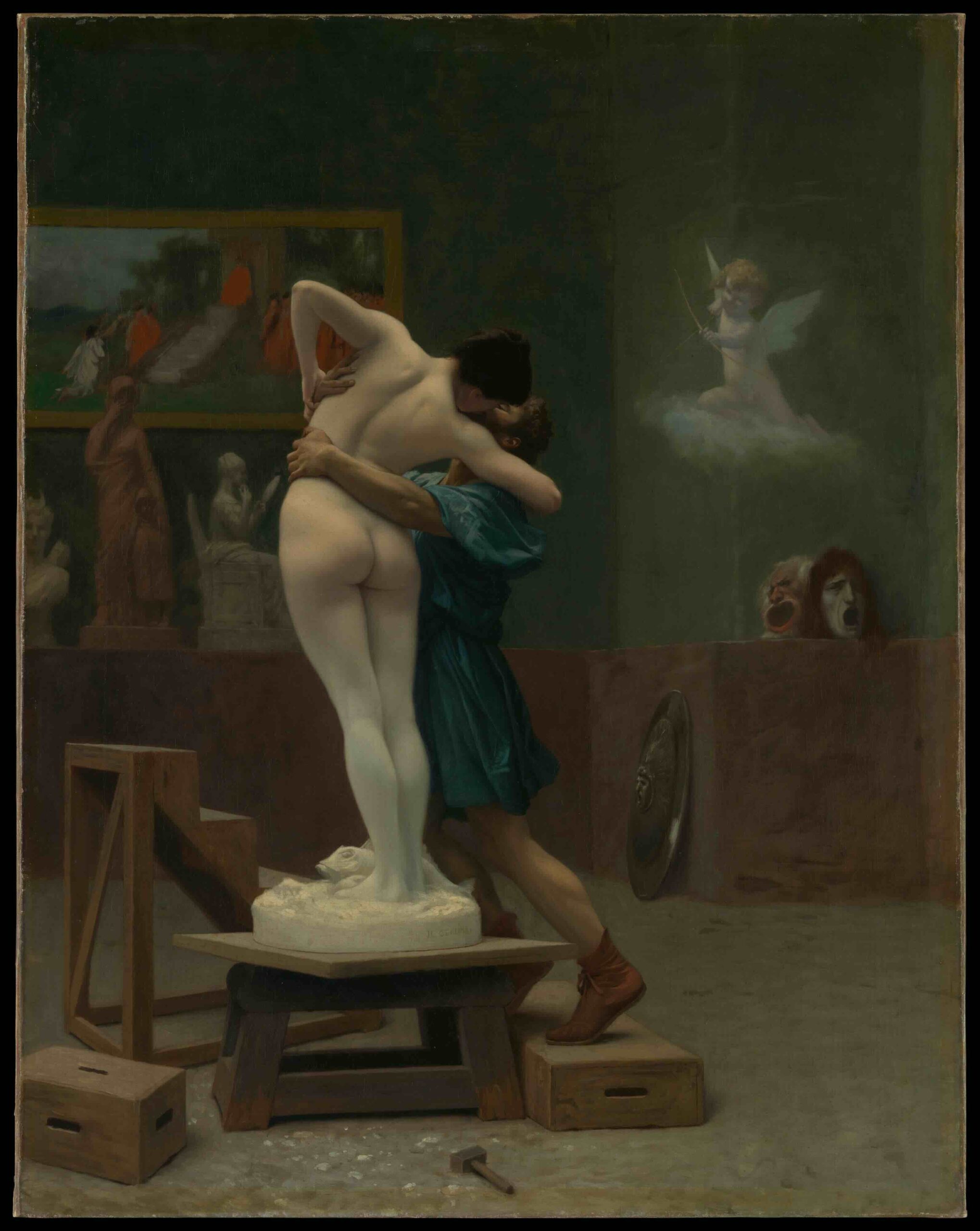
4. Jean-Léon Gérôme, Pygmalion and Galatea
Inspired by Roman mythology, Jean-Léon Gérôme’s Pygmalion and Galatea brings to life the myth from Ovid’s Metamorphoses (Dönüşümler). The Cypriot sculptor Pygmalion, who avoids women, devotes himself entirely to his art. He carves a perfect ivory statue, names her Galatea, and falls deeply in love with his creation. He watches her for hours, touches her, and adorns her carefully. During a festival honoring Aphrodite, he prays for her to come to life—and his wish is granted.
Gérôme captures this moment of transformation with emotional intensity and visual delicacy. Galatea’s body remains partially bound to the pedestal, still bearing the cold texture of marble. Kneeling before her, Pygmalion witnesses his creation come alive as they embrace passionately. This closeness reveals the intensity of the bond between creator and creation. The work can be seen at the Metropolitan Museum of Art.
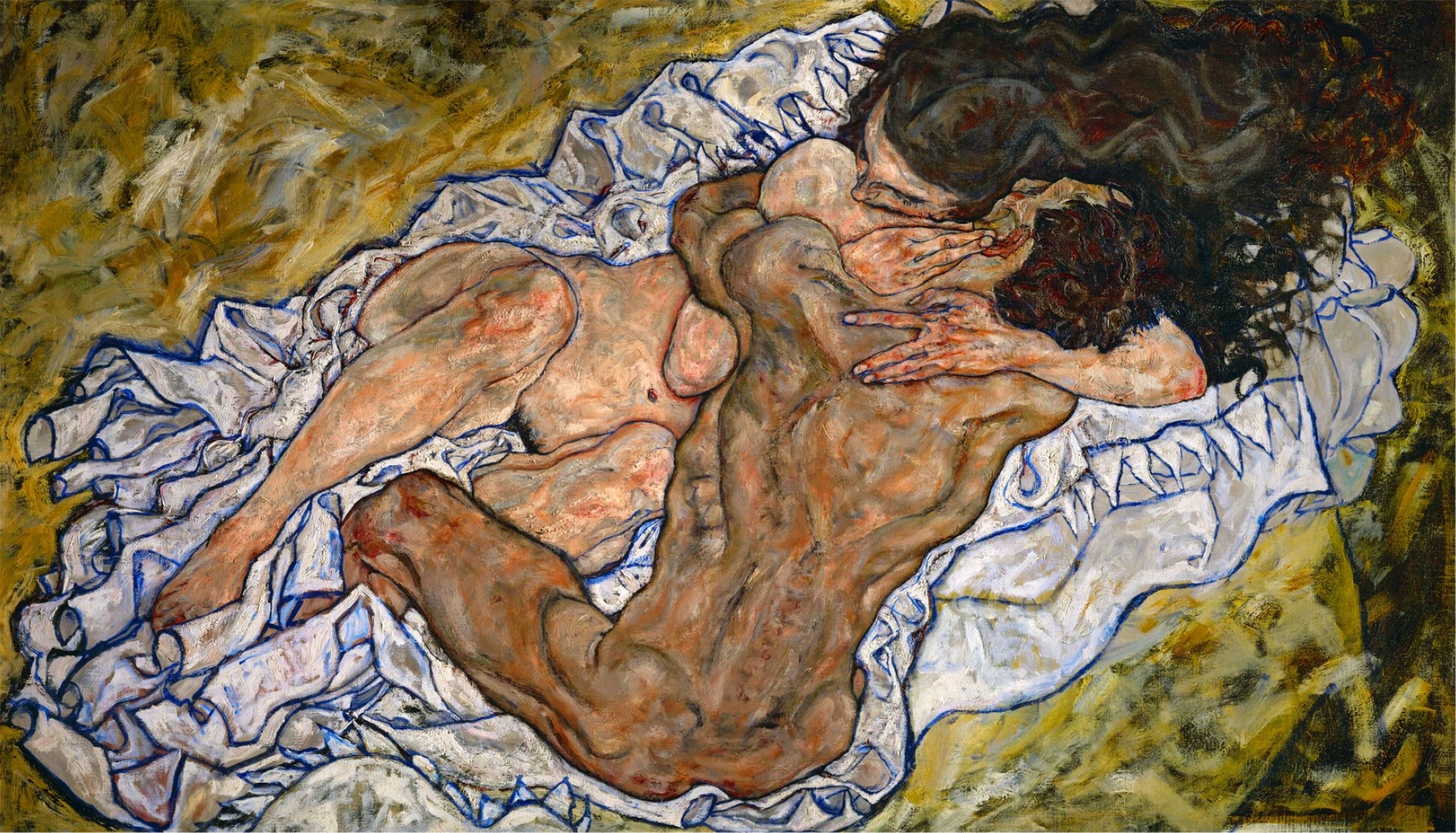
5. Egon Schiele, The Embrace
Egon Schiele’s 1917 painting The Embrace depicts two nude figures locked in a simple yet intense moment of closeness. Rather than erotic tension, the scene emphasizes the need for protection and contact. Their thin, bony bodies appear fragile, yet their embrace is resolute. At the center lies a quiet form of mutual support.
Through line, form, and color, Schiele makes the bond between the bodies visible. The painting conveys a temporary refuge rather than pain. This rare tenderness gives The Embrace a special place in his oeuvre. Rejecting idealization, Schiele portrayed vulnerability and raw emotion, often provoking controversy. Influenced by Van Gogh and Munch, he became one of modern art’s most striking figures despite his short life.
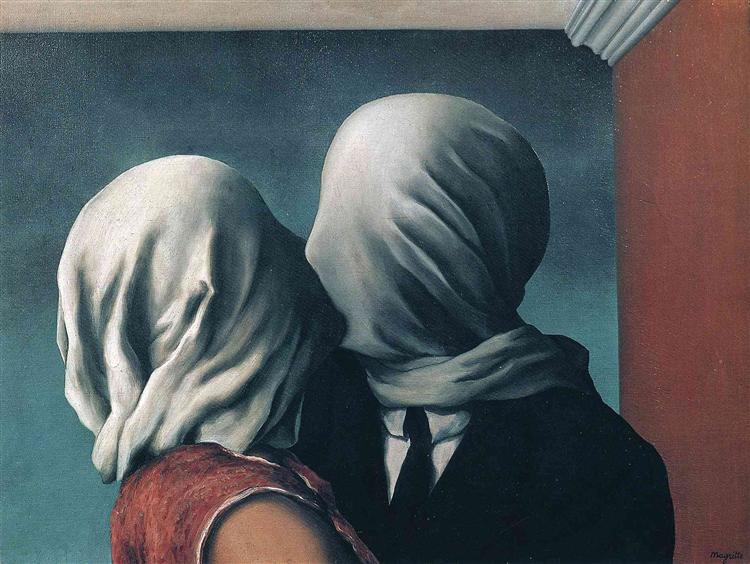
6. René Magritte, The Lovers (Les Amants)
René Magritte’s 1928 painting The Lovers (Les Amants) transforms a familiar image of love into a disturbing paradox. Two figures kiss passionately, yet their faces are entirely covered with white cloth. This simple intervention renders intimacy both impossible and infinite. As Magritte often emphasized: “Everything we see hides another thing.” Here, what is hidden is love itself. The saying “Love is blind” takes on a dark, claustrophobic meaning in his brush.
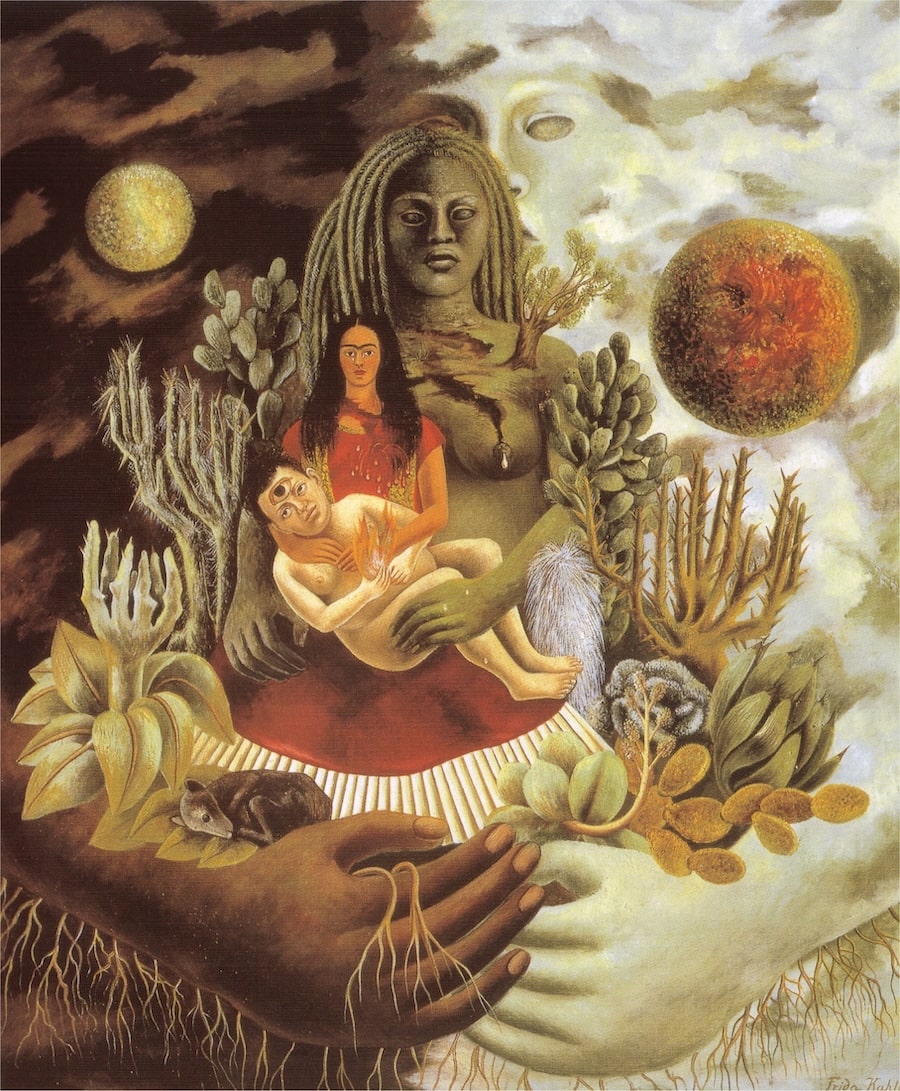
Frida Kahlo, The Love Embrace of the Universe, the Earth (Mexico), Myself, Diego, and Señor Xolotl, 1949, oil on Masonite, 70 × 60.5 cm.
7. Frida Kahlo, The Love Embrace of the Universe, the Earth (Mexico), Myself, Diego, and Señor Xólotl
Frida Kahlo’s 1949 painting places her complex relationship with Diego Rivera within a cosmic framework. Frida holds Diego in her arms; he appears almost childlike, leaning against her chest. The scene reflects her protective, almost maternal feelings. She wrote: “Every moment he is my child. Every moment, my child reborn from me.”
Her body merges with Mexican soil, while the universe appears in the background. Their relationship transcends the personal, becoming entwined with nature and cosmic cycles.
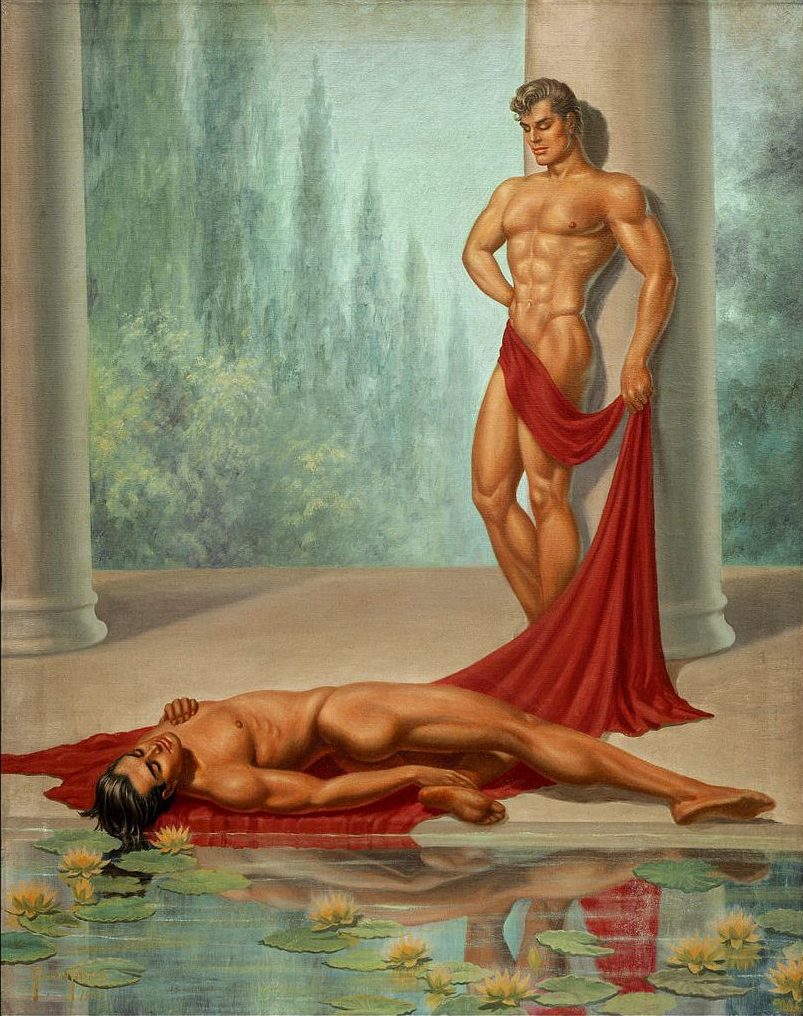
8. George Quaintance, Idyll
George Quaintance’s 1952 Idyll stands out as a bold aesthetic statement within the rigid norms of 1950s America. At a time when homosexuality was heavily suppressed, Quaintance centered the male body in his work.
In Idyll, two youthful Adonis figures stand side by side in a pastoral setting framed by classical columns. Beneath the calm surface lies emotional tension. By using classical references, Quaintance situates contemporary intimacy within a “safe” aesthetic frame. With around fifty homoerotic works, he is now regarded as a pioneer of queer aesthetics.
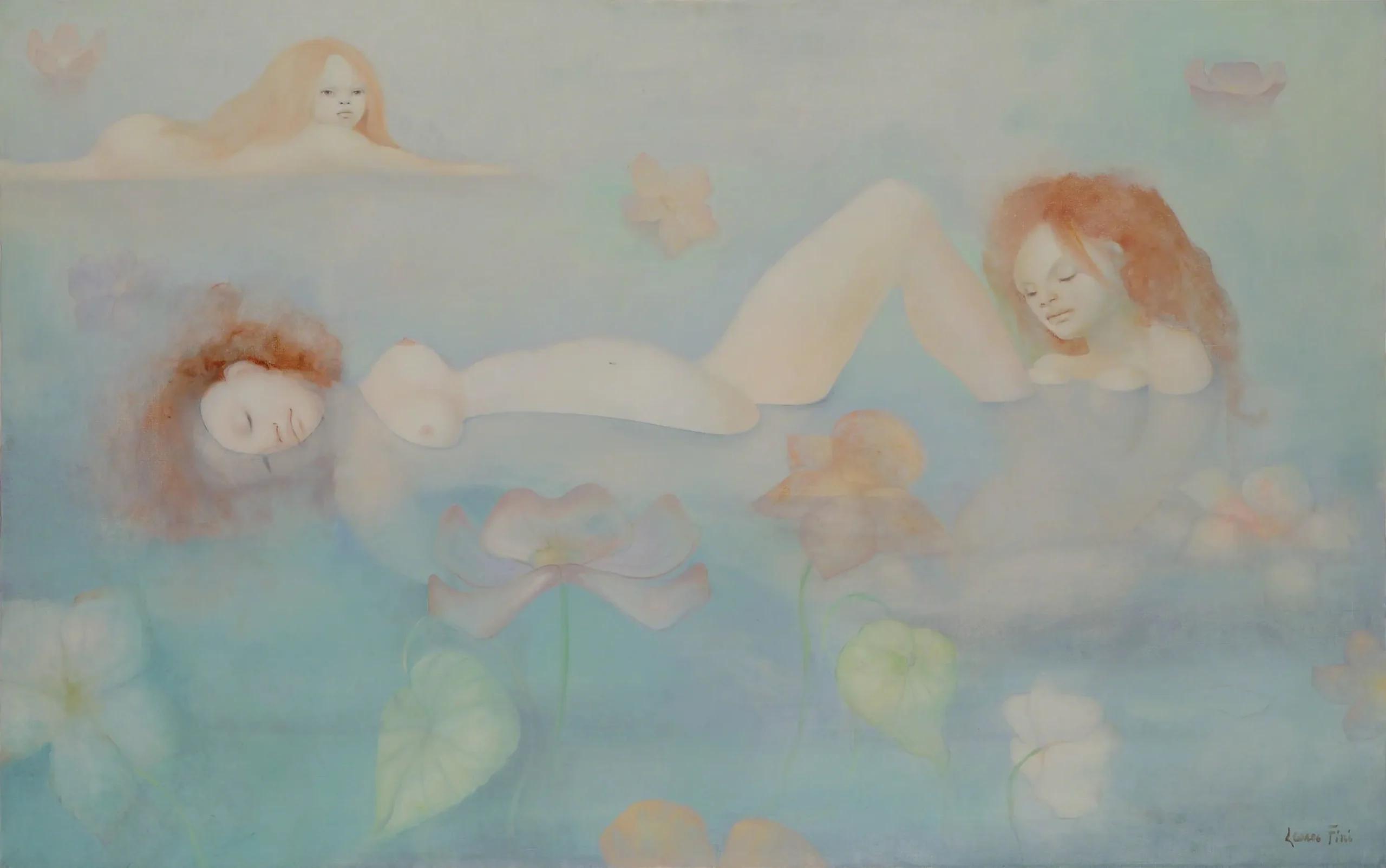
“Les Baigneuses (The bathers)”, 1972
Weinstein Gallery.
9. Leonor Fini, Les Baigneuses (The Bathers)
Leonor Fini’s Les Baigneuses (The Bathers) (1972) reflects her independent artistic stance. Openly bisexual and supportive of nontraditional relationships, she explored desire and intimacy through female experience.
In this work, the touch and gazes between semi-nude women create an intense emotional atmosphere. Fini presents love not as drama but as everyday closeness—tender and equal. The painting can be read as a narrative of female desire, solidarity, and bodily freedom.
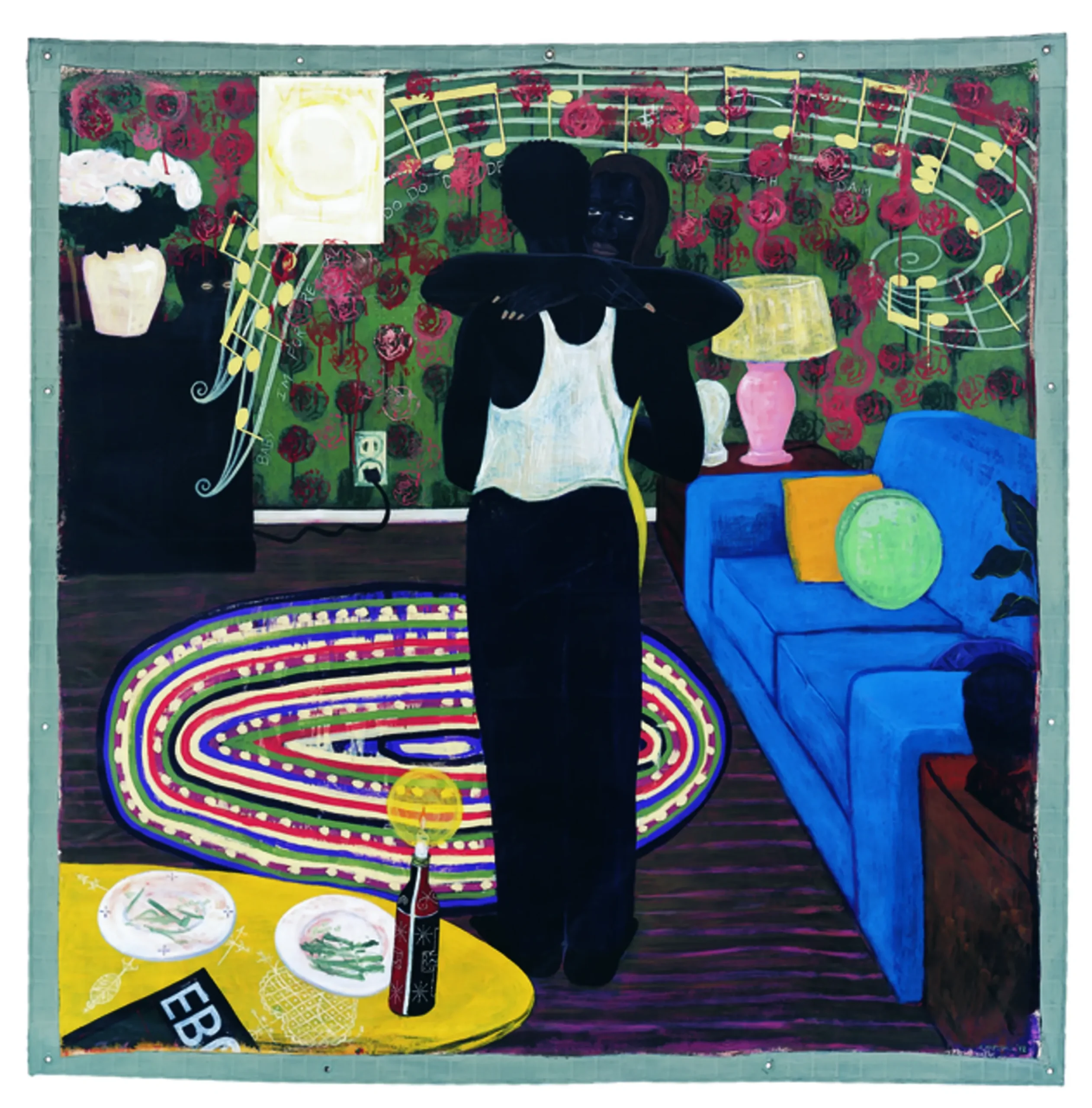
“Slow Dance”, 1992-1993, “Kerry James Marshall: Mastry”, MCA Chicago.
10. Kerry James Marshall, Slow Dance
Our final work is Kerry James Marshall’s Slow Dance (1992–1993). Known for centering Black life in his paintings, Marshall redefines figurative tradition. Two lovers dance slowly in their living room. Candlelight and soft music fill the space. Beyond cultural references, the painting’s power lies in the warmth of shared time and the security found in touch.