

Presented at Mine Sanat Gallery, Unregistered Teams appears as an outcome of the artist’s recent focus on themes of personal and social memory. Interweaving personal recollections related to the histories of Turkey and Cyprus, the exhibition carries ghost-like images of the past into the present, inviting the viewer on a kind of journey through time. As the artist stated in an interview, “I depicted what I lived,” and his narrative is defined as “not merely personal, but the story of a collective past transformed into art.” As emphasized in the exhibition texts, the overall installation merges individual memory with the social, proposing a profound practice of remembrance.
Upon stepping into Mine Sanat Gallery, visitors witness the space transforming into a journey of memory. The walls display not only artworks belonging to the exhibition but also works that function like documents bearing witness to recent history. Each piece serves as a fragment of a distinct narrative. Walking through the exhibition feels like wandering through the archives of the past; the relationships between the works are constructed with a clear and deliberate rhythm. The artworks invite the viewer into a spatial narrative system—so much so that this structure draws the viewer’s stream of consciousness into memories, while the figure or image emerging behind each subsequent work carries the visitor deeper into the past.
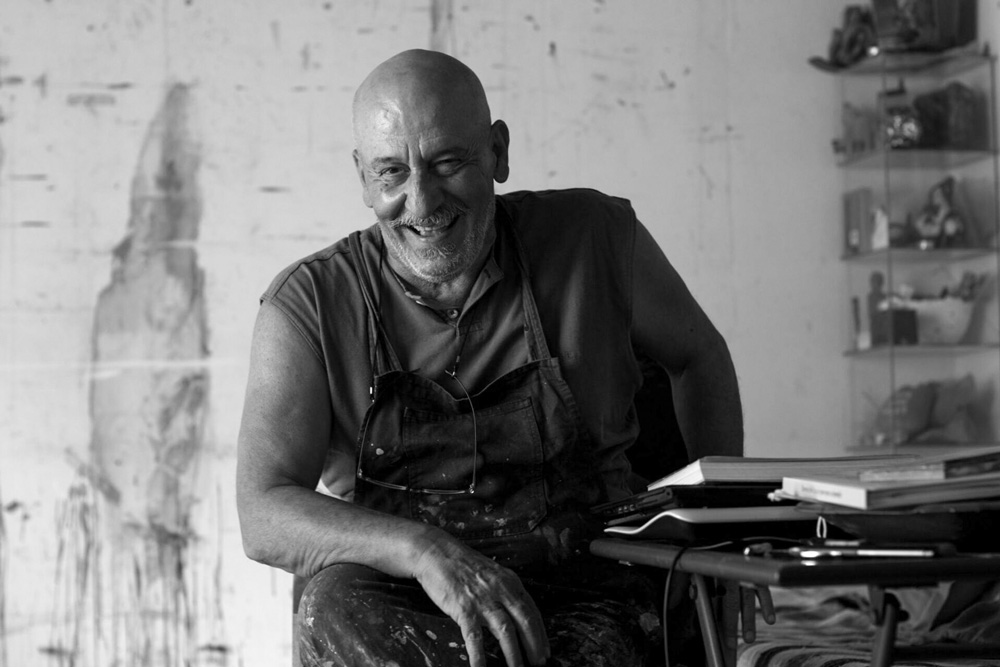
The 42nd issue of Çağdaş 1985, published by Mine Sanat Gallery, is dedicated to the artist’s exhibition. In an interview with Esra Plümer Bardak included in the publication, Çizenel states: “The memory of a small society like ours has repeatedly failed to transform processes capable of forming memory into written texts… What I want to do is to trigger a lost but memory-laden past by rediscovering it.” This statement essentially summarizes the artist’s motivation: Çizenel does not treat the past as a nostalgic material, but rather as an archive capable of completing the deficiencies of the present. Unregistered Teams embodies precisely this act of activation. It re-circulates forgotten images within a space where individual and collective memory seep into one another.
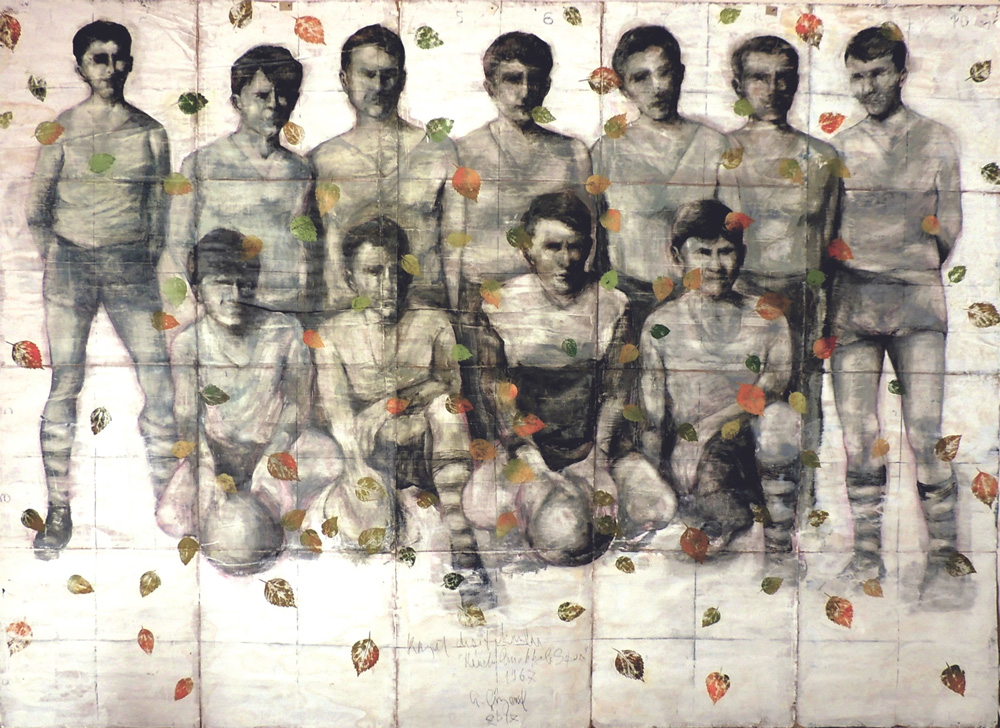
For instance, at the entrance of the gallery space, viewers encounter a black-and-white football team: eleven figures, seven standing and four crouching. Positioned in front of these figures, holding a ball, stands a single person—the artist himself. As the figure on the scene transforms into a self-portrait extending from the shadow of the past into the present, it appears as an ironic gesture that, in Anber Onar’s words, “formalizes the unregistered.” This figure draws the viewer into the game; yet the ambiguity of whether the player is offensive or defensive compels the viewer to take an active position. In this sense, Unregistered Teams is both an exhibition and a match played on the field of memory. As Onar notes, the gestures in the Golden Gate Painting series grant visibility to stories that have remained within oblivion. The triangular abstract portraits function as silent witnesses representing individuals and collective identities. At their core, these triangles originate from photographic portraits; leftover fabric pieces from tailors’ workshops are transformed in the artist’s hands into abstract portraits. Thus, Unregistered Teams explores how identity remains concealed within everyday materials and how art can render the concealed visible.
“Personal History” and “Drawers”
When examining the choice of materials, it can be argued that each element carries a historical code. Çizenel renders lost and unregistered memories visible again through used paper, envelopes, notes, and textile fragments. These materials establish a metaphorical bridge between past and present as part of the artist’s effort to update memory. The work Team, featuring the figures of football players, traces the remnants of a ceremony that was once proudly celebrated but later forgotten, appearing as a fragment of an old photograph. Paper surfaces resembling torn pages from a book are filled with faded memories, while folded paper fragments evoke abandoned neighborhoods of the island and a sense of longing. Emin Çizenel’s works carry the dust of Malya, where he was born and raised; this personal archaeology resurfaces through the papers, envelopes, fabrics, and notes used in the exhibition.
The artist describes the sections titled Personal History and Drawers as “excavating one’s own archaeology.” This approach elucidates the delicate bond between Çizenel’s artistic production and history: revealing what historiography has forgotten through the aesthetics of a personal narrative. Oya Silbery defines this as follows: “Emin Çizenel’s art is like an uninterrupted record of memory composed of interconnected themes.” In this exhibition, memory appears to circulate across both material and abstract layers. Precisely in this sense, as the artist himself states, Çizenel renders a repressed memory visible once again. This expression, in fact, encapsulates the fundamental distance permeating all the works.
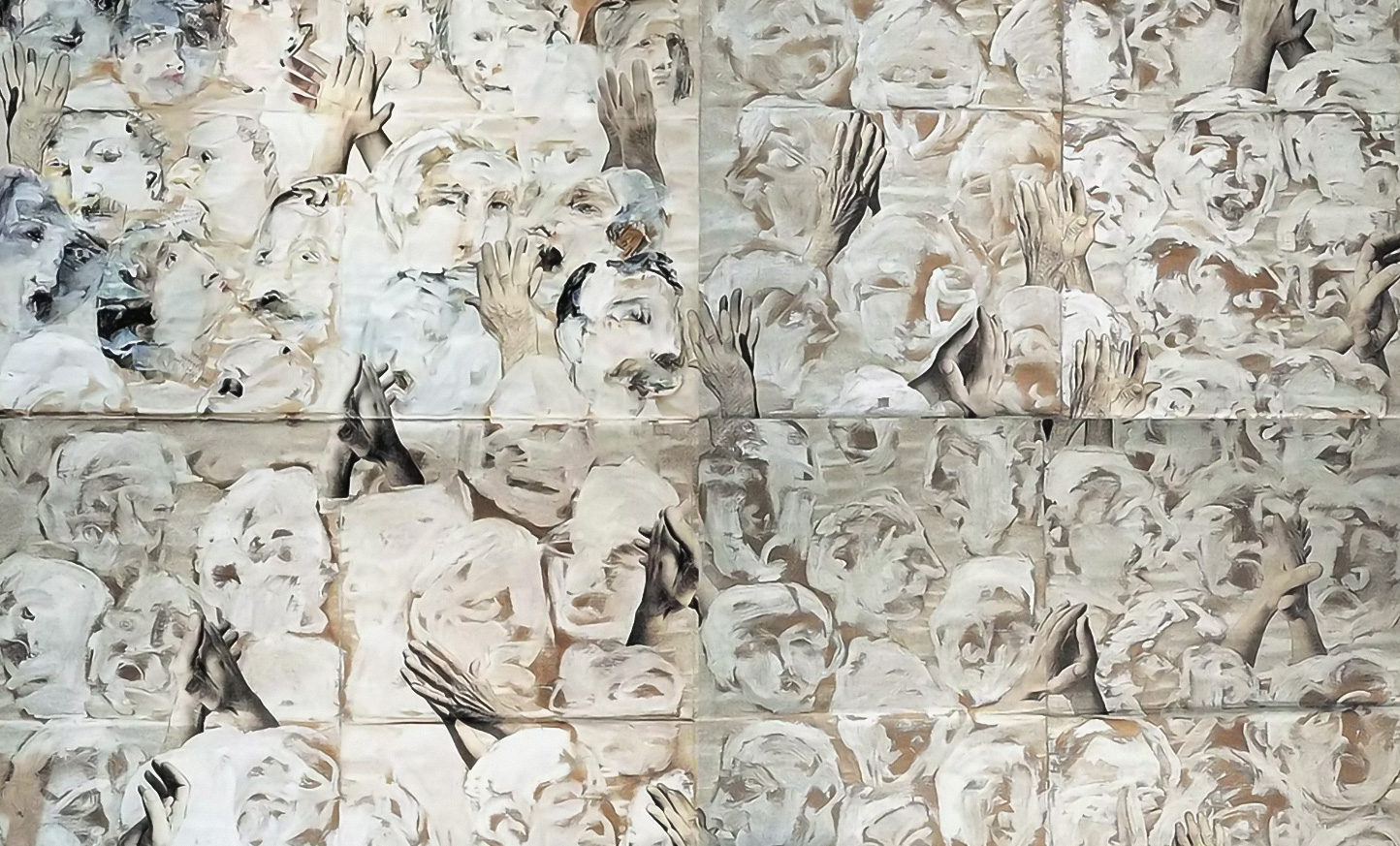
Figurative drawings composed of rough lines and stains contain indistinct faces, much like blurred recollections. Rather than standing out with distinctive features, each face transforms into an anonymous narrator belonging to a collective story. This anonymity evokes the many anonymous stories subjected to oblivion, inviting the viewer to look into the depths of their own memory. Consequently, the exhibition becomes a multilayered narrative that navigates the tension between remembering and forgetting. The ironic tone present throughout the exhibition merges with a sense of political humor. Çizenel’s figurative system, much like the formation of a team, opens a discussion on the relationship between the individual and society. As Turan Aksoy notes, the artist’s “playful personality” is simultaneously narrator and player.
Since the 1970s, the artist has addressed issues of identity and selfhood—reflections of island history—in much of his work. The first pieces of the Unregistered Teams series, which he began producing between 2018 and 2019, were first presented to the public in 2021, and now continue their journey at Mine Sanat Gallery by gaining a new spatial dimension. In this way, the artist’s intention to construct a distinct archive of memory renders tangible traces extending from past to present.
Çizenel’s practice represents a way in which people define themselves; while reconstructing a forgotten collective memory, the artist situates individual stories within a historical context. Oya Silbery describes this as “a historical memory record that contributes to the construction of the social through the individual.” In this respect, Unregistered Teams can be viewed as a re-reading of forgotten records. While the works shed light on the shadows of the past, the artist invites viewers to map their own memory. Moreover, the exhibition offers a multilayered experience that guides the viewer along the boundaries between the visible and the invisible, forgetting and remembering. Figures and images emerge like calls that resonate within memory. Thus, the exhibition can be seen as a practice that invites the unraveling of the complexities of the past—an opportunity to illuminate every forgotten memory once more. By articulating the stories of the past, Emin Çizenel calls out to those who carry the burden of memory.