





While the Turkish Statistical Institute’s 2024 data points to a record surge in cultural expenditures, this growth has not translated into real improvement for the wide network of cultural workers spanning editors, authors, translators, and printing laborers. The cultural economy is expanding, yet the share of labor continues to narrow.
According to the Turkish Statistical Institute’s 2024 data, cultural spending increased by 83.3 percent, reaching 408.3 billion TL, although its share within the GDP remained at 0.9 percent. In Turkey, culture has long been treated as a secondary field at both political and economic levels. The 2024 figures reveal a contradictory picture. The numbers are rising, yet the question of how this growth is reflected in the lives of cultural workers remains unanswered.
In the Shadow of Rising Inflation
Cultural spending reaching 408 billion TL with an 83.3 percent rise in 2024 may appear impressive at first glance. However, this figure must be evaluated in the context of the high inflation environment Turkey experienced that year. In a period when annual inflation hovered above 50 percent, an 83.3 percent increase points to a more modest real growth.
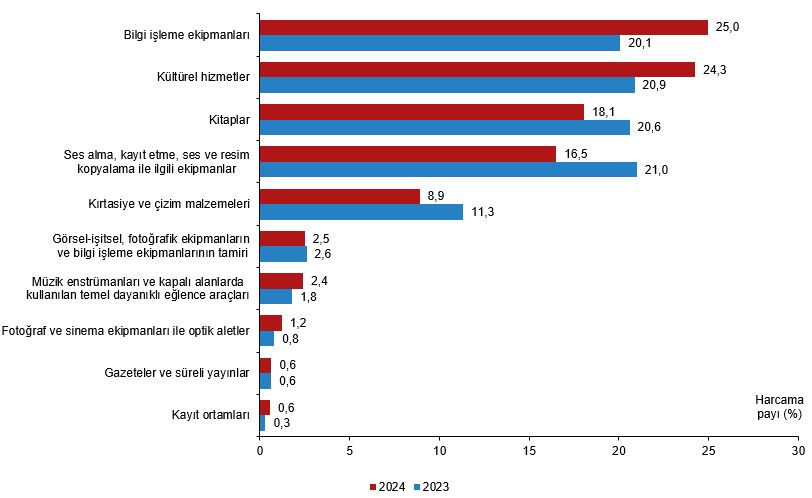
Particularly striking is the 91.5 percent increase in household cultural expenditures. Yet when examining the composition of this spending, the fact that information processing equipment takes a 25 percent share suggests that a significant portion of this increase went toward technological products such as phones, computers, and tablets. Books receiving only an 18.1 percent share, on the other hand, is a troubling sign that reading culture remains in the background.
Where Is the Publishing Chain in These Numbers
The Turkish Statistical Institute’s 2024 Cultural Economy data highlights the large economic volume of the cultural sector, but leaves unanswered how the invisible labor components of the publishing industry, including editors, translators, authors, printing workers, distributors, and booksellers, benefit from this growth. The cultural economy may have reached a size of 408.3 billion TL, yet how this translates into the daily lives of workers in publishing remains a major uncertainty.
Editors and Translators: The Invisible Backbone of the Cultural Economy
Editors and translators, who occupy the intellectual production side of publishing, are among the groups with the highest levels of education in the sector. According to the data, nearly half of all cultural employment consists of university graduates. A significant portion of this group is made up of white collar workers active in the publishing field.
However, this high level of education does not guarantee stable income or secure employment, because of freelance editors and translators work on a project basis with per piece payments, royalty fees rapidly lose value against inflation, ocial insurance and retirement rights are largely left to individual initiative
As the cultural economy grows, this group, which forms the intellectual backbone of publishing, remains visible in statistics yet invisible in social policy.
Royalty Income: A Shrinking Share in an Expanding Market
The fact that books still have an 18.1 percent share in household cultural expenditures indicates that Turkey maintains a significant readership market. Books remain one of the three strongest cultural spending categories alongside cinema, digital platforms, and information processing equipment. However, the segment that directly benefits from market growth within the royalty chain, stretching from the reader to the publisher and from the publisher to the author, is extremely limited. The increase in book prices is directly affected by distribution and printing costs, currency based increases in paper prices, stock, storage, and return expenses yet royalty rates in most publishing fields cannot be updated at the same pace. As a result, even when book sales increase, the real income of authors, translators, and editors declines or stagnates.
Printing and Distribution: The Most Fragile Links of Publishing
The apparent financial strength of print publishing masks the immense burden carried by the printing sector. Rising energy costs, dependence on imported paper, machinery maintenance, and labor expenses that escalate each year have pushed printing houses into a severe bottleneck. During the 2023 to 2024 period, uncontrollable cost increases forced many small and medium sized printing firms to either downsize or close entirely. This situation narrows the foundational production base of the publishing chain.
The situation is even more complicated on the distribution front. Small and independent distributors struggle to survive against the dominance of chain bookstores. Lengthening payment terms disrupt publishers’ cash flow, while the return system keeps both publishers and printing houses in constant uncertainty. Books are produced, stored, and shipped, yet whether they will sell and when payments will be collected often remain unclear for a long time.
957 Thousand People Work in the Cultural Sector
The report also includes data on cultural employment. Gender distribution appears relatively balanced, with 52.2 percent of employees being men and 47.8 percent women. The 47.8 percent female employment rate surpasses the national average and indicates that the cultural sector provides women with comparatively higher access to employment opportunities. However, this quantitative balance does not necessarily mean qualitative equality. While the numbers reveal that the cultural sector is accessible to women, they also remind us that equality must be reconsidered not only in terms of representation but also through wages, status, and career continuity.